Quality 101
The Power of Portable Measurement: How 3D Laser Scanning Augments Metal Forming Processes From Start To Finish
3D laser scanning can and should play an integral role in the metal forming workflow processes.
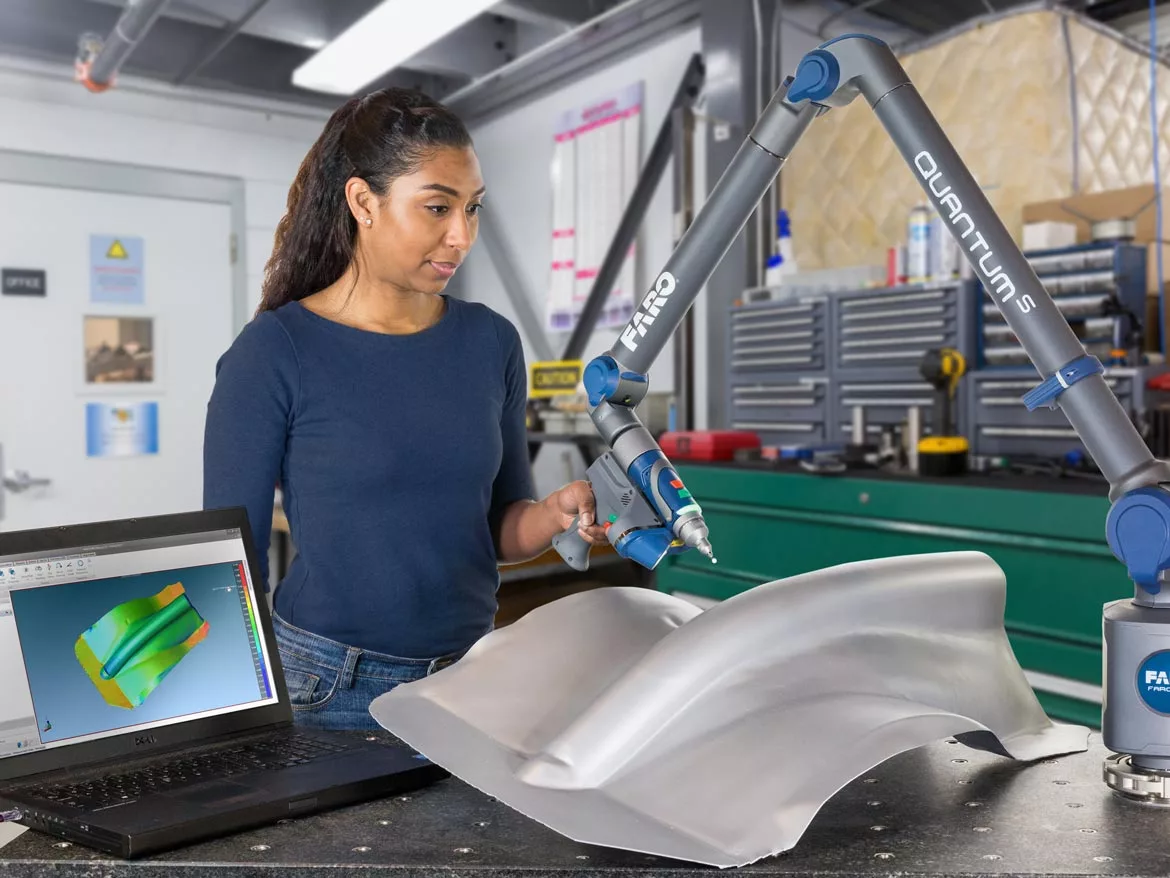
Image Source: Morsa Images / E+ via Getty Images
As a branch of metalworking, a subset of fabrication, metal forming is a foundational process, involved in a wide range of parts assembly: from the metal stamping of consumer goods used at home to many of the component elements of airplanes and automobiles. With so much product at stake and billions of dollars on the line, accuracy, precision and repeatability are key.
This is especially the case as the U.S. emerges from the Covid-19 pandemic and the global metal stamping market, which was valued at $220 billion in 2019, is projected to experience a compounded annual growth rate of 2.8 percent from 2020-2027 and the global metal forging market, valued at $84 billion (also in 2019) is forecast to grow at 5 percent over the same time period. Likewise, the international comeback will be felt in other sectors of the economy too, with the International Monetary Fund calling for a 6 percent GDP surge, besting its January forecast. In a growth environment like this, production failures, costly rework, products out of tolerance, and safety issues cannot occur.
Thus, 3D laser scanning by way of noncontact portable measurement technology, along with its quality assurance and inspection software, continues to be among a quality engineer’s must-have tools to guarantee that not only an individual part matches its original CAD design or blueprint, but that the pressing and forming and die-based machines tasked with shaping the eventual finished product themselves are also operating to established specs. That’s true whether for stamping (essentially a deforming process, reflecting the ability of a material to change shape via applied high-pressure without being destroyed) or forging – often analogized to “stamping with fire,” (think: high heat) in either open or closed dies.
Taking The ‘Pressure’ Off
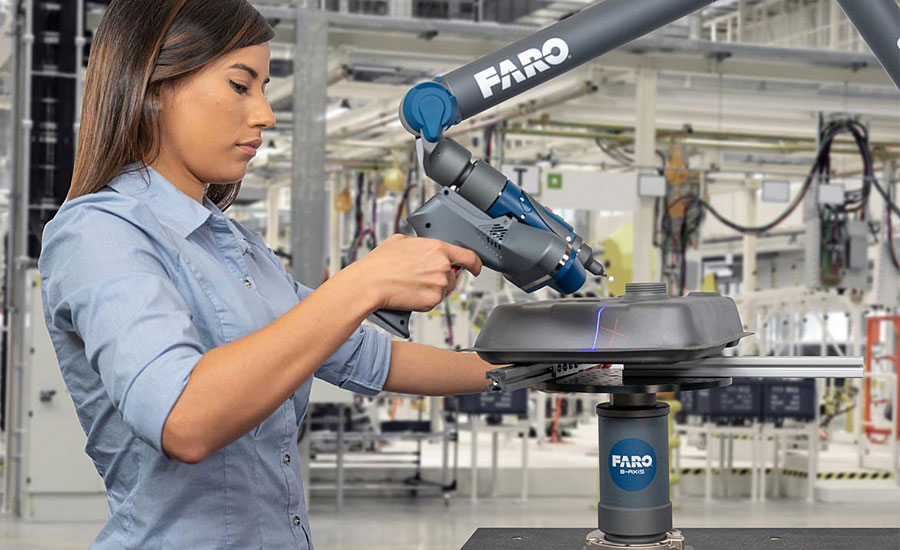
Thanks to the latest technology as well as multi-axis scanning turntable platforms, precision measurement has never been faster or easier. The way it works is simple: an articulated portable coordinate measuring arm (PCMM) is fitted with a noncontact laser which measures in real time, X, Y, and Z coordinates and digitizes that 3D data in a virtual environment. In one technology example, a laser stripe is reflected back by the part being scanned and into a camera that records the data, creating a 3D point cloud, a digitized model containing the X, Y Z coordinates of the entire surface that has been scanned.
Combined, these twin technologies – the laser and the turntable, along with powerful yet user friendly software, can: quickly identify component features that deviate from nominal conditions (allowing for prompt machine adjustments to be made before out of tolerance situations arise), perform in-process component inspection, and, even capture precise digital measurement data for reverse engineered parts that lack relevant blueprints or CAD drawings.
From a metal forming workflow perspective, today’s advanced 3D metrology hardware and software solutions have greatly streamlined what was once a cumbersome process, reliant on error-prone hand tools like calipers and micrometers to accomplish time-consuming tasks. That is, if it could be accomplished at all. By its very nature, stamping metal is a complex, multi-step operation that creates a large diversity of products – many of which include difficult-to-measure “organic” or irregular geometries.
Even fixed CMMs struggle to measure up. Unlike their PCMM cousins, CMMs are bulky, immobile, require advanced engineering programming expertise, and they are kept in specialized temperature-controlled metrology rooms. Perhaps most important, fixed CMMs are unable to measure parts (or machines) in-process; manufactured components must be transported to them, causing inspection bottlenecks and attracting additional costs.
In automobiles for instance, stamping is involved with building body panels, framing, doors, and a number of small components. Airplanes, too, require extensive stamped parts including: structural components, oxygen generating systems, military aircraft housings and enclosures, relays, switches and lighting systems. When evaluating the metal forming process and how 3D laser scanning can help at each step along the way, several factors must be considered:
- Stamping’s effect on the design functionality – Are the stamped parts within the specified tolerances of the CAD model? This is true for first article inspection as well as subsequent inspections.
- Are the stamped parts staying within specifications – Data from scanning software can be fed into a statistical process control (SPC)) system which can assist in determining whether parts are trending outside of tolerance.
- Is the die consistently producing parts to the same specification – Or are parts trending out of tolerance due to tool wear? If so, then it’s time to perform 3D measurement inspection on the dies themselves.
- Safety first satisfied – Is the part safe and functional, conforming to industry-specific or national requirements?
- What is the time required – for production and quality control? What is the value of higher throughput with lower scrap?
Images Source: FARO
Workflow Wizardry At Work
As evidenced from above, 3D laser scanning can and should play an integral role in the metal forming workflow processes. At each step along the way toward product completion, laser scanning can vastly enhance the speed and quality of measurements taken – both for individual/constituent parts, and also on the machines themselves.
Pulling back the lens, here is a breakdown of what the metal forming workflow looks like in an easy-to-follow manner:
Step 1 Engineering: The process begins when design engineers and metalworkers develop various shapes and objects, including domes, cones, half spheres, squares, eyeballs, or ovals. Once developed, they are used to make the dies that will form the metal.
Step 2 Approval and Action: With an approved product drawing and die created, the process moves to the metal stamping team. Here, the staff works to evaluate the product drawings and will determine which metal stamping process and equipment to use.
Step 3 Customized Work: With a drawing, die, and plan in place- metal stamping commences. Specific tools and sub-steps required depend on what product is being stamped, as well as material employed and production size.
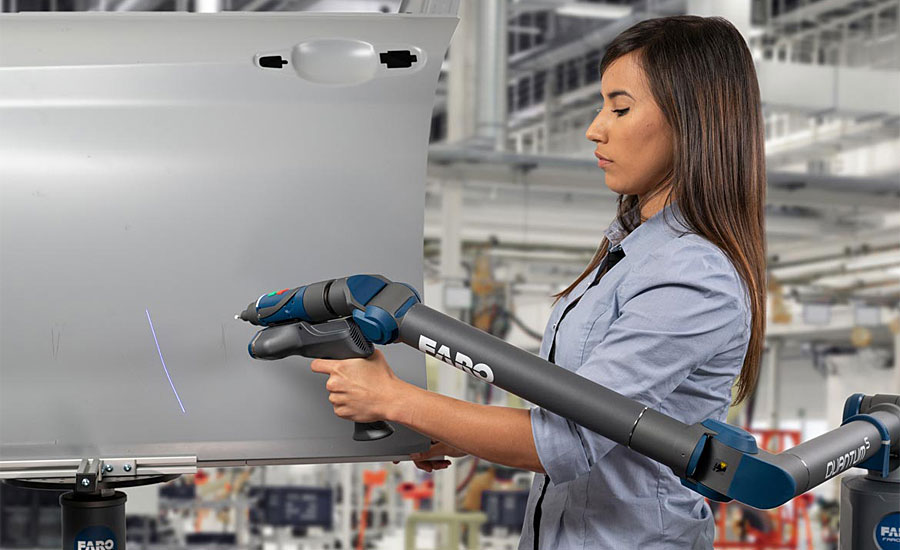
Step 4 Assembly: Depending on the complexity of the product, assembly can take place. That is, fitting component parts together into the stamped product, potentially requiring binding, welding, or bending. It is critical, after assembly, all products are inspected for accuracy before they are completed. This is where 3D laser scanning solutions prove most vital and help streamline costs while increasing efficiency.
Step 5 The End: Once assembly is complete, products may be finished with machining. This can include tapping, drilling, sawing, milling, grinding, and even sandblasting. Any painting, sealing, or priming would complete the process.
Images Source: FARO
Say ‘No’ To The Q3 Quandary
After all of the these steps are checked off, final inspection ensures a metal formed product is ready for public or industrial use and that revenue is maximized from increased throughput by reducing machine downtime and lowering costs from material waste.
According to many of the world’s top economists, the third quarter of 2021, which kicks off this month (July), is where the world will begin to take its first halting steps back to normalcy. And it’s where the global economy really starts gathering the steam it needs to meet those 6 percent growth predictions.
As consumers begin to burn off their “Covid cushion” (Bloomberg Economics estimates Americans are sitting on $1.3 trillion in pandemic savings) now is the time the metal forming industry should kick their operations into high gear and do so with confidence that whatever product they’ve produced – and the machines that produced them – are operating within expected tolerances. The best way to achieve that essential quality control line of sight is by use of 3D laser scanning solutions and its attendant software products.
The power of portable measurement has never been this potent.
Orlando Perez, Director, Product Marketing, FARO Technologies.
Looking for a reprint of this article?
From high-res PDFs to custom plaques, order your copy today!