Management
Supplier Management through Quality 4.0: Building Geopolitically Resilient Supply Chains
Instead of being caught off guard by quality issues arising from sudden supply chain changes, firms can build control and visibility into their supplier ecosystems.

Global supply chains are operating in one of the most turbulent environments in decades. Following the COVID-19 pandemic and global semiconductor shortages, geopolitical tensions, trade wars, and shifting tariff regimes are fundamentally altering how organizations source materials and manage suppliers. The years following the COVID-19 pandemic have already exposed the fragility of global supply networks. However, 2024 and 2025 have intensified these challenges, with renewed geopolitical tensions, trade policies, and regionalization of supply chains (Lenihan, 2025). According to McKinsey (2022), on average, a supply chain disruption lasting longer than a month occurs every 3.7 years. Further, these disruptions can cost a business up to 45% of one year’s profit over a decade (McKinsey, 2022). Table 1 summarizes several of the recent global supply chain disruptions and their associated quality implications.
Table 1. Recent global supply chain disruptions and quality implications
| Event | Year(s) | Supply Chain Impact | Quality Implication(s) |
|---|---|---|---|
| Red Sea shipping disruptions | 2024-2025 | Transit delays | Schedule pressure impacting quality controls |
| Russia-Ukraine conflict | 2022-present | Energy, raw material disruptions | Process variability, cost-driven quality tradeoffs |
| COVID-19 pandemic | 2020-2022 | Factory shutdowns, supplier exits | Emergency supplier onboarding, increased defect risk |
| Semiconductor shortage | 2021-2024 | Long lead times, allocation constraints | Use of alternate components and suppliers |
| U.S.-China trade tensions | 2018-present | Tariffs, decoupling | Supplier switching, qualification challenges |
Organizations across industries are rapidly reshaping their supply chain networks. Near-shoring, friend-shoring, dual sourcing, and local supplier development have moved from strategic options to urgent necessities. While these changes may reduce geopolitical exposure, they introduce a new and often underestimated risk: quality disruption.
Switching suppliers quickly, onboarding new vendors, or relocating production without robust supplier qualification and quality validation can create brittle supply chains. Supplier performance, on-time delivery, and product quality are deeply interconnected. When organizations react hastily to geopolitical shocks without a structured quality strategy, they risk production stoppages, customer dissatisfaction, regulatory non-compliance, and in some industries, severe safety consequences.
The question is no longer whether supply chains will face disruptions, but how prepared organizations are to manage quality risks during disruption. Amid this scenario, Quality 4.0 becomes a critical enabler of supply chain resilience.
Quality 4.0 as a strategic response to geopolitical risk
The integration of Industry 4.0 technologies, including Internet of Things (IoT), big data analytics, artificial intelligence (AI), machine learning (ML), and advanced automation, has given rise to Quality 4.0 (Sony et al., 2020). At its core, Quality 4.0 enhances traditional quality management by embedding real-time data, predictive intelligence, and digital connectivity across the value chain. Quality 4.0 is not simply about digitizing inspections or automating reports. It represents a shift from reactive quality control to predictive and preventive quality management (Chiarini et al., 2021).
Certain industries, including healthcare, pharmaceuticals, automotive, aerospace, and electronics, are particularly vulnerable to quality failures. In these sectors, quality disruptions do not just impact cost or delivery; they can affect patient safety, regulatory approvals, and public safety and trust. As organizations diversify their suppliers or localize production, maintaining consistent quality across new and unfamiliar suppliers becomes a significant challenge.
Quality 4.0 enables organizations to continuously monitor manufacturing processes, detect early signals of quality deviation, and predict potential failures before they escalate. Instead of being caught off guard by quality issues arising from sudden supply chain changes, firms can build control and visibility into their supplier ecosystems.
Supplier management through Quality 4.0
Supplier management is an important application of Quality 4.0 in building supply chain resilience. Traditional supplier evaluation methods, such as periodic audits, scorecards, and historical performance reviews, are no longer sufficient in fast-changing and uncertain environments.
Quality 4.0 enables organizations to extend quality monitoring beyond their own factory walls and into the operations of their suppliers (Zonnenshain & Kenett, 2020). By integrating digital quality systems across suppliers, IoT devices, organizations can gain near real-time visibility into process capability and variation, defect rates and trends, on-time delivery performance, and compliance with manufacturing processes, specifications, and standards.
A digital twin, enabled by IoT sensors, digital quality records, and connected manufacturing execution systems (MES), allows data to flow seamlessly from suppliers to original equipment manufacturers (OEMs). Advanced analytics and AI models analyze this data to identify patterns, anomalies, and early warning signs of potential quality disruptions, as well as root cause analysis.
For example, instead of discovering a supplier quality issue after defective parts arrive at the factory, predictive models can flag rising variation or process instability in advance. Predictive models enable organizations to intervene early through corrective actions, process adjustments, or supplier support, which prevents disruptions from propagating downstream.
From reactive firefighting to proactive risk management
One of the key advantages of Quality 4.0 is the transition from reactive problem-solving to proactive quality risk management. In many organizations, quality issues are addressed only after defects occur or customers complain. Figure 1 illustrates the evolution from traditional quality to Quality 4.0. In a geopolitically volatile environment, this reactive approach is costly and unsustainable.
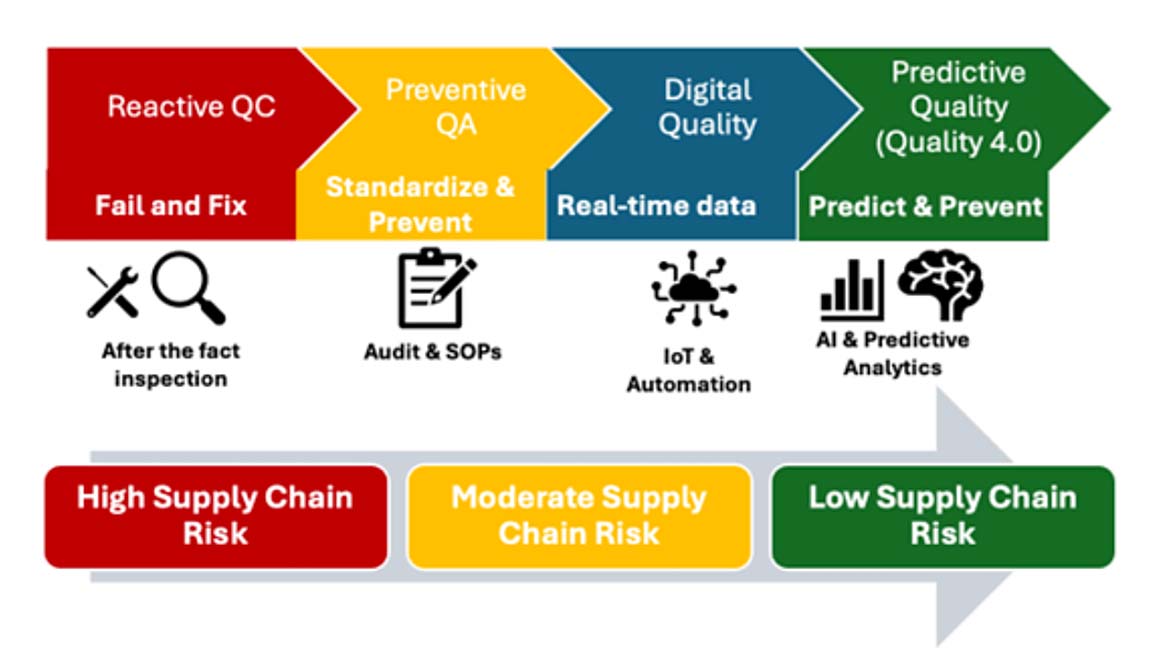
Quality 4.0 tools enable organizations to compare expected versus actual supplier performance continuously and conduct rapid root cause analysis using real-time data. It can detect quality drift before products leave the supplier’s facility, which can reduce rework, scrap, and emergency inspections.
By applying machine learning models to supplier quality data, organizations can also benchmark multiple suppliers simultaneously. These models allow them to identify which suppliers are resilient and which are risky. Such insights are invaluable when organizations must make fast sourcing decisions.
Quality 4.0 as a foundation for supply chain resilience
Supply chain resilience literature consistently emphasizes the importance of continuous network monitoring, risk mapping, maintaining risk registries, and having contingency plans in place. Quality 4.0 aligns naturally with these principles.
Digital quality platforms serve as a foundation for supplier risk dashboards that integrate quality metrics with supply chain risk indicators. These dashboards allow organizations to visualize supplier vulnerabilities, simulate disruption scenarios, and evaluate the impact of supplier changes.
Moreover, Quality 4.0 helps bridge trust gaps when onboarding new suppliers or shifting production geographically. Transparent, data-driven quality monitoring reduces ambiguity and builds confidence between buyers and suppliers. Over time, this initiative for data transparency and technology adoption strengthens collaboration, accelerates learning curves, and fosters social capital across the supply chain.
A framework for integrating Quality 4.0 and supply chain resilience
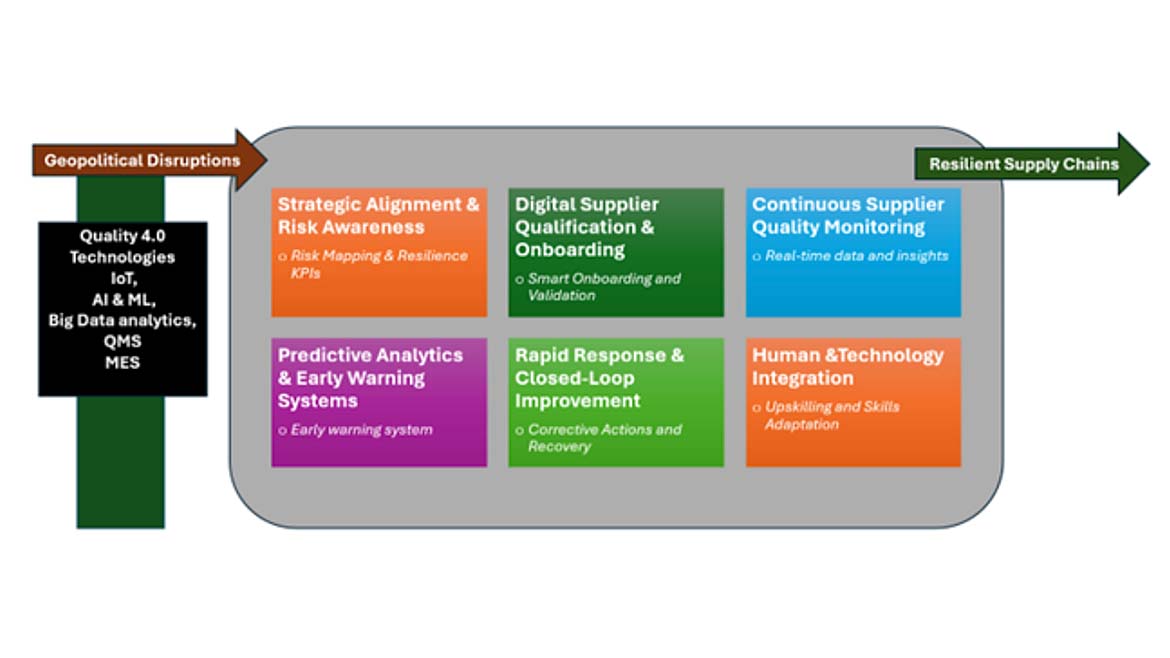
An effective Quality 4.0 framework for resilient supply chains includes the following elements:
-
Digital supplier qualification
Use data-driven qualification models that combine historical performance, process capability, and real-time pilot data from new suppliers. -
Continuous quality monitoring
Implement IoT-enabled data collection and digital quality systems to monitor supplier processes in near real time. -
Predictive analytics and AI
Apply machine learning models to detect early signals of quality degradation, delivery risks, and process instability. -
Integrated risk management
Link quality metrics with supply chain risk indicators, including geopolitical exposure, logistics constraints, and capacity risks. -
Rapid response and learning loops
Enable fast root cause analysis, corrective actions, and closed-loop learning across organizational and supplier boundaries. -
Human-technology integration
Empower quality professionals with advanced tools while investing in upskilling and change management.
Figure 2 presents an integrated framework that allows organizations not only to respond to disruptions but also to adapt and evolve in uncertain environments.
The role of quality professionals in a resilient future
As supply chains become more complex and uncertain, the role of quality professionals is expanding. Quality leaders must look beyond factory-level metrics and understand how their decisions impact supply chain continuity and organizational resilience.
Successful Quality 4.0 implementation depends on integrating human expertise with digital intelligence. Upskilling the workforce, developing data literacy, and enabling cross-functional collaboration are essential (Al Saleh, 2025). By combining human judgment with digital intelligence, organizations can develop robust manufacturing capabilities with high-quality standards while navigating geopolitical uncertainty.
Quality professionals must incorporate resilience-focused metrics into their supplier scoring and selection processes to ensure a more robust approach to supplier evaluation. Traditional cost and quality metrics should be complemented with indicators such as responsiveness, recovery capability, and adaptability in the face of disruption.
Key takeaways and call to action
- Geopolitical tensions are no longer episodic events; they are a persistent feature of the global business landscape. Disruptions will impact organizations that rely on reactive quality management and static supplier evaluation models.
- Quality 4.0 offers a pathway to integrate quality excellence with supply chain resilience. By leveraging real-time data, predictive analytics, and digital collaboration, organizations can minimize quality disruptions, improve supplier performance, and build adaptable supply chains capable of withstanding uncertainty.
- Industry leaders and quality professionals must move beyond traditional quality approaches and embed resilience thinking into quality strategy. Investing in Quality 4.0 is no longer optional; it is a strategic imperative for sustaining quality, trust, and competitiveness in a geopolitically volatile world.
References
Allgood, K. & Hong, P.K. (2025). How supply chains need to adapt to a shifting global landscape. World Economic Forum. https://www.weforum.org/stories/2025/06/how-supply-chains-need-to-adapt-to-a-shifting-global-landscape/
Al Saleh, H. (2025). Leveraging digital tools in the age of supply chain disruption. World Economic Forum. https://www.weforum.org/stories/2025/01/supply-chain-disruption-digital-winners-losers/
Chiarini, A., Tortorella, G.L., & Kumar, M. (2021). Lean Six Sigma and Industry 4.0 integration for operational excellence. International Journal of Production Economics, 240, 108219. https://doi.org/10.1016/j.ijpe.2021.108219
Lenihan, R. (2025). From pandemic to AI boom: The new reality of global supply chains. The Street. https://www.thestreet.com/technology/the-new-reality-of-global-supply-chains
McKinsey (2022). What is a supply chain? https://www.mckinsey.com/featured-insights/mckinsey-explainers/what-is-supply-chain
Sony, M., Antony, J., & Douglas, J.A. (2020). Essential ingredients for the implementation of Quality 4.0. The TQM Journal. 32(4), 779–793. https://doi.org/10.1108/TQM-12-2019-0275
Zonnenshain, A., & Kenett, R. S. (2020). Quality 4.0—the challenging future of quality engineering. Quality Engineering, 32(4), 614–626. https://doi.org/10.1080/08982112.2019.1706744
Looking for a reprint of this article?
From high-res PDFs to custom plaques, order your copy today!