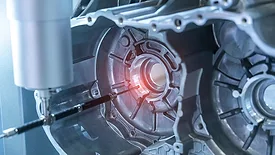
Often inexperienced coordinate measuring machine (CMM) operators will perform dimensional measurements without correctly establishing a part alignment. Manual and computer numerical control (CNC) CMM operators sometimes try to use the CMM as a 2-D or 1-D height gage.
No matter how many times I think I have addressed the topic of manufacturing health in the United States, it seems like I always find myself revisiting the subject.
Like many of my colleagues in the gage making business, I am astounded at how many manufacturers blaze away making parts to iffy or unknown specifications. Often the parts are made to a drawing with fuzzy details, and this lack of information is only brought to attention when a truckload of rejected parts hits the receiving dock.
The United Stated has been losing its manufacturing edge for a number of years to global competitors. Research shows that we continue to use the 1950s product control principle, PDCA (plan-do-check-act), to manage processes.
The EXAscan, a self-positioning and portable handheld laser scanner, does not require an additional coordinate measuring machine (CMM) arm or other external tracking devices. The scanner, developed by Creaform (Québec, Canada), is able to scan highly detailed surfaces and small objects in many industries including automotive and aerospace. Its applications run from reverse engineering to design and manufacturing, inspection, digital mock-ups and simulation.
No one wants a product to fail. A materials test can prevent problems from occurring. “Materials testing is commonly performed to assess the performance of materials such as metals, plastics and ceramics under stress,” explains Mark Fridman, marketing manager at Mark-10 (Copiague, NY). As such, it is a growing area, with changes ranging from equipment to standards to software.
The need to ensure the repeatability and reliability of mechanical test results between individual testing systems, whether those systems are located in the same lab or different labs, or a comparison is being made between multiple suppliers, has recently surfaced as a critical concern throughout every industry. This is not surprising since product quality is critical and quality assurance depends on the ability of testing systems to provide accurate results.
Precise Laser Waterjet & Stamping (PLW&S, North Aurora, IL) specializes in fabricating precision parts in short to medium runs, typically around 1,000 pieces, and prototyping. By the late 1980s, PLW&S began to experience a downturn as traditional customers moved their stamping-or even their entire business-offshore. The company responded through diversification and a strategy to expand by adding capabilities, initially those complementary to stamping. Today, PLW&S also offers EDM machining, CNC milling and welding.
Recently an American-based German manufacturer was awarded a contract to produce some parts for a Japanese company. According to the contract, critical surface areas of the parts were to meet roughness criteria as defined by the Rz parameter. This appeared to be no problem. However, it turned out that the Rz specified was not the current ISO or U.S. standard version they were used to, but a much older Japanese domestic standard dating from 1982.
 RSS
RSS