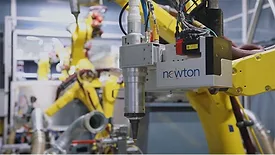
Precision has long been the backbone of manufacturing. But today, precision alone no longer guarantees performance. As automation, artificial intelligence, and digital transformation redefine production systems, the science of measurement—metrology—is evolving at an unprecedented pace.
Erik Nieves is the co-founder and CEO of Plus One Robotics. He's been in the industry for more than 30 years, and he also serves on the board of directors of A3 and is a frequent speaker and contributor to public policy and robotics.
Six Sigma is entering a fourth generation—one that connects operational excellence directly to enterprise strategy. This article explores how leaders can evolve continuous improvement (CI) into a portfolio-driven discipline that links financial outcomes, innovation, and customer experience.
The aerospace and manufacturing sectors are bracing for change as the IAQG (International Aerospace Quality Group) Standard Development Organization works to revise AS9101 and AS9104/1 with IA9104/1 (Requirements for Aerospace Quality Management Systems Certification Bodies) and IA9101 (Requirements for Aerospace Auditor Competence).
The most popular standard of the 27,000 standards produced by the International Organization for Standardization (often referred to as “ISO”) is ISO 9001 the standard for quality management systems – and it’s going through changes right now.
You’re already a superstar in quality control, but are you also a bit of a wordsmith? Can you unleash a wicked pun, or do you just like a good laugh? Join our caption contest and show your wit and creativity (try your best not to be vulgar, though)
As inspection systems capture more visual and dimensional data than ever before, aerospace manufacturers are using artificial intelligence to find variation earlier, connect processes in real time and redefine what it means to manage quality.
Quality engineers on aircraft and defense programs must verify that every part meets design requirements and keep records that can be audited for years.
In manufacturing, quality has always been defined by consistency — the ability to produce every part to the same standard, every single time. Inspection remains essential, but the industry’s focus has shifted. Rather than catching defects after they occur, the goal today is to eliminate variation at the source.
After Greg Weaver got out of the Navy, he started working in mining in northern Nevada. After a few winters, it was time to do something else. “It was like six degrees, and I’d be working outside.” He found a listing in the paper for an aerospace company that did turbine blade repair.
 RSS
RSS
.webp?height=168&t=1766182668&width=275 "Nieves_Q-Cast_Image (1).jpg")