We must continue to build a community where everyone we engage with – whether formal members, clients, prospective members, event attendees, and others – feels a sense of belonging, partnership, and growth.
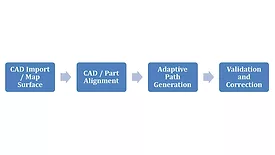
Modern automated ultrasonic testing solutions designed to perform 3D scanning of complex aircraft parts are generally programmed from the inspected part CAD coordinates, assuming exact geometric conformity.
The next few years mark a major convergence in quality and compliance standards. ISO 9001, the foundational global quality management system (QMS) standard, is being revised for 2026. In aerospace and defense, AS9100 is evolving into IA9100, aligning with ISO’s revisions, and incorporating tighter supply-chain and digital assurance practices.
As industries transition to higher-performance technologies, the materials used in electric vehicles, semiconductors, and aerospace systems are operating under increasingly demanding conditions.
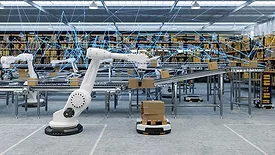
The momentum behind robotics is stronger than ever, but so too are the expectations. After years of aggressive growth projections and a wave of new entrants promising smarter, faster, and more flexible automation, 2026 will demand demonstrable, validated, production-grade reliability.
Eric Hayler is a Lean Six Sigma Master Blackbelt and principal of the Hayler Group. He's also an adjunct professor of business analytics at the University of South Carolina Upstate in Spartanburg, South Carolina.
By knowing the material, thickness, composition, and smallest feature of interest, you give your testing partner the information they need to design an efficient and accurate inspection.
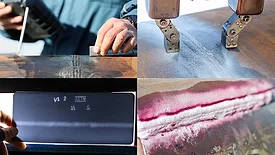
X-ray inspection has long been one of the most trusted methods for inspecting a part without cutting it open. Within the broader field of nondestructive testing (NDT), radiography remains a remarkably flexible tool—able to reveal hidden flaws, confirm weld quality, or verify internal structures that can’t be seen by eye. It’s used everywhere from aerospace and defense to energy, electronics, and manufacturing.
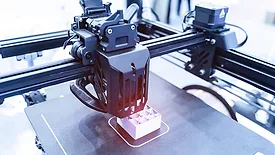
Additive manufacturing (AM), often referred to as 3D printing, has changed how metallic components are designed and produced, enabling layer-by-layer fabrication directly from digital models.
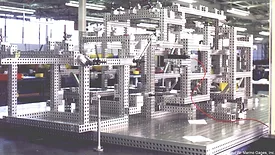
When asking a few of my favorite friends and colleagues about whether a CMM holding or checking fixture should be made by traditional welded base plates with common clamping methods versus a modular fixturing system, I tried very hard not to be “partisan” about the fixturing needs for manufacturing everything from rocket engines to automobiles.