Automation
Robotics and Process Control: Building Quality Through Automation
Modern robotic systems strengthen process stability, consistency, and control, turning automation into a foundation for manufacturing quality.

In manufacturing, quality has always been defined by consistency — the ability to produce every part to the same standard, every single time. Inspection remains essential, but the industry’s focus has shifted. Rather than catching defects after they occur, the goal today is to eliminate variation at the source.
That’s where automation, and robotics in particular, have become transformative. By enforcing precision and removing the variability inherent in manual operation, robotic systems now serve as critical enablers of process discipline and repeatability. They don’t just improve efficiency; they help manufacturers build quality directly into their processes.
At Shape Process Automation, this evolution is evident across every industry we serve. Robots are no longer deployed solely for speed or labor savings — they’ve become central to how manufacturers stabilize processes, control variation, and sustain the level of consistency that modern quality standards demand.
From Speed to Stability
For many years, robotic implementation in manufacturing focused on maximizing speed and throughput. But as automation technology matured, it became clear that quality and productivity depend far more on stability than on velocity. The ability to execute a process precisely and repeatedly — without drift or deviation — is what defines modern process control.
That shift from motion to precision has changed how manufacturers evaluate automation performance. Success is now measured not just in output per hour, but in process capability and predictability. Robotics provide the mechanical and software precision to maintain these parameters reliably over long production runs.

This is particularly true in applications like cutting, trimming, welding, and assembly, where even slight variations can impact appearance, fit, or structural integrity. Through rigid path control, calibrated tooling, and software-defined parameters, robotic systems deliver a level of process stability that is difficult to achieve manually.
Designing for Quality from the Start
Process control begins long before a robot ever cycles. It starts in the design phase, where automation engineers define the mechanical, software, and control parameters that govern performance.
By integrating quality goals into the earliest stages of automation design, it becomes possible to engineer variation out of the process before production begins. That means:
- Establishing validated process parameters in control software.
- Calibrating tools and sensors to maintain alignment and repeatability.
- Designing fixtures and mounts to minimize deflection and mechanical error.
- Verifying process consistency through early data collection and testing.
When automation systems are designed with these principles in mind, quality is no longer a downstream verification step — it’s an inherent outcome of the process itself.
Matching Automation to Process Complexity
The most effective automation systems are those aligned with the complexity of the process. Manufacturers often face a decision: How much control is required to achieve the desired quality, and what level of automation best fits that requirement?
It’s easy to over-automate a process with unnecessary complexity, or to under-automate and leave variability unaddressed. The optimal solution balances cost, risk, and control — applying the right technology to achieve the necessary level of precision.
In practice, this often means starting with standardized, modular robotic cells that deliver proven repeatability. Once a process is stable, data from production can guide the next steps in optimization — whether that involves adding machine vision, adaptive path correction, or advanced inspection integration.
By scaling strategically and maintaining control at each stage, manufacturers can steadily increase both automation maturity and quality confidence.
Robotics vs. CNC: Quality Across Different Production Volumes
CNC machines are common fixtures in automotive production, where precision is paramount. They also serve as a prime example of how that precision changes as production volumes rise.
Both CNC machines and robotic laser cutting systems offer precision, but they differ in how they deliver it — and how well they adapt across production volumes.
CNC systems excel at high-precision, low-variability machining, particularly in low- to mid-volume production where tool paths are rigid, tolerances are extremely tight, and part geometries don’t change frequently. They maintain accuracy through mechanical rigidity and fixed programming, producing micron-level precision part after part. However, they can be less flexible when product mix or geometry shifts, since reprogramming and fixturing changes take time.
Robotic systems, on the other hand, provide flexible precision — an ability to perform multiple tasks or adapt to new geometries with minimal retooling. While absolute accuracy may be slightly lower than that of a CNC machine, modern robotic motion control and calibration tools allow for highly repeatable performance, especially in processes like laser cutting, trimming, or assembly. For high-volume production or where multiple part types must be processed within the same cell, that flexibility becomes a major quality advantage.
Adapting to Real-World Variation
Even the most precisely designed process must contend with dimensional variation in real parts. Modern robotic systems can respond dynamically through integrated sensing and adaptive control.
Vision systems locate parts when they’re not in predictable positions, ensuring that the robot always starts from the correct reference point. Force sensing allows the system to adjust process parameters in real time — for instance, modulating speed or pressure when trim edges or joint tolerances vary.
For parts with larger deviations, surface probing can map dimensional differences and automatically offset the robot’s path to maintain precise tool alignment. Combined with a robot’s inherent dexterity — six degrees of freedom that enable fine positioning and optimal tool orientation — these capabilities ensure high-quality outcomes even when part variation can’t be fully eliminated upstream.
In fact, if volumes reach a level where multiple CNC machines are being used in production, overall quality suffers in comparison to the repeatable performance of robotic laser machining. Slight variabilities in parts, fixtures, and machines all add up — just three machines producing the same part can equate to nine different variations, all of those multiplying as the number of CNC machines increases.
Robotic Laser Cutting Case Study
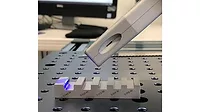
The distinction is clear in applications like robotic laser cutting, where repeatability and process control often matter more than static accuracy. A well-calibrated robot can execute thousands of identical cuts at consistent speeds, angles, and power levels — delivering exceptional surface quality and uniformity across batches.
A project for a Tier 1 automotive supplier illustrates how robotic process design bridges the gap between CNC-level precision and large-scale production flexibility. The supplier manufactures high-appearance aluminum components for the automotive industry — products that demand precise dimensional accuracy and flawless surface finish.
The cost and floor space needed to automate the CNC-based production line was insurmountable. By transitioning to robotic laser systems, Shape Process Automation was able to provide an inline solution that greatly reduced cost and footprint.
To maintain precision standards, Shape Process Automation engineered a robotic laser cutting system designed for exceptional motion precision and repeatable alignment. Each cut path was modeled digitally and optimized for stable, consistent operation. Laser power, focal offset, and motion speed were defined as controlled variables, ensuring identical results on every part.
While a traditional CNC system could deliver similar single-part accuracy, the robotic approach allowed the automotive supplier to scale that precision across high-volume production with minimal setup time and strong process consistency. The result was a process with consistent edge quality, minimal thermal distortion, and virtually no rework.
By embedding precision and repeatability into the system’s design, the automation platform delivered not only higher throughput, but also a measurable improvement in quality yield — demonstrating how robotics can bring CNC-like quality to continuous, flexible production environments.
Data as a Foundation for Process Control
Even in systems that aren’t built for closed-loop feedback, digital traceability remains a powerful enabler of long-term quality assurance. Every robotic motion, speed, and torque reading represents valuable data that can be monitored for trends, deviations, or early signs of wear.
By collecting and analyzing this process data, manufacturers can verify that systems continue to perform within specification. Over time, these insights help fine-tune process parameters, improve maintenance schedules, and maintain consistent part quality without adding complexity.
Data-driven validation also supports regulatory and customer requirements for traceability. When each part can be tied to a known, validated process history, it builds confidence throughout the supply chain and strengthens overall quality systems.
Robotics as a Platform for Quality
The role of robotics in manufacturing quality extends beyond mechanical precision. Robots provide a stable platform for process improvement — a consistent baseline against which variation can be measured and minimized.
When robotic systems perform a task identically, cycle after cycle, it becomes far easier to identify the sources of any residual variation. That clarity accelerates root-cause analysis, supports Six Sigma and SPC initiatives, and drives continuous improvement. When equipped with vision, force, or probing systems, robots not only maintain consistency but learn from variation — adapting processes in real time to preserve dimensional integrity.
In effect, robotic automation transforms production variability into a quantifiable, controllable parameter — making quality measurable and manageable in ways that manual processes simply cannot.
Robotic technologies continue to advance to the point where the industry will be able to consider using robots for processes that could only use CNC in the past. While the precision of CNCs is unquestioned, robotics strengthen process control as they ensure repeatability at scale.
Looking for a reprint of this article?
From high-res PDFs to custom plaques, order your copy today!