Quality Magazine logo
search
cart
facebook twitter linkedin youtube
  • Sign In
  • Create Account
  • Sign Out
  • My Account
Quality Magazine logo
  • NEWS
  • PRODUCTS
    • FEATURED PRODUCTS
    • SUBMIT YOUR PRODUCT
  • CHANNELS
    • AUTOMATION
    • MANAGEMENT
    • MEASUREMENT
    • NDT
    • QUALITY 101
    • SOFTWARE
    • TEST & INSPECTION
    • VISION & SENSORS
  • MARKETS
    • AEROSPACE
    • AUTOMOTIVE
    • ENERGY
    • GREEN MANUFACTURING
    • MEDICAL
  • MEDIA
    • A WORD ON QUALITY PUZZLE
    • EBOOK
    • PODCASTS
    • VIDEOS
    • WEBINARS
  • EVENTS
    • EVENT CALENDAR
    • IMTS
  • DIRECTORIES
    • BUYERS GUIDE >
      • Supplier Insights
    • NDT SOURCEBOOK
    • VISION & SENSORS
    • TAKE A TOUR
  • INFOCENTERS
    • Digital Quality Management Systems
    • NEXT GENERATION SPC & QUALITY ANALYTICS
  • AWARDS
    • ROOKIE OF THE YEAR
    • PLANT OF THE YEAR
    • PROFESSIONAL OF THE YEAR
  • MORE
    • Expert Columns
    • NEWSLETTERS
    • QUALITY STORE
    • INDUSTRY LINKS
    • SPONSOR INSIGHTS
  • EMAG
    • eMAGAZINE
    • ARCHIVES
    • CONTACT
    • ADVERTISE
  • SIGN UP!
AutomationNDTAerospace

NDT | Automation

Enhancing Metrology through Automation: Elevating Quality and Cycle Time in Precision Manufacturing

The aerospace industry is one example of where the marrying of automation and metrology is being adopted to elevate product quality and operational excellence.
By Erik Novak, Patricia Browne
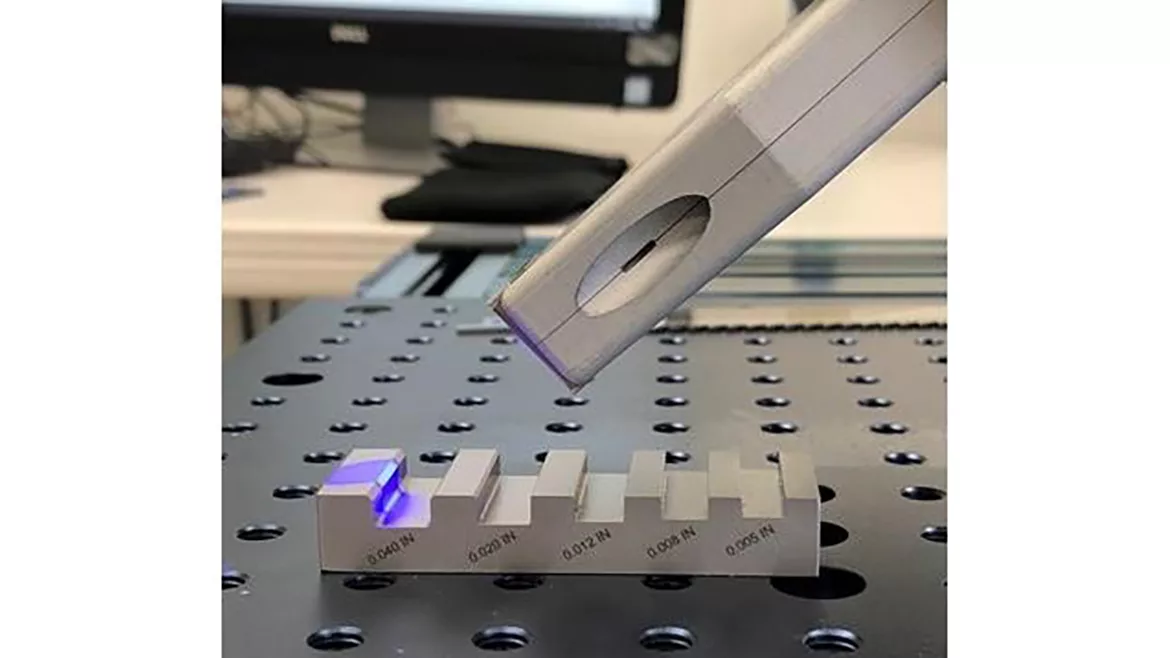
PSL metrology head measuring a chamfer on a machined chamfer and radius standard.

Figure 1. PSL metrology head measuring a chamfer on a machined chamfer and radius standard. All Images Source: 4D Technology

June 14, 2024
✕
Image in modal.

In today’s competitive landscape where safety is a priority, manufacturers of precision components in such industries as aerospace, automotive and medical devices are continually challenged to improve and monitor product quality while also improving efficiency. Small defects can dramatically compromise the integrity and performance of components, leading to part rejections, costly rework and repairs, and loss of market share.

The diverse requirements and critical parameters of interest that are controlled for precision components vary greatly. Unfortunately, there is no single system that can effectively address all measurement challenges taking into consideration resolutions, accuracy requirements, surface reflectivity, measurement range, operating environment, and user skill level. In addition, throughput is another critical element in meeting cost and efficiency demands, operations need to weigh current manual practices against higher efficiency, robotic approaches.

NDT

Related Articles

  • Exploring the Integration of AI and Machine Learning in AM Aerospace Applications
  • NDT Robotic Path Planning: Automatic Methods for Ultrasonic Scanning Paths Generation
  • A Guide to Understanding and Achieving AS9100 Certification
  • Read More NDT ⮞

The aerospace industry is one example of where the marrying of automation and metrology is being adopted to elevate product quality and operational excellence. The aviation industry prioritizes safety and is driving a heightened emphasis for stringent quality control and efficient labor management amid the ongoing post-pandemic labor shortages and recent highly publicized component failures.

Components in this industry have increasingly tight tolerances on defects, radii, chamfers, and blend geometries. Rapid and precise quantification of these features in production is essential to ensuring the highest quality levels efficiency and rework velocities.

Traditional Measurement Methods

To date, quantification of defects and features on precision-machined components has relied on traditional and manual measurement methods that are prone to be subjective and inaccurate but have been used for decades.

Visual Inspection

Currently, visual inspection of defects and features of engines and many other precision machined parts is the standard quality control practice. Done by eye, or with the aid of an optical comparator, manual inspection is slow and subjective. One of the most common inspection methods for assessing feature heights is to visually compare a defect to features of known quality on a coupon; a method that is neither precise nor repeatable. Inspectors err on the side of caution, and these conservative assessments often result in unnecessarily high rates of rework and rejection.

Many measurement locations cannot be measured by eye or are in hard to reach, requiring inspectors to generate replicas of the feature of interest, or even disassemble parts, and then brought to off-line measurement techniques such as optical comparators with templates (shadowgraphs), incurring higher labor costs, increasing the inspection time, and can still be subjective.

In addition, when considering the hundreds of callouts that can be needed on a single component, cycle time can take hours to days to measure – an extremely labor-intensive process.

2D Profilers

Higher resolution stylus-based measurement systems are another method widely used for quantifying feature heights, profiles and roughness. For short scan lengths, a stylus can be relatively fast, however, a stylus is a 2D technique that provides a single line of data across a feature, often not even crossing the deepest or widest portion of a defect. They are also susceptible to positional variations given their sensitivity to measurement position of the single scan. Some profilers can be programmed to do multiple scans for an area measurement; however, this greatly increases the inspection time for a single location, and exponentially for multiple locations. These systems can be difficult to set up, and susceptible to environmental factors, making them less suitable for shop floor applications. Additionally, as a contact-based method there is a higher risk of damage to the component and instrument.

3D Optical Profilers

3D optical profilers are non-contact systems known for having extremely fast, nm-resolution capability to identify surface roughness, features and defects; however, they are highly vibration-sensitive and require extremely quiet environments to be able to measure accurately and repeatably. In addition, due to their large form factors they have limited reach and are typically not considered a viable option for measuring on a shop floor.

Portable, 3D Optical Gages

Optical gages are small, portable systems that provide non-contact, 3D measurement of features and defects. One specific optical gauge technology, polarized structured light (PSL), has been successfully measuring defects and features in aerospace and precision machining applications for nearly a decade, measuring defects such as pits, scratches and corrosion and features such as edge break, radius, and chamfers from 2.0µm to 9mm in height. The surface gage is similar to PSL optical gage but its technology is significantly faster and has demonstrated to reduce rework rates by up to 30% on critical engine components with its ability to correctly quantify defects. The underlying technology is vibration-immune, making it uniquely capable of using non-contact, three-dimensional optical metrology for measuring in extreme environments, including production and shop floors. These handheld systems measure in < 1 second—hundreds of times faster than manual inspection.

Automating Optical Metrology

In industries such as aircraft engines and automotive, where hundreds of different categories of features and locations require quick, precise inspection, automated metrology is emerging as a transformative approach.

Automated inspection makes it possible to quickly measure hundreds of features and defects per part.

Automation significantly increases throughput with higher sampling rates, and accuracy with the robotics’ precision. For one of our customers, they were able to measure 400 typical engine callouts in under 30 minutes. It can even open up capabilities for design and specification optimization when combined with computer aided design (CAD) comparison, digital twinning, and advanced predictive analytics.

With the additional skilled workforce challenges, robotic metrology solutions are an attractive option to efficiently quantify critical callouts across many part locations with minimal operator involvement, enabling manufacturers to reallocate labor to other critical tasks.

While the upfront costs of automation may be viewed as a barrier to adoption, taking a deeper look into the return on investment (ROI) and cost savings can justify the adoption of automated optical metrology.

Table 1 below shows an example from a typical aircraft engine facility, using conservative values provided by various engine manufacturers after implementing automated 3D PSL optical gage measurements. Assuming an automated system might cost as much as $500,000, the breakeven point is a mere three months and ROI on the investment over the 5-year capital cycle would be about 20X. For a given operation, each case will need its own justification, but this provides a quick look at potential savings with an automated 3D PSL system.

Table 1: Example table showing potential cost savings associated with automated 3D measurement solution for aircraft engine components.

The integration of robotics with optical polarized structured light gages is enabling new possibilities in precision manufacturing, offering improved precision, throughput and labor utilization to companies who are adopting it, and providing a competitive advantage for the future,

KEYWORDS: 3D measurement gages manufacturing measurement methods metrology optical optical metrology

Share This Story

Looking for a reprint of this article?
From high-res PDFs to custom plaques, order your copy today!

Erik Novak, Ph.D., is the director of technology development at Veeco Instruments Inc. (Plainview, NY). For more information, call (520) 741-1044, e-mail [email protected] or visit www.veeco.com.

Patricia Browne is the director of product marketing for 4D Technology. For more information, call (520) 294-5600, email [email protected] or visit www.4DTechnology.com.

Recommended Content

JOIN TODAY
to unlock your recommendations.

Already have an account? Sign In

  • 2024 Quality Rookie of the Year Justin Wise 1440x750px banner with "Quality Rookie of the Year" logo inset

    Meet the 2024 Quality Rookie of the Year: Justin Wise

    Justin Wise is an exceptional individual who has been...
    Aerospace
    By: Michelle Bangert
  • Man with umbrella and coat stands outside while it rains at night looking at a building.

    Nondestructive Testing: Is there an ethics problem?

    I was a whistleblower who exposed fraudulent activities...
    NDT
    By: Dale Norwood
  • Unraveling Deflategate: Football stadium with closeup of football on field

    Unraveling the Tom Brady Deflategate

    The Deflategate scandal erupted following the 2014 AFC...
    Measurement
    By: Greg Cenker and Henry Zumbrun
Manage My Account
  • eMagazine Subscriptions
  • Newsletters
  • Online Registration
  • Subscription Customer Service
  • Manage My Preferences

More Videos

Sponsored Content

Sponsored Content is a special paid section where industry companies provide high quality, objective, non-commercial content around topics of interest to the Quality audience. All Sponsored Content is supplied by the advertising company and any opinions expressed in this article are those of the author and not necessarily reflect the views of Quality or its parent company, BNP Media. Interested in participating in our Sponsored Content section? Contact your local rep!

close
  • Key Takeaways for Quality Leaders
    Sponsored byComplianceQuest

    Key Takeaways for Quality Leaders from the 2026 Gartner Magic Quadrant™ for QMS

  • This image shows a person seated next to a Bobcat T66 compact track loader.
    Sponsored byPolyWorks by InnovMetric

    Supercharging Digital Gauging at Bobcat North America

  • Dorsey Calibration Lab photo by Tom LaBarbera Picture this Studios
    Sponsored byDorsey Metrology International

    Ensuring Product Quality in a Competitive Manufacturing Landscape

Popular Stories

This image shows a person seated next to a Bobcat T66 compact track loader.

Supercharging Digital Gauging at Bobcat North America

a professional in the aviation field performing maintenance, repair, and overhaul (MRO) work

Manufacturing Retention: Strategies for Improving Company Culture, Engagement and Skill Development

Dorsey Calibration Lab photo by Tom LaBarbera Picture this Studios

Ensuring Product Quality in a Competitive Manufacturing Landscape

2026 Quality Professional of the Year!

Events

June 22, 2026

Automate 2026

Automate is North America's largest robotics and automation event — and the best place to take your ideas from insight to impact.
 
Our show floor features the world’s leading automation solutions, from AI and robotics to motion control, vision systems, and more. Plus, our educational conference is second to none, led by the brightest minds in automation today.
 
Ready to transform the way you work? Take the next step at Automate.
July 14, 2026

Quality Leaders Forum: Better Communication, Better Quality Data

The Quality Leaders Forum is a quarterly, editor-moderated fireside chat series hosted by Quality Magazine, featuring candid conversations with senior manufacturing and operations executives shaping enterprise-level quality.

View All Submit An Event

Products

Lean Manufacturing and Service Fundamentals, Applications, and Case Studies

Lean Manufacturing and Service Fundamentals, Applications, and Case Studies

See More Products
Quality Podcast Channel Custom Content

Related Articles

  • Applied manufacturing technologies, autonomous mobile robot AMR factory automation

    Enhancing Manufacturing Quality Through Automation: A Strategic Approach

    See More
  • a conceptual 3D rendering of a car factory production line

    Cobots Drive Flexibility and Precision in Automotive Manufacturing

    See More
  • Portrait of a black female engineer technician smiling, wearing a hard hat and holding a clipboard in a warehouse packaging factory.

    Focus on Process Cycle Time to Save Time and Money

    See More

Related Products

See More Products
  • Getting Factory Automation Right (The First Time)

  • Quality Improvement Through Planned Experimentation 3/E

  • Lean Manufacturing in a Small Shop DVD

See More Products

Events

View AllSubmit An Event
  • August 12, 2025

    Enhancing Shop Floor Metrology: The Case for 3D Optical Gauges in Quality Management

    On Demand This webinar will discuss how 3D optical gauges can help you qualify and quantify your inspection callouts, defects, geometries of interest, and surface finish in seconds – right on the shop floor.
View AllSubmit An Event
×

Stay in the know with Quality’s comprehensive coverage of
the manufacturing and metrology industries.

Newsletters | Website | eMagazine

JOIN TODAY!
  • RESOURCES
    • Advertise
    • Contact Us
    • Directories
    • Manufacturing Division
    • Store
    • Want More
  • SIGN UP TODAY
    • Create Account
    • eMagazine
    • Newsletters
    • Customer Service
    • Manage Preferences
  • SERVICES
    • Marketing Services
    • Market Research
    • Reprints
    • List Rental
    • Survey/Respondent Access
  • STAY CONNECTED
    • LinkedIn
    • Facebook
    • YouTube
    • X (Twitter)
  • PRIVACY
    • PRIVACY POLICY
    • TERMS & CONDITIONS
    • DO NOT SELL MY PERSONAL INFORMATION
    • PRIVACY REQUEST
    • ACCESSIBILITY

Copyright ©2026. All Rights Reserved BNP Media, Inc. and BNP Media II, LLC.

Design, CMS, Hosting & Web Development :: ePublishing