Vision & Sensors | Trends
Intelligent Automation: A Recipe for Enhancing Quality, Productivity, and Efficiency
Let’s take a closer look at just a few specific technologies currently shaping the future of the global manufacturing industry.
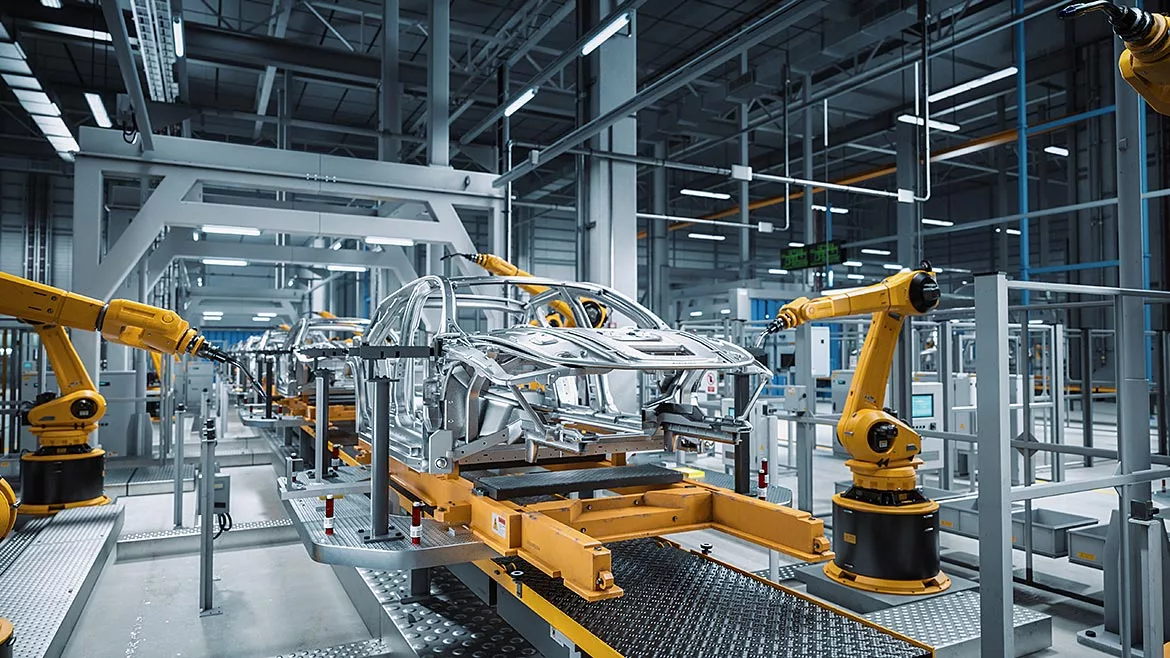
Image Source: gorodenkoff / iStock / Getty Images Plus
Historically, manufacturing existed at the heart of technological and industrial innovation. Powered almost exclusively by manual processes and specialized human expertise, the industry has consistently empowered business leaders across industries from behind the scenes to bring their revolutionary visions to life, delivering progressively cost- and time-efficient solutions to the design, production, and deployment of their products at scale, while simultaneously strengthening and supporting the evolution of the global economy.
Now we find ourselves in the midst of an equally consequential, yet fundamentally different kind of technological revolution, in which operational improvements are driven by rapid advancements in artificial intelligence (AI) and other software-based, data-driven solutions, and critical tasks that previously required a manual approach are made dramatically more efficient or entirely replaced by automated processes. It is a monumental paradigm-shift—even for an industry that has played such a pivotal role in the advancement of human productivity over the years—and one that many manufacturers have yet to truly leverage to their advantage.
This is primarily because, despite the gradual implementation of new software tools, there is still a largely unresolved disconnect between operation and information technology throughout the industry. More specifically, manufacturers lack the seamless visibility needed to leverage this new ecosystem of data effectively and drive meaningful improvements to efficiency, productivity, and quality on the factory floor. In fact, according to Zebra’s 2024 Manufacturing Vision Study, only 16% of manufacturing leaders around the world today report having a solution to enable real-time visibility into processes across the production lifecycle.
Fortunately, industry leaders are moving quickly to close these visibility gaps through the strategic integration of AI and other advanced digital solutions. According to Zebra’s study, 61% of manufacturers say they expect AI to drive growth by 2029, up from 41% in 2024. This considerable surge in AI adoption, combined with 92% of survey respondents prioritizing broader initiatives around digital transformation, underscores an increasingly urgent intent among manufacturers to modernize their operations in a way that truly maximizes collaboration between frontline workers and innovative, connected manufacturing technologies.
Visibility is the first step toward transformation, and the integration of AI and other emerging technologies allows manufacturers to utilize data more effectively. This capability helps them identify, respond to, and prioritize issues and projects, enabling them to achieve incremental efficiencies throughout the manufacturing process, ultimately yielding the greatest immediate impact.
What we’re seeing today is a rapidly broadening implementation of AI-driven strategies and technology, foreshadowing perhaps the most significant reconfiguration of traditional manufacturing processes to date. With the intelligent automation of business-critical workflows at the forefront, powered by advanced technologies like machine vision, AI, radio-frequency identification (RFID), and autonomous mobile robots, this transformation is poised to result in the unprecedented enhancement of visibility and data integration across applications and at all levels of manufacturing.
To better understand this ongoing trend, and how manufacturers can utilize intelligent automation to redefine efficiency and quality and drive growth in today’s highly competitive market, let’s take a closer look at just a few specific technologies currently shaping the future of the global manufacturing industry.
Machine Vision & Fixed Industrial Scanning (MV/FIS)
If there’s one thing virtually all manufacturing operations have in common, regardless of the product or industry, it’s the need to ensure that production runs as quickly and consistently as possible without sacrificing overall quality. However, while manufacturers have refined their processes over the years to maximize accuracy and efficiency, there are certain irreconcilable limitations to any task that can’t be performed without constant human oversight or intervention.
There have been plenty of attempts over the years to utilize advanced technology as a means of breaking through these limitations, including the installation of on-site cameras and scanners that can capture and analyze data for efficiency and quality control. But even if frequently accurate, these tools presented complications of their own, namely their lack of an intuitive, centralized platform for processing and tracking the captured data in real-time, resulting in a further unnecessary consumption of time and resources.
Today, all of this is changing through the development and implementation of advanced, AI-driven machine vision (MV) and fixed industrial scanning (FIS) technologies, which build on the overall accuracy and precision of previous iterations and also bridge that critical gap between the physical and software-based components.
More specifically, MV-powered smart cameras can be strategically placed on the factory floor to manage the oversight of product assembly. Whether you’re building an automobile or mass-producing pharmaceuticals, these smart cameras can evaluate all components to detect human error and ensure the accuracy of measurements before moving on to the next stage of production. Meanwhile, FIS units also capture and validate the location of all components throughout the lifecycle, further streamlining and enhancing the real-time visibility of the manufacturing workflow.
Perhaps most importantly, when connected to a unified software management platform, the data being captured and processed is neither isolated nor unnecessarily complicated. Instead, all information is easily accessed via a modern, intuitive user interface that can be easily set up, deployed, and programmed to power and integrate both technologies into the factory or warehouse management system.
RFID Printing & Encoding Technology
Expanding on the crucial area of visibility, the modernization of radio-frequency identification (RFID) tags is another transformative breakthrough in the rapidly evolving manufacturing landscape, providing fixed and mobile scanning solutions to ensure quality and accountability both inside and outside the warehouse or factory floor.
For one, the inherent flexibility and ruggedness of RFID technology speeds up and enhances the accuracy of the identification process on the production line. Put simply, RFID tags are optimized for readability, unlike traditional barcodes, allowing for reliable deployment in particularly busy and/or overcrowded environments. However, this basic functionality is only the tip of the iceberg, and the real value of modern RFID technology lies in its increasing versatility, ease of use across industries and disciplines, and ability to automate tracking and tracing in way that enables real-time decision-making to address small or potentially catastrophic errors.
Whether fixed or handheld, the advanced and highly scalable RFID printing and encoding devices emerging on the market today have significant implications for both production and inventory management in the retail, automotive, healthcare, and broader manufacturing sectors. And this is primarily because, much like MV and FIS, modern RFID technology is designed with all possible users in mind, from upper management to frontline workers, and when you combine its trademark ease-of-use with the virtually limitless possibilities for application, it’s easy to understand why its implementation has become a top priority for business leaders across industries.
In fact, demand for advanced RFID printing and encoding solutions threatens to surpass that of more speculative technologies currently arising from the AI-driven tech boom. According to Zebra’s study, 85% of business decision-makers stated they believe RFID will be an important emerging technology for their organizations. Moreover, 65% have shared plans to implement RFID over the next five years, while 43% are in the process of upgrading existing RFID-based supply chain management solutions.
Robotics Automation
Finally, given the manufacturing sector’s historically unwavering reliance on manual processes, there has arguably always been a strong interest in leveraging advanced robotics technology to streamline productivity and quality control, enhance safety, and reduce costs amidst a steadily declining labor pool.
To be clear, while robotics as an engineering discipline has been around for more than a century, the ability to deploy functional models at scale—paired with the flexible, cloud-based software needed to facilitate intelligent automation in a manufacturing or fulfillment setting—is still a relatively new development. However, despite only coming into maturity over the past decade, both the immediate and potential impacts of AI-driven robotics automation on everything from basic mechanical systems to business-critical decision-making are nothing short of transformative.
Looking at Zebra Technologies’ evolving robotics capabilities, we can see that beyond the surface-level proposition of task automation lies a comprehensive, AI-powered solution that orchestrates workers and robots in real time to maximize throughput, accuracy, and efficiency. Combining AMRs with wearable technologies, detachable carts, advanced software, and actionable analytics, the system effectively blends the functions of a warehouse execution system (WES) with intelligent robot fleet management—delivering lower costs per unit picked and faster profits with up to 30% fewer robots.
This type of AMR solution synchronizes every picker with a team of AMRs in a precisely directed workflow that can be learned in minutes. The inclusion of low-cost, detachable carts eliminates idle time for robots and increases cubic capacity by up to 300%, further reducing the number of robots needed without compromising performance. Meanwhile, managers gain detailed visibility into order movement, average tour times, and bottlenecks, enabling real-time decisions that empower every shift to operate at peak productivity.
It’s also important to remember that robotics automation isn’t confined to one specific model or environment. While some solutions are purpose-built for warehouse operations, the underlying technologies—AI, machine learning, and edge-based analytics—remain applicable across a broad spectrum of manufacturing and logistics use cases. From automotive assembly lines to warehouse picking operations, the potential for intelligent robotics to drive measurable improvement is expansive.
Ultimately, this only scratches the surface of how intelligent automation is redefining industrial workflows. By integrating next-generation tools like AI-powered machine vision, fixed industrial scanning, RFID, and robotics automation, manufacturers and logistics operators alike can set a new trajectory of growth—one that enables smarter, faster, and more agile operations in response to a rapidly evolving market landscape.
Looking for a reprint of this article?
From high-res PDFs to custom plaques, order your copy today!