Vision & Sensors | Automation
Augmenting Your Workforce: Three Opportunities to Leverage Technology to Automate Repetitive Tasks
As with any good engineering approach to problem-solving, we can divide the manufacturing labor challenge into parts.
All Images Source: Zebra Technologies
Manufacturers across industries are faced with increasingly complex challenges today. They must balance profitable growth and quality while managing worker and knowledge retention, deploying and integrating new technology, and minimizing disruption.
On top of this, labor remains elusive for manufacturers – 65% cite the inability to attract and retain employees as their top challenge in the recent NAM Manufacturers’ Outlook Survey. While the manufacturing industry has advanced from the lows of the pandemic when about 1.4 million jobs were lost, a gap still exists, with 622,000 manufacturing jobs open as of January 2024 according to the U.S. Chamber of Commerce.
Simultaneously, the predictability of manufacturing is rapidly decreasing and the need to be agile, flexible, and productive in a volatile, uncertain, complex, and ambiguous (VUCA) world is increasing. From my experience, skilled human labor is by far the best, most important resource to address this challenge.
Whether it is a plant in Ohio or Guangzhou, China, I’ve seen people assembling, inspecting, and processing material through factories with phenomenal efficiency, flexibility, and accuracy. As Elon Musk learned on the Model 3 production line, no automation compares to a human, especially when it comes to the most precious and limited resource we have – time, and specifically, time to implement.
So what are we to do? As with any good engineering approach to problem-solving, we can divide the manufacturing labor challenge into parts. Think of your eyes, your arms, and your legs. They relate to three clear opportunities to automate and augment labor: inspection, handling, and materials movement. Recent advancements have made augmentation and automation more viable for a multitude of applications with quick time to implementation. Let’s start with the inspection.

The Powerful Vision Behind Fast and Accurate Inspection
The human eye is a marvel. Think of your eyes as a super 500-megapixel high-tech camera that can see in 24-bit color. Intuitively, they “digitally” zoom to a focus area of about 3% at an astonishingly fast rate of 60 frames per second.
By the time you reach 18 and are lucky enough to have excellent vision, you’ve processed the equivalent of one petabyte (PB), an extremely large unit of digital data. Essentially, that’s equal to watching 10 gigabytes (GB) of video every hour for over 100,000 waking hours. That’s a lot of data – 1,000 terabytes (TB) to be exact.
Putting it in terms of machine vision powered by artificial intelligence (AI), it’s a lot of annotated data. While our mortal eyes are indeed miraculous, using them to repetitively inspect items on an assembly line is tedious, time-consuming, and prone to error. That’s where machine vision technology comes in.
Inspection is a critical and constant part of the manufacturing process from assuring the quality of raw materials to finished goods. It is estimated that millions of manufacturing jobs globally are involved in inspection. Ultimately, the promise of AI, 3D, color, and machine vision technology can support replacing repetitive inspection tasks for workers by automating traceability to increase visibility.
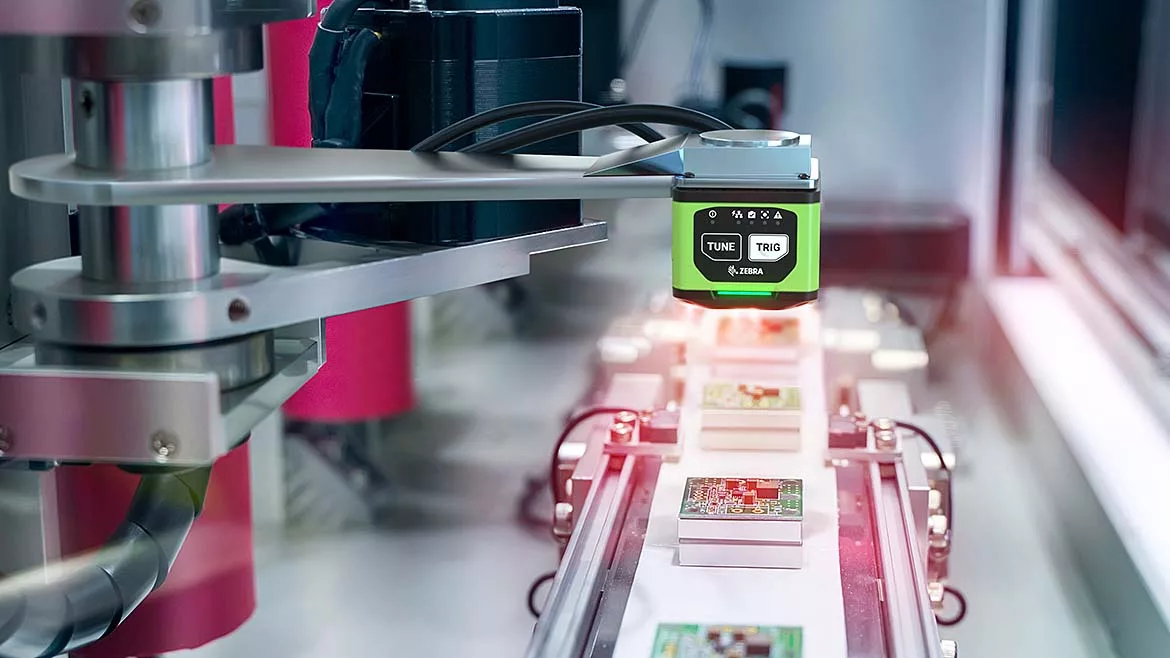
Advanced machine vision systems can perform inspections with speed and accuracy that humans (even with our amazing eyes) can’t surpass. Powered by AI, machine vision systems analyze images, identify, sort, and track assets and products – from small items to large pallets – and even the most complex inspections with speed and precision. However, they do require training to learn how to recognize what a “good” part, defect, or anomaly looks like – and that takes time, from weeks to months.
That’s why I’m excited to see advancements in machine vision technology. Now, by combining cloud-based training and annotating with edge AI systems and 3D cameras, the time to implement advanced inspection systems is significantly reduced.
Cloud-based training allows workers to annotate and manage images and train new models anywhere in real time. With cloud-based annotation – or labeling images or data to train an AI model – multiple people can work on the same data sets simultaneously while teaching the AI model to be more accurate. Edge AI systems support data processing in real time, processing data, and refining systems on the spot. Finally, with advancements in 3D cameras, information can be captured in more detail, making them ideal for inspection.
It all adds up to faster, more accurate inspection with more visibility into assets and production, implemented in less time with less disruption.
Adding Augmentation for a Better Grip on Materials Handling
Think about your arm and hand for a moment. Your arm can move up, down, side to side, and everywhere in between. Your hand is incredibly complex with 27 bones, 34 muscles, and more than 100 ligaments and tendons.
Hand-eye coordination happens in the blink of an eye. It’s so quick and accurate that it’s measured in fractions of a second with precision in sub-millimeters. With our fingertips, we can sense things down to tens of nanometers. It’s why we’re able to thread a needle or carry large items.
Although much simpler with fewer degrees of freedom, collaborative robots (cobots) powered by machine vision can replace many repetitive tasks such as machine tending. Vision guided robots’ (VGR) web-based interfaces allow an operator to easily set up a new task. This enables the robot to “see” and interact with its environment more effectively, such as picking and placing items on an assembly line, increasing production times.
Other technology tools like wearable mobile computers equipped with workforce management, communication, and analytics software can significantly help improve materials handling. Handling is a major workflow in manufacturing, from loading and unloading machines to packaging finished products and more. Augmenting workers with robotic automation and tech tools enables greater precision and speed. Connecting workers with technologies that streamline workflows allows them to focus on tasks that add the most value and reduce the rate of repetition.
Autonomous Mobile Robots (AMRs) Take Materials Movement to the Next Level
Our legs and feet keep us moving. The human leg contains about 30 bones and 20 muscles, and the foot has 26 bones and 20 muscles. That’s a lot of power behind our movement. While speed is variable, the average human walking speed is about 3.1 miles per hour.
Now what could our limbs do with automation? Interestingly, AMRs can move at about the same speed as humans (some are built to be faster), but their superpower is they never get tired, bored, or need breaks. Given this, AMRs can cover more ground with more efficiency than human workers tasked with moving materials in a manufacturing plant.
Beyond boosting efficiency or reducing walking time, AMRs can also improve worker safety by taking over higher-risk tasks, like working in hazardous environments, moving dangerous materials, or pushing heavy carts to significantly improve worker safety. The most recent AMR advancements integrate with wearable technologies, software, and analytics to enhance performance while maintaining quality and accuracy.
Blending AMRs with other technologies improves throughput and cycle time, enables informed decision-making, and allows flexibility for changing demands, ultimately enhancing overall operational agility and resilience. Best of all, implementation time is quick. As AMRs are designed to work alongside humans, major infrastructure changes aren’t required, allowing them to jump in and collaborate without disruption.
Automate and Augment While Minimizing Downtime
Navigating the path to an agile, efficient, and resilient plant floor with an engaged, skilled workforce is no easy feat. Advancements in imaging, connectivity, computing, and AI are empowering operations leaders to deploy solutions faster with less disruption and downtime. Time to implementation and flexibility to adjust to changing demands are critical considerations for any project. Traditional, capital-intensive investments in automation still have significant value in certain applications and industries. That said, new opportunities are emerging to deploy bespoke flexible solutions. With machine vision-based inspection, robotics automation, and AMR materials movement, the orchestration of human workers with automation will lead the way.
Looking for a reprint of this article?
From high-res PDFs to custom plaques, order your copy today!