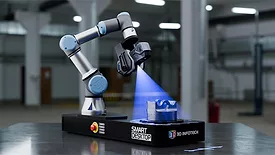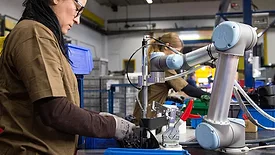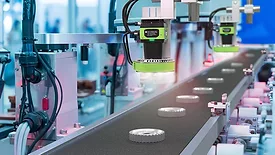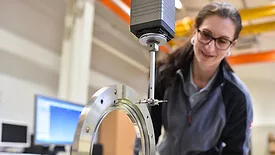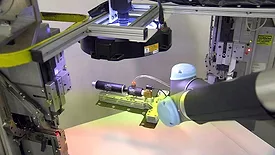
When you buy a cobot, you may have just one application in mind, but leading cobots are platforms for almost any number of quality applications - and not just quality applications.
I've noticed that operators and inspection workers often realize upon first meeting collaborative robots (cobots) that they aren't replacements for human labor. Instead, cobots signal a shift from traditional automation in quality and inspection, providing distinct advantages over traditional robots.
ETQ just released the second annual global survey, the ETQ Pulse of Quality in Manufacturing. CEO Vick Vaishnavi sat down with Quality Managing Editor Michelle Bangert to discuss the study's interesting insights.
Recently, I ordered gym clothes online using an AI's size recommendation based on my past purchases, which suggested a "medium." Trusting the technology, I placed the order, but the clothes didn’t fit. While this was a minor inconvenience for me, it sparked a thought: What if such inaccuracies occurred in manufacturing?
Coy Limon from 3D Infotech highlights how innovations like metrology automation, machine learning, and augmented reality (AR) are transforming quality control in manufacturing, enhancing efficiency and accuracy while integrating with Industry 4.0.
Atty Chakraborty, our 2025 Quality Rookie of the Year, discusses her work in the emerging field of AI in the medical industry, including examples, predictions for the future, and how it may apply in your work.
This article highlights how thoughtful automation can reduce variation, improve process stability, and support lean goals like flow and quality. When integrated within a lean framework, automation complements the human-centered philosophy of lean and enhances its effectiveness across the value stream.
As manufacturers increasingly use robots, 3-D printing, AI systems and other cutting-edge technologies, they create new risks that are not covered by existing rules. As a result, even the most foundational rulebooks are changing.
Engineers rely on industry standards for safety, which require extensive development time. However, the rapid pace of emerging technologies poses challenges for timely standardization, as reaching consensus on new standards becomes difficult in a fast-changing environment, according to Shawn Moylan from NIST.
The job market is struggling with fake job postings that mislead American job seekers and distort employment data. These listings, created to collect résumés or inflate company statistics, erode trust in online job platforms and create inefficiencies in the hiring process, worsening challenges for job seekers and the unemployed.
By 2025, automation technologies such as AI-driven inspection systems and autonomous robots are essential for manufacturers, enhancing productivity and quality assurance through precision and intelligent decision-making.
Over half (55%) of organizations plan to adopt Generative AI for security this year, especially in manufacturing. While AI enhances efficiency and cost savings, its rapid adoption poses new security risks and regulatory challenges. Manufacturers must proactively manage these risks to maintain operational stability.