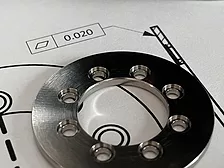
Quality assessments of parts often rely on a "yes" or "no" on a printed report, a "good" part versus "bad." However, advancements like 3D scanning allow engineers to visualize and analyze surface textures, revealing crucial insights beyond basic roughness values, which is vital for meeting increasing performance demands.
In Geometric Dimensioning and Tolerancing (GD&T) there has been a long-standing conflict between the worlds of specification and measurement. The goal of specification is to ensure that components will function; the goal of measurement is to ensure that manufactured components meet those functional requirements.
Specifications for surface texture frequently focus on surface “roughness”—the finer structures in the texture—often to the exclusion of the “waviness”—the larger structure of the texture. Unfortunately, problems related to sealing, vibration, noise, wear, etc., are regularly caused by issues hidden in the waviness domain, which cannot be captured by common roughness specifications.