Noncontact Inspection Keeps Pace with Production
Today, the optical comparator is a reliable factory stalwart that workers find easy to understand and use, whether on the shop floor or in the inspection room. But they are a far cry from the basic shadowgraph. The transition from purely observational optical measurement to direct digital analyses began about 20 years ago. Modern comparators are equipped with better optics, readout devices, software interfaces, geometric measuring capabilities and screens that range in size from 12 inches to 40 inches.
The first optical comparators, known as shadowgraphs, entered the factory when customers’ needs for identical parts became more critical. The shadowgraph presented a magnified shadow of a part that allowed easy comparison to an accurate profile of the part, usually in the form of an overlay. The operator would use a micrometer head to move the X- and Y-axes to approximate the horizontal and vertical deviation between the overlay and the part. Making note of any discrepancies, the operator went back to his machine, reworked the part and repeated the process until the part was within tolerance. It was essentially a simple go/no-go or pass/fail test.
Today, the optical comparator is a reliable factory stalwart that workers find easy to understand and use, whether on the shop floor or in the inspection room. But they are a far cry from the basic shadowgraph.
The transition from purely observational optical measurement to direct digital analyses began about 20 years ago. Modern comparators are equipped with better optics, readout devices, software interfaces, geometric measuring capabilities and screens that range in size from 12 inches to 40 inches. Light path options are offered in horizontal or vertical orientations, determined by the application. Today, many optical comparators are configured with optical edge detection. This greatly aids the operator because it is simple, repeatable and enables all operators to receive the same results.
The evolution of the optical comparator has accelerated in recent years with increasingly powerful digital readouts (DRO) and PC-based readout systems. There is even a new hybrid combining a comparator with a video adaptor creating a video-based measuring system that has the light transmission of a video zoom lens along with higher magnification beyond the range of comparators. In keeping with the optical comparator tradition, this hybrid is simple and cost-effective.
A manual vision system provides superior surface illumination and the flexibility of a zoom lens with magnification ranging from 10X to 240X. At one time, the manual vision system used a simple crosshair, cathode-ray tube (CRT) monitor and geometric readout. Those that offered edge detection required the use of complex computer systems. Today, however, video edge detection is a common feature and operators familiar with a comparator find the accompanying electronics and readout intuitive and easy to learn.
Popular features include the ability to grab images and archive them, add text and upload data to a flash memory device. In fact, the latest manual vision systems provide most of the capabilities found on computer-based systems without the longer learning curve and higher cost. Operators familiar with a comparator frequently find the manual vision system to be an easy and affordable step up in capability.
Growing production volume will inevitably require increased throughput and repeatability from the inspection process. With large batches, inspection often involves repetitive measurement routines that naturally lend themselves to automation. At the same time, increasingly tight tolerances may simply be incompatible with manual inspection and operator subjectivity. When inspection can no longer keep pace or accurately inspect complicated parts, an automated noncontact inspection process may be the answer.
For manufacturers with large batches of components, the inspection process also can be streamlined by arranging the work on pallets. The solution is in using fixtures to organize parts. By creating a fixture set-up in rows and columns, the offset between parts will be a known and constant size in both the X-and Y-axes. This information is used to program a measuring routine appropriate for the fixtured parts. For some applications, though, the fixture could be as simple as a right-angled plate against which parts are placed, one after the other.
Lighting, for example, is essential for obtaining optimum contrast. Quadrant lighting provides individual control over the angle and direction of the light source. Through-the-lens lighting is frequently necessary for height measurements and for seeing down blind holes.
Automated vision systems use video edge detection to automatically establish points. Some systems are now able to take up to 300 data points with the click of a mouse, to measure a feature such as a circle or a line. In 2-D scanning mode, the software can take up to 5,000 data points around the shape. The more data on the part, the more precise the comparison to the reference file.
For example, an operator using a traditional overlay to check parts can now import a 2-D CAD file, create a tolerance, and using a video tool, scan around the part and collect around 5,000 data points. Then the system automatically fits the points to the CAD profile and tells the operator whether the part has passed or failed.
This process is a little longer than the traditional way, but the operator is able to obtain infinitely more data for the comparison. The data points can be stored for future reference or inspections-something that cannot be done with the overlay method. For parts with very tight tolerances, accuracy may require the use of an automated vision system, some of which are capable of a working accuracy of less than 4 microns.
For example, medical instrument manufacturers are finding the inspection of small intricate parts, such as surgical blades and bone drills, has become so complex they require the magnification and accuracy of a vision system. Optical comparators are still used for many shop-floor inspections while vision systems are providing measurement repeatability and increased productivity in the quality control department.

The decision to go with a multi-sensing inspection system warrants careful analysis. Some parts are best suited to physical measurement using touch-probe inspection. Other more intricate parts with 2-D features, for example, are better suited for a vision system because of its ability to precisely find the part’s edge and take a large number of data points.
Then there are situations where assemblies can include both 2-D and 3-D features that require the capabilities of both the touch probe and vision system. This is where the multisensor inspection system becomes essential. It enables the operator to use the touch probe when it is most appropriate and switch to the vision system as necessary, treating the entire inspection in a single routine.
For accurate results, fixturing needs to be considered when using automated multisensor measuring systems. Correct fixturing is critical for producing reliable measurements. For example, different fixturing is required when making contact with the part via touch probe vs. vision or laser options that do not require contact with the part.
Totally automated inspection is becoming a reality today. Some vision systems, for example, can interface with pallet-loading robots. The vision system coordinates positioning the work stage, loading the work piece, measuring the part and calling on the robot to present the next part for inspection.
In the future, it may be possible to interface inspection with a pallet loading robot and the machining center so that systems can be used to measure, then visualize modifications and communicate the new offsets and dimensions back to the machining center. Today’s visual inspection goals will continue to be removing subjectivity from the production process, while improving accuracy, repeatability and throughput.
Noncontact measurement has evolved into a resource with many options designed to suit an array of applications. While the future relevance and use of optical comparators was once the subject of debate, shop-floor friendly comparators still have their place in the production area. Where illumination and magnification have become issues, the transition to a manual vision system is relatively easy and economical. And where throughput, speed, volume and repeatability issues loom, automated inspection systems are an ideal solution. Q
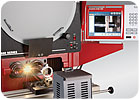
This optical-video adaptor for vision inspection capability uses graphic capabilities. Source: Starrett
The first optical comparators, known as shadowgraphs, entered the factory when customers’ needs for identical parts became more critical. The shadowgraph presented a magnified shadow of a part that allowed easy comparison to an accurate profile of the part, usually in the form of an overlay. The operator would use a micrometer head to move the X- and Y-axes to approximate the horizontal and vertical deviation between the overlay and the part. Making note of any discrepancies, the operator went back to his machine, reworked the part and repeated the process until the part was within tolerance. It was essentially a simple go/no-go or pass/fail test.
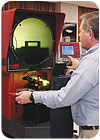
Today, the optical comparator is a reliable factory stalwart that workers find easy to understand and use, whether on the shop floor or in the inspection room. But they are a far cry from the basic shadowgraph.
The transition from purely observational optical measurement to direct digital analyses began about 20 years ago. Modern comparators are equipped with better optics, readout devices, software interfaces, geometric measuring capabilities and screens that range in size from 12 inches to 40 inches. Light path options are offered in horizontal or vertical orientations, determined by the application. Today, many optical comparators are configured with optical edge detection. This greatly aids the operator because it is simple, repeatable and enables all operators to receive the same results.
The evolution of the optical comparator has accelerated in recent years with increasingly powerful digital readouts (DRO) and PC-based readout systems. There is even a new hybrid combining a comparator with a video adaptor creating a video-based measuring system that has the light transmission of a video zoom lens along with higher magnification beyond the range of comparators. In keeping with the optical comparator tradition, this hybrid is simple and cost-effective.
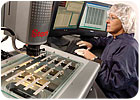
Workers find comparators understandable and easy to use, whether on the shop floor or in the inspection room. Source: Starrett
Stepping Up to Vision
While the comparator is a versatile measuring and inspection tool, it does have limitations when it comes to high surface illumination and magnification requirements. For these applications, the manual vision system is the next logical step up from a comparator.A manual vision system provides superior surface illumination and the flexibility of a zoom lens with magnification ranging from 10X to 240X. At one time, the manual vision system used a simple crosshair, cathode-ray tube (CRT) monitor and geometric readout. Those that offered edge detection required the use of complex computer systems. Today, however, video edge detection is a common feature and operators familiar with a comparator find the accompanying electronics and readout intuitive and easy to learn.
Popular features include the ability to grab images and archive them, add text and upload data to a flash memory device. In fact, the latest manual vision systems provide most of the capabilities found on computer-based systems without the longer learning curve and higher cost. Operators familiar with a comparator frequently find the manual vision system to be an easy and affordable step up in capability.
Growing production volume will inevitably require increased throughput and repeatability from the inspection process. With large batches, inspection often involves repetitive measurement routines that naturally lend themselves to automation. At the same time, increasingly tight tolerances may simply be incompatible with manual inspection and operator subjectivity. When inspection can no longer keep pace or accurately inspect complicated parts, an automated noncontact inspection process may be the answer.
For manufacturers with large batches of components, the inspection process also can be streamlined by arranging the work on pallets. The solution is in using fixtures to organize parts. By creating a fixture set-up in rows and columns, the offset between parts will be a known and constant size in both the X-and Y-axes. This information is used to program a measuring routine appropriate for the fixtured parts. For some applications, though, the fixture could be as simple as a right-angled plate against which parts are placed, one after the other.
Inspection and data collection efficiencies can be achieved with the combined productivity of a vision system and a palletized inspection method. Source: Ultrasource Inc.
The Need to See More
As parts become smaller and more intricate, the demands on inspection systems become greater. Higher magnification and better illumination underscore a basic, yet enduring principle for vision systems: If you cannot see it, you cannot measure it.Lighting, for example, is essential for obtaining optimum contrast. Quadrant lighting provides individual control over the angle and direction of the light source. Through-the-lens lighting is frequently necessary for height measurements and for seeing down blind holes.
Automated vision systems use video edge detection to automatically establish points. Some systems are now able to take up to 300 data points with the click of a mouse, to measure a feature such as a circle or a line. In 2-D scanning mode, the software can take up to 5,000 data points around the shape. The more data on the part, the more precise the comparison to the reference file.
For example, an operator using a traditional overlay to check parts can now import a 2-D CAD file, create a tolerance, and using a video tool, scan around the part and collect around 5,000 data points. Then the system automatically fits the points to the CAD profile and tells the operator whether the part has passed or failed.
This process is a little longer than the traditional way, but the operator is able to obtain infinitely more data for the comparison. The data points can be stored for future reference or inspections-something that cannot be done with the overlay method. For parts with very tight tolerances, accuracy may require the use of an automated vision system, some of which are capable of a working accuracy of less than 4 microns.
For example, medical instrument manufacturers are finding the inspection of small intricate parts, such as surgical blades and bone drills, has become so complex they require the magnification and accuracy of a vision system. Optical comparators are still used for many shop-floor inspections while vision systems are providing measurement repeatability and increased productivity in the quality control department.
This compact manual vision system features a live video camera feed. Source: Starrett
Noncontact measurement evolves
Successfully measuring complex parts requires the most suitable scanning method and the mathematical power to extract and compare key dimensional features. Today’s advanced vision systems are integrating video and laser scanning with touch-probe inspection. This creates a multisensing vision system capable of switching between methods, depending on the needs of the part. With these new systems the phrase used earlier-if you cannot see it, you cannot measure it-is no longer a concern because if the vision system cannot see it then the part can probably be measured using either a touch probe or a laser.The decision to go with a multi-sensing inspection system warrants careful analysis. Some parts are best suited to physical measurement using touch-probe inspection. Other more intricate parts with 2-D features, for example, are better suited for a vision system because of its ability to precisely find the part’s edge and take a large number of data points.
Then there are situations where assemblies can include both 2-D and 3-D features that require the capabilities of both the touch probe and vision system. This is where the multisensor inspection system becomes essential. It enables the operator to use the touch probe when it is most appropriate and switch to the vision system as necessary, treating the entire inspection in a single routine.
For accurate results, fixturing needs to be considered when using automated multisensor measuring systems. Correct fixturing is critical for producing reliable measurements. For example, different fixturing is required when making contact with the part via touch probe vs. vision or laser options that do not require contact with the part.
Totally automated inspection is becoming a reality today. Some vision systems, for example, can interface with pallet-loading robots. The vision system coordinates positioning the work stage, loading the work piece, measuring the part and calling on the robot to present the next part for inspection.
In the future, it may be possible to interface inspection with a pallet loading robot and the machining center so that systems can be used to measure, then visualize modifications and communicate the new offsets and dimensions back to the machining center. Today’s visual inspection goals will continue to be removing subjectivity from the production process, while improving accuracy, repeatability and throughput.
Noncontact measurement has evolved into a resource with many options designed to suit an array of applications. While the future relevance and use of optical comparators was once the subject of debate, shop-floor friendly comparators still have their place in the production area. Where illumination and magnification have become issues, the transition to a manual vision system is relatively easy and economical. And where throughput, speed, volume and repeatability issues loom, automated inspection systems are an ideal solution. Q
Tech Tips
- While the comparator is a versatile measuring and inspection tool, it does have limitations when it comes to high surface illumination and magnification requirements. For these applications, the manual vision system is the next logical step.
- Popular features on manual vision systems include the ability to grab images and archive them, add text and upload data to a flash memory device.
- Data points can be stored for future reference or inspections.
- Today’s advanced vision systems are integrating video and laser scanning with touch-probe inspection, thereby creating a multisensing vision system.
Looking for a reprint of this article?
From high-res PDFs to custom plaques, order your copy today!