Quality Measurement: May The Force Be With You
It's taught in high school or college physics class that force is an intimidating subject, filled with strange Greek letters, indecipherable formulae and insurmountable complications. In reality, the concept of force is quite simple. What all those complex-looking derivations and diagrams essentially boil down to is that a force is a push or pull acting on a body. Sir Isaac Newton said that every action has an equal and opposite reaction. In force testing, compressing or pulling on a sample will yield an equal and opposite reaction force. This force can be measured.

Why Measure Force?
The most common force experienced is the gravitational pull of the Earth on one's body. This is usually referred to as weight. Force as it applies to quality control is somewhat different, manifesting itself in many everyday activities, from opening a bag of chips, to honking the car horn, or even typing an e-mail. If it was difficult to open the bag of chips, choose a different brand the next time. Requiring too much effort to honk the horn presents a safety hazard. A keyboard with keys that are too difficult to press might tire the typist's fingers.Virtually any product or component that is probed, pushed, pulled or otherwise physically acted on should be force tested to ensure that it operates acceptably in its intended application. Force measurement is a broad term that can sometimes be used interchangeably with more specific terms such as pull testing, push testing, tensile testing and compression testing.

Types of Force Measurement
Force testing can be destructive or nondestructive, depending on the sample being tested. First, consider destructive tests. As an example, baseball players sometimes break the bat when they hit a ball. That break occurred largely because of a particular force, a value that is certainly of interest to bat manufacturers.In the aerospace industry, the trigger button to launch missiles from a fighter jet must require a particular amount of force to engage it. Being too difficult to press or too easy to press has a range of potential consequences. In the wire harness industry, manufacturers must perform terminal pull-off tests to ensure that terminals do not separate from wires prematurely.
Not all products have to be destroyed in order to be tested. A common nondestructive test is spring testing; specifically, measuring the compression or tension force of a spring at a specific displacement. After compressing or stretching a spring, it will return to its former shape unless its yield point has been exceeded. It is easy to think about situations in which springs with inappropriate force behaviors would be a problem. Just consider the feeling of riding in an automobile when the springs are too soft or too firm.
So how much force is good and how much is bad? Companies will typically adopt a standard, either from an organization such as the American Society for Testing and Materials, or through their own research, with which they gage the quality of their products. The standard will usually specify the test procedure and acceptable range of force for a particular sample.
After a force standard is adopted, requirements and specifications for the test, and the sample must be gathered and compared against the many models of force testing equipment available. Typical test characteristics to note are 1) expected maximum force; 2) sample dimensions; 3) number of tests per day; 4) data processing requirements; and 5) test procedures. After this information is collected, a force testing system can be configured. A typical force measurement system consists of:
-Force gage
-Test stand
-Distance meter
-Grips and fixtures

Force Gage
The basic force measurement instrument is the force gage. A force gage is a mechanical or digital instrument with a loading shaft and internal sensor that measures the force produced on it, usually measured in newtons (N). Other force measurement units also are commonly used, including pound, ounce, kilogram and gram. These units are technically considered mass units, not force units, but have been adapted into the force measurement lexicon.These instruments can be handheld or mounted to a fixture or bench during testing. Mechanical force gages had been widely used for many years until the advent of electronic force gages in the late 1970s. Electronic gages today measure with greater accuracy, higher resolution and better repeatability than their mechanical counterparts.
Electronic force gages vary widely in features and configurations, although most gages share such features such as peak or ultimate force recall, accuracy of better than ±1% of full scale and selectable units of measurement. More advanced gages can have a number of features useful for many applications. Some major features include:
-Serial communication. This allows force data to be sent to a PC, printer or other data collection device for further analysis. Manufacturers offer a range of simple and advanced software programs that will perform graphing and statistical analysis, or provide a vehicle through which data can be sent to common programs such as Microsoft Excel for further manipulation.
-Set points-ideal for go/no-go type testing. Set points allow the operator to specify the range of acceptable force for their test. Consider again the example of a spring test. A manufacturer may determine that Spring A must compress at a force between 90 to 110 newtons at a displacement of 1 inch. Set points in a force gage can trigger an indicator, buzzer or other device if the force is out of range, ideal for repetitive testing in high production environments.
-Data averaging. This feature comes in handy in applications with prolonged force that may vary over time. If a long strip of tape, for example, needs to be peeled off a surface, variations at certain points along the sample may require a changing amount of force. An averaging mode allows the operator to specify the length of time to take measurements, and computes the average force produced over that time. Another application for data averaging is friction testing, where one material is dragged across another material. Variations in friction may be present, and the operator may be interested in the average force over a specific amount of time.
-External trigger. A force gage can display the force at which an electrical contact was made, a common requirement for switch and keypad manufacturers.
Some force gages have built-in statistical processing capabilities and data memory made possible by advanced electronics. Force gages are available in a wide range of capacities, from as low as 0.5 newton full scale to 5,000 newtons full scale. In cases where it is difficult to read an instrument, or a test setup in which it would be dangerous or physically impossible for the operator to be in close proximity to the test area, remote force sensors are available. With remote sensors, it also is possible to measure far more force than with an integrated instrument.
Test Stand
A force gage can be mounted to another major component of a force testing system, a test stand. Test stands vary considerably in size, capacity, loading methods and sophistication. Test stands are useful because they regulate the speed of a test, thereby minimizing force variations caused by speed.

Distance Meter and Grips/Fixtures
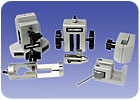
Some applications require the measurement of both force and distance, as in spring testing. Distance meters can be mounted to test stands. Some more advanced test stands have integrated force and distance displays.The last major components of a force testing system are grips and fixtures for securing the sample during a test. Many types of grips are available for various tests, however, not all applications and sample dimensions can be addressed. In cases where standard grips are not appropriate, companies often fabricate their own fixtures for use with force gages and test stands.
Economic Factors
Whatever the product or type of test, it is important that quality control managers have well-defined force measurement procedures. In today's hyper-competitive manufacturing environment, with some industries operating on razor-thin margins, manufacturing processes must be as streamlined and efficient as possible.
Additionally, with production facilities spread across the globe, it is important to establish procedures that can be replicated and repeated with ease, whether the operator is in Sheboygan or Shanghai. In new manufacturing facilities, particularly those in developing countries, effective force testing procedures can capture manufacturing defects soon after they occur, helping minimize costly product returns, recalls and brand damage.
So, the next time you get frustrated in a traffic jam on your way home from the office, or sit down to enjoy a snack, or start to type a memo, hope that "the force" is with you. If it is not, think for a moment how those experiences might be different if the products were not subjected to force measurement testing. Q
Tech Tips
-Force testing can be destructive or nondestructive, depending on the sample being tested.
-A force gage is a mechanical or digital instrument with a loading shaft and internal sensor that measures the force produced on it.
-A common nondestructive test is spring testing; specifically, measuring the compression or tension force of a spring at a specific displacement.
Looking for a reprint of this article?
From high-res PDFs to custom plaques, order your copy today!


