In-Process Gaging 101
The in-process gage controls size so you don’t produce scrap.
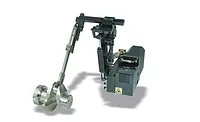
There was a time, not so long ago, when everyone knew that “in-process” gaging meant installing a jump-on gage on a grinder to tell the control when the workpiece was at size. That definition is still accurate, but only for one specific use of the technology. It doesn’t begin to cover the full range of “in-process” gaging applications at work today.
The difficulty arises over the definition of the word “process.”
Grinding certainly is a “process” and measuring size during the operation certainly is doing it “in-process.” But grinding may only be one step in a multi-step “process” that ultimately yields a finished part from a cell or other configuration of production machines. In that situation, any gaging operation performed anywhere between raw stock and finished part also can be legitimately called “in-process.”
While the first definition is more familiar, it is the second that is growing most rapidly today, driven by the relentless pressure for lower cost and higher quality. This makes the selection and application of the correct “in-process” gaging technology more challenging, but also makes the reward of getting it right much greater as well. But before proceeding, ask yourself this question:
Do You Really Need A Gage At All?
I know it’s an odd question coming from someone who makes his living in the gaging business. But, it’s also a legitimate question that everyone should ask before embracing a gaging “solution” to a manufacturing or quality challenge.
First of all, don’t buy a gage just to have a gage. The gage isn’t going to make a worn out machine work like it did when it was new; the gage is only as good as the machine it’s attached to. Have your gage supplier survey your machines before you start down that path.
On the other hand, if what you really have is an operator-related problem, or a machine that’s been “adjusted” until it no longer holds tolerances, then a gage just might offer a solution, IF it will work with the machine and control, and IF the machine can be returned to an acceptable condition.
Finding the answer to those questions usually requires close collaboration between the machine manufacturer and the gaging supplier. More about that in a minute, but if a gaging system really is the answer, here are some of the things you should consider in selecting it:
What Do You Really Need To Gage?
Start by analyzing the part and the process to determine which dimensions really need to be controlled in real-time and how that is best accomplished. In many cases, a machine-mounted pre- and/or post-process gage, teamed with an “in-process” gage will produce the most cost-effective solution.
Measuring the workpiece before it’s processed lets you optimize the machining operation to achieve minimum cycle time because you know exactly how much stock has to be removed. A pre-process gage also can provide orientation information to a robot or other part-handling automation.
The in-process gage controls size so you don’t produce scrap, and provides real-time control inputs to optimize the cycle. Depending on the specifics of the application, this gage may, or may not, be able to handle some of the operations described for the pre-process gage.
The post-process gage provides process-derived feedback to the machine control, input to the next operation, and statistical quality information to the control network.
Where Do You Put The Gages?
That’s not as simple a decision as it may first appear. For example, if the gage or gages are to be mounted on the machine, they have to be placed somewhere that does not interfere with any necessary operator access, automated load/unload operations, moving machine elements, guards, coolant plumbing, or anything else peculiar to the specific machine and operation.
As a practical matter, it is quite often easier and better to locate the “in-process” gaging stations that aren’t actually measuring real-time stock removal between the machines that are processing the part rather than on them.
If the gaging system is being installed on new machines, the OEM is the best source for advice on where and how to mount the individual gages and, even more importantly, how to interface them with the machine controls. As mentioned above, however, installing such a system on existing machines is an entirely different story.
Avoiding a Failure To Communicate
Beyond the mechanical issues discussed above, a retrofit also has to work electronically with whatever control system the machine is using. To paraphrase the warden in “Cool Hand Luke,” a failure to communicateis one of the greatest challenges to be overcome in retrofitting a gaging system to an existing machine. Specifically, getting the gage to “talk” to the control can be a major roadblock because old controls frequently utilize proprietary software that is both unsupported and obsolete.
Overcoming this kind of challenge requires experience, good tools, and often a lot of creativity. Any of the major gaging suppliers will have the necessary electronic tools to handle common interfaces like Discrete, FieldBus, and serial interfaces, and most can even accommodate discrete connections to really old controls. Really challenging applications may require use of an intermediate device, like a small PLC to perform signal conversion and data translation between the gage and the control.
Is It Really Worth The Effort?
Short answer: yes. Let me illustrate the benefits with a brief case history of a recently completed project.
A hydraulic pump manufacturer had been successfully producing precision components on a 1990s era grinder that had never been equipped with an in-process gage. As the machine aged, it required more and more operator attention and input to produce good parts. Quality, to a large extent, was determined by the operator’s experience level and attention to the process, and scrap rates were becoming unacceptable.
The manufacturer contacted us to supply a jump-on gage for the machine in the hope of reducing the scrap rate while avoiding the cost of a new machine. After analyzing the machine, we recommended that the owner contract with the machine OEM to modify it and bring it back up to specification prior to installing the gage.
Bottom line, the scrap rate went from unacceptable to virtually zero, while the need for skilled operator intervention was completely eliminated—all at a cost much less than replacing the machine.
Regardless of which definition one uses, in-process gaging is very much worth the effort when it’s properly specified, engineered and applied. It’s not a panacea, and it won’t make new machines out of worn out relics, but it will let you squeeze out every last bit of productivity your equipment can deliver.
Looking for a reprint of this article?
From high-res PDFs to custom plaques, order your copy today!