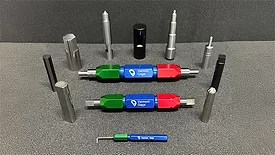
What is a custom gage? Is it a standard fixed limit gage made per ASME B47.1, or a modification of an existing design? Does the product require a new gage, a fixture, or a variable type gage? This article will explore modifications to existing plug gage designs and some special gage designs.
Gear inspection has significantly evolved since the early 20th century. What began as basic evaluations for high-precision gears in the 1920s has now become a complex field with standardized protocols and advanced technology. This evolution continues to transform quality assurance in gear manufacturing.
Integrated digital inspection ecosystems eliminate manual programming, accelerate reporting, and empower teams to act on live data before parts drift out of specification.
Speed and traceability are vital in fast-paced manufacturing. Automation and digital integration enhance inspection workflows by streamlining CMM programming, generating compliant reports, and enabling real-time quality monitoring.
Students at Ohio State's capstone program have led successful projects with various sponsors in manufacturing, service, healthcare, non-profit, and education. These projects create win-win outcomes, with sponsors reinforcing students’ learning and students driving positive change.
With ISO 21920 bringing a myriad of changes for metrology professionals, it is critical that all elements of the standard are understood for accurate measurements.
ISO 21920 introduces many changes for quality inspectors, engineers, and metrology professionals, requiring understanding of all standard elements for accurate measurements. The sections in the article highlight key parts and their practical measurement applications.
A simple cable or a wireless system? Each path has clear strengths, and neither is universally “better.” Understanding the tradeoffs helps quality engineers pick the proper setup for the job.
As parts become smaller, more complex, and increasingly performance-critical, traditional measurement tools are reaching their limits. The solution? A shift from tactile to optical metrology — and with it, from reactive troubleshooting to predictive quality assurance.
Cloud-based digital color management solutions improve communication of colors between brands and suppliers. They integrate all phases of color management—from creation to production assessment—through a single, effective platform.
Color in manufacturing is essential for product integrity and consumer trust, going beyond visual appeal to require measurable consistency. Despite improvements in measurement tools, many manufacturers face challenges with color variation, leading to rework and approval delays.
How new tools—including 3D laser scanning and probing devices—can help the industry innovate and adapt in an increasingly competitive (and tariffed) world.
The future of manufacturing belongs to companies that can move faster, train smarter, and deliver consistent quality with fewer barriers to finished results. One key method of achieving this coveted four-way win is adopting portable 3D scanning and probing technologies.
 RSS
RSS


dieSonne-114.webp?height=168&t=1753301600&width=275 "BrukerAlicona-FocusX (c)die Sonne")
.webp?height=168&t=1751673478&width=275 "Color reproduction on different substrates")