Quality Magazine logo
search
cart
facebook twitter linkedin youtube
  • Sign In
  • Create Account
  • Sign Out
  • My Account
Quality Magazine logo
  • NEWS
  • PRODUCTS
    • FEATURED PRODUCTS
    • SUBMIT YOUR PRODUCT
  • CHANNELS
    • AUTOMATION
    • MANAGEMENT
    • MEASUREMENT
    • NDT
    • QUALITY 101
    • SOFTWARE
    • TEST & INSPECTION
    • VISION & SENSORS
  • MARKETS
    • AEROSPACE
    • AUTOMOTIVE
    • ENERGY
    • GREEN MANUFACTURING
    • MEDICAL
  • MEDIA
    • A WORD ON QUALITY PUZZLE
    • EBOOK
    • PODCASTS
    • VIDEOS
    • WEBINARS
  • EVENTS
    • EVENT CALENDAR
    • IMTS
  • DIRECTORIES
    • BUYERS GUIDE >
      • Supplier Insights
    • NDT SOURCEBOOK
    • VISION & SENSORS
    • TAKE A TOUR
  • INFOCENTERS
    • Digital Quality Management Systems
    • NEXT GENERATION SPC & QUALITY ANALYTICS
  • AWARDS
    • ROOKIE OF THE YEAR
    • PLANT OF THE YEAR
    • PROFESSIONAL OF THE YEAR
  • MORE
    • Expert Columns
    • NEWSLETTERS
    • QUALITY STORE
    • INDUSTRY LINKS
    • SPONSOR INSIGHTS
  • EMAG
    • eMAGAZINE
    • ARCHIVES
    • CONTACT
    • ADVERTISE
  • SIGN UP!

Quality 101: Surface Finish Measurement Basics
September 1, 2004
quality 3

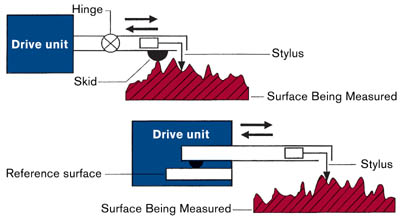
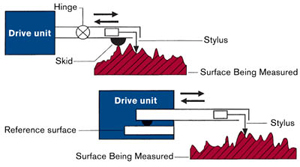
In skidded gages, the sensitive, diamond-tipped stylus is contained within a probe, which has a skid that rests on the workpiece. Skidded gages (upper) measure roughness only. Skidless gages (lower) use an internal precision surface as a reference. This enables skidless gages to be used for measurements of waviness and form, in addition to roughness. Source: Mahr Federal Inc.

CLICK TO VIEW LARGER IMAGE

Ever since E.J. Abbot developed the first surface finish tester at the University of Michigan in the 1940s, industry has been aware that roughness is an important characteristic of machined surfaces.

The growing influence of surface finish can be traced to dramatic changes in manufacturing specifications and drastic tightening of dimensional tolerances over the past few decades. As a result of these changes, the proportion of the tolerance range, which is taken up by surface irregularities, has increased from roughly 15% in the 1940s to nearly 50% in some cases today.

Surface geometry is measured for two principle reasons: to try to predict the performance of the machined parts, such as engine pistons and fuel injection parts, and to try to control the manufacturing process.

A surface consists of three basic components: form, waviness and roughness. On a turned part, form is the result of errors in the way the lathe produces a part, commonly known as straightness errors, and waviness is a result of various vibrations, both in the machine tool and from outside sources. Roughness, on the other hand, is the result of feed-rate tool geometry, tool condition, and variations in material and hardness.

There are two general types of surface-finish measuring systems: "skidded," measuring roughness only, and "skidless," evaluating form, waviness and roughness. In skidded gages, the sensitive, diamond-tipped stylus is contained within a probe, which has a skid that rests on the workpiece. Thus, skidded gages use the workpiece itself as the reference surface.

Skidless gages use an internal precision surface as a reference. This enables skidless gages to be used for measurements of waviness and form, in addition to roughness.

Because the three basic forms of surface geometry are caused by different factors and tend to have different relationships to the performance of the part, it is common to separate them during analysis. This separation is achieved by the selection of filter or cutoff settings that allow the operator to select the degree of filtering that will be applied to the measured profile.
 

quality 4

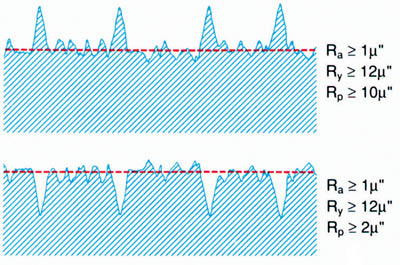
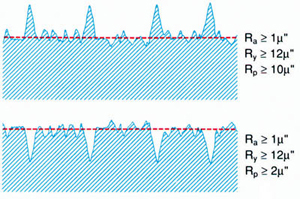
Here, two very different surfaces have the same Ra. Source: Mahr Federal Inc.

CLICK TO VIEW LARGER IMAGE

The irregularities of the machined surface consist of high and low spots created by the tool bit or by a grinding wheel. These peaks and valleys can be measured and used to define the conditions and sometimes the performance of the surface. There are more then 100 ways to measure a surface and analyze the results, expressed as parameters, but for most cases, only a few are specified. Each of the parameters has its own advantages and limitations. Often one parameter is incapable of defining a surface adequately. Therefore, a complete definition of a surface often involves two or more parameters, and in some cases, the relationship or ratio of one parameter to another.

The most common parameter is Ra, or Arithmetic Average Roughness. It basically reflects the average height of roughness component irregularities from a mean line. Ra provides a simple value for accept/reject decisions. It is a default parameter on a drawing if not otherwise specified, and is available even in the least sophisticated instruments. Ra is not a good discriminator for different types of surfaces as it is incapable of differentiating between "spiky" and "scratched" surfaces having the same Ra. Additional parameters should be specified for this purpose, such as Rp (Maximum Peak Height), Rv (Maximum Valley Depth) and Ry (Maximum Peak-to-Valley Roughness Height).

In Europe, the more common parameter for roughness is Rz, or Mean Roughness Depth. It is the average distance between the highest peak and the deepest valley in five sampling lengths, or cutoffs. Rz is more sensitive then Ra to the changes in surface finish because maximum profile heights, and not the averages, are being examined. There is no firm conversion between Ra and Rz parameters, as the actual ratio depends upon the shape of profile, but the approximate ratio of Rz = x4 - x7Ra could be used.
 

Surface finish measurement procedures, general terminology, definitions of most parameters and filtering information can be found in American Standard ASME B46.1 - 2002, Surface Texture, and in International Standards, ISO 4287 and ISO 4288.

Share This Story

Looking for a reprint of this article?
From high-res PDFs to custom plaques, order your copy today!

Recommended Content

JOIN TODAY
to unlock your recommendations.

Already have an account? Sign In

  • 2024 Quality Rookie of the Year Justin Wise 1440x750px banner with "Quality Rookie of the Year" logo inset

    Meet the 2024 Quality Rookie of the Year: Justin Wise

    Justin Wise is an exceptional individual who has been...
    Aerospace
    By: Michelle Bangert
  • Man with umbrella and coat stands outside while it rains at night looking at a building.

    Nondestructive Testing: Is there an ethics problem?

    I was a whistleblower who exposed fraudulent activities...
    NDT
    By: Dale Norwood
  • Unraveling Deflategate: Football stadium with closeup of football on field

    Unraveling the Tom Brady Deflategate

    The Deflategate scandal erupted following the 2014 AFC...
    Measurement
    By: Greg Cenker and Henry Zumbrun
Manage My Account
  • eMagazine Subscriptions
  • Newsletters
  • Online Registration
  • Subscription Customer Service
  • Manage My Preferences

More Videos

Sponsored Content

Sponsored Content is a special paid section where industry companies provide high quality, objective, non-commercial content around topics of interest to the Quality audience. All Sponsored Content is supplied by the advertising company and any opinions expressed in this article are those of the author and not necessarily reflect the views of Quality or its parent company, BNP Media. Interested in participating in our Sponsored Content section? Contact your local rep!

close
  • Key Takeaways for Quality Leaders
    Sponsored byComplianceQuest

    Key Takeaways for Quality Leaders from the 2026 Gartner Magic Quadrant™ for QMS

  • This image shows a person seated next to a Bobcat T66 compact track loader.
    Sponsored byPolyWorks by InnovMetric

    Supercharging Digital Gauging at Bobcat North America

  • Dorsey Calibration Lab photo by Tom LaBarbera Picture this Studios
    Sponsored byDorsey Metrology International

    Ensuring Product Quality in a Competitive Manufacturing Landscape

Popular Stories

This image shows a person seated next to a Bobcat T66 compact track loader.

Supercharging Digital Gauging at Bobcat North America

Dorsey Calibration Lab photo by Tom LaBarbera Picture this Studios

Ensuring Product Quality in a Competitive Manufacturing Landscape

a professional in the aviation field performing maintenance, repair, and overhaul (MRO) work

Manufacturing Retention: Strategies for Improving Company Culture, Engagement and Skill Development

2026 Quality Professional of the Year!

Events

June 22, 2026

Automate 2026

Automate is North America's largest robotics and automation event — and the best place to take your ideas from insight to impact.
 
Our show floor features the world’s leading automation solutions, from AI and robotics to motion control, vision systems, and more. Plus, our educational conference is second to none, led by the brightest minds in automation today.
 
Ready to transform the way you work? Take the next step at Automate.
July 14, 2026

Quality Leaders Forum: Better Communication, Better Quality Data

The Quality Leaders Forum is a quarterly, editor-moderated fireside chat series hosted by Quality Magazine, featuring candid conversations with senior manufacturing and operations executives shaping enterprise-level quality.

View All Submit An Event

Products

Lean Manufacturing and Service Fundamentals, Applications, and Case Studies

Lean Manufacturing and Service Fundamentals, Applications, and Case Studies

See More Products
Quality Podcast Channel Custom Content

Related Articles

  • Measuring circuit board surface roughness

    How Accurate Surface Finish Measurement Improves Product Life and Performance

    See More
  • surface finish measurement

    Using CMMs for Surface Finish Measurement

    See More
  • Figure 2: The MarSurf M410, a portable, skidless unit

    Ensuring Precision: A Guide to Calibration in Surface Finish Measurement

    See More

Related Products

See More Products
  • Measurement and Gaging DVD

  • Work Measurement DVD

See More Products

Related Directories

  • Dimensional Measurement Inc.

    Dimensional Measurement, Inc. (DMI) provides CMM inspection, Laser scanning/measurement, non-contact and surface finish inspection, fixture/jig certification, hand gages sales and certification, and CMM measurement/programming. Our CMM's are operating with PC-DMIS, OpenDMIS and PolyWorks software. Our on-site services include portable CMM and hand gage calibration. DMI is accredited to ISO/IEC 17025:2017 in dimensional testing and calibration. Email us your request at: [email protected] or call 248-960-8801
  • Surface Scan

    Professional 3D scanning, CAD, and 3D printing services across the UK. We offer in-house and mobile scanning using advanced equipment for metrology, terrestrial, and color capture. Our high-capacity print facility delivers fast turnaround on thousands of plastic parts. Trusted by engineers, manufacturers, and designers for precision, speed, and quality.
×

Stay in the know with Quality’s comprehensive coverage of
the manufacturing and metrology industries.

Newsletters | Website | eMagazine

JOIN TODAY!
  • RESOURCES
    • Advertise
    • Contact Us
    • Directories
    • Manufacturing Division
    • Store
    • Want More
  • SIGN UP TODAY
    • Create Account
    • eMagazine
    • Newsletters
    • Customer Service
    • Manage Preferences
  • SERVICES
    • Marketing Services
    • Market Research
    • Reprints
    • List Rental
    • Survey/Respondent Access
  • STAY CONNECTED
    • LinkedIn
    • Facebook
    • YouTube
    • X (Twitter)
  • PRIVACY
    • PRIVACY POLICY
    • TERMS & CONDITIONS
    • DO NOT SELL MY PERSONAL INFORMATION
    • PRIVACY REQUEST
    • ACCESSIBILITY

Copyright ©2026. All Rights Reserved BNP Media, Inc. and BNP Media II, LLC.

Design, CMS, Hosting & Web Development :: ePublishing