QUALITY MEASUREMENT: Fixturing Presents Quality Products
A diverse array of products, parts and components can travel through automated assembly lines. For any assembly line, there will always be the requirement of holding and fixturing these parts. Fixturing includes everything from conventionally machined, dedicated nests to more complicated variable systems that automatically adapt and accommodate the part currently being assembled.
Fixturing is essential for quality results. This is true of automated manufacturing including machining, welding, assembly and inspection. "With the inspection process, the fixture may be necessary to present the product to the automated in-line inspection equipment," says Jim Vander Wal, president of Omni Structures (Ada, MI). "While many inspection machines like CMMs (coordinate measuring machines), vision-based equipment and other testing devises can adapt to some orientation differences, there will be a higher level of accurate and repeatable measurements if the part is held in a similar manner."
Fixturing for in-line processing ensures that a part is being checked the same way every time. Without a fixture, there is too much operator dependence on getting the parts inspected accurately and efficiently. "This in-line process helps to ensure that parts are inspected to print and any potential problems can be seen ahead of a complete shut down of a cell or line," says John L. Ray, president of R&R Sales and Engineering (Grand Haven, MI). "In-line monitoring utilizing inspection equipment and fixturing will streamline a company to be more adaptive and to give real-time data to the customer during this process."
Fixturing is significant to many manufacturing sectors, but it is of particular importance to the automotive industry. Robert Ellig, president of Bluco Corp. (Naperville, IL) says that fixturing for the automotive sector is so important that the real battle for car sales success is not in a dealer's showroom, but on the manufacturing floor. "Quality sells," he says. "In order to ensure a quality product, steps need to be taken in manufacturing to control the process. Close fits and high-finish standards require the delivery of timely information on the process. This requires rugged, precise inspection fixtures and measuring instruments to generate this information."
Forms of fixturing
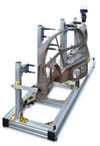
Fixtures can be as simple as a three-point stand. This is often just three blocks stabilizing the part for measurement. The part must be somewhat rigid to allow the measurement system to establish datums directly from the part.But this simplified version has drawbacks. "Some sheet metal and plastic parts cannot be fixtured in this manner because of their flexibility," Ellig cautions. "In these cases, the part needs to be held in body position with the fixture replicating the mounting of the part in the final assembly. Such fixtures are much more complex with multiple locating and clamping points, some of which must be removable in order to allow the loading and unloading of the part. These fixtures generally include tooling balls, which establish the datums. All measurement data extracted from this type of fixture reflect the geometry of the part as it would be mounted on a vehicle."
Advanced fixtures include staging functions that allow various levels of assemblies to be fixtured correctly as each element is attached. For example, a body side panel incorporates an outer skin, stiffeners of various designs and an inner skin. Each needs to be measured and the final assembly needs to be measured. One fixture with exchangeable features allows this to happen seamlessly.
In addition to geometry, it also is important to consider gap-and-flush values. "The fixture needs to incorporate reference surfaces that allow these measurements to be taken," says Ellig. "In some cases, different types of electronic measuring devices can be attached and directly wired to a network of computers for direct computation and immediate communication up and down stream."
Dedicated and modular
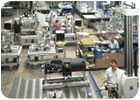
Dedicated fixturing is built according to the requirements of the manufacturing process. This is even true in processing lines where there are multiple, identical fixtures and a variety of operations. "To ensure consistent process results, each fixture must be the same," says Vander Wal. "Dedicated fixtures can be built within the constraints of the part and machined to consistent dimensions. Modular, or rebuildable fixturing, can be assembled and adjusted to hold a wide variety of parts, but even the best modular system may not hold everything. A few dedicated components will be required to complete the location and holding. As with everything, generally the more you put into the product, the better the results."Modular fixturing offers more flexibility for changeovers and future parts. It is universal and reusable. The fixture is built and left configured for the life of the part or process. When it is no longer needed for that part, then it can be made to fixture a different part. "Fixtures can be built that same day, unlike custom fixtures that will need to be designed and built-this can take weeks," says Ray. "Money is saved through reuse and by getting measurements in a process that much faster."
Vander Wal believes that with modular manufacturing fixturing there are two basic approaches to the accuracy of the holding system. "One design method is to have each component built to an accuracy that allows the assembly without the need to tune or adjust to get the final results," he says. "This method puts the expense into each and every component of the fixture with the desired goal that the fixture won't need adjustment to conform to the specifications."
He says the other method is to build sufficiently accurate components so there will not be any assembly difficulties and then adjust the holding components to the desired locations. Each method allows the opportunity to have an accurate and reliable fixture. "With the first option, the cost of accuracy is built in up front in each component, whether it is needed or not," Vander Wal says. "With the second option the accuracy is adjusted into each fixture. With option one, the cost is in the components; option two has the cost in the construction. With either option, there's a good chance that the final fixture will need some level of adjustment. This is true of dedicated, designed-to-the-task fixturing as well. Seldom will perfection appear on the first pass."
Getting customized
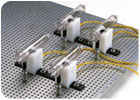
Customized fixturing is another option. It is the application of customized components to a dedicated fixture manufactured from modular components. "Having a full range of modular elements to choose from speeds the design and build process for an inspection fixture without compromising its function and the accuracy of its application," Ellig says. "When a dedicated fixture is planned using modular elements as the basis for design, most of the work has been done in advance by the engineers who designed the modular system."Locating and clamping points required of the part determine the selection of modular components for the fixture design. The customized elements are those that interface directly with the part. "Where surface contact is called for, a support element is machined to conform to the surface," Ellig says. "When it is mounted to the base fixture, it is measured on a large CMM and then tuning spacers in three axes are used to bring the part into a fixed, precise and certified location. There will be no concerns with unauthorized individuals tweaking the fixture, distorting the results."
Larger parts may be well suited for modular fixtures, but very small parts with multiples that need to be inspected may be better suited to custom fixtures. The complexity of a part or its holding and restraining requirements also dictate which fixturing type is best.
"Buyers should ask what is the best method to locate and hold parts and how many parts can fit on a fixture," says Lonnie Miller, project engineer at Advanced Machine & Engineering Co. (Rockford, IL). Alvin Goellner, sales manager at Advanced Machine & Engineering Co. agrees, saying that this is particularly true because there are now larger selections of workholding components used on a wider variety of machining centers.
In-line fixturing also includes gaging. In-line gaging can increase quality and decrease off-line inspection handling. It can also feed back into the machining operation valuable data that quickly adjusts product size.
Fixture buyers need to examine costs. "They should ask themselves if not using in-line fixture gages would increase the handling cost," says David Birdsall, president of Birdsall Tool & Gage Co. (Farmington Hills, MI). "They should also consider the quality requirements and the risks involved in producing poor-quality parts. In-line fixture gages are a time saver and lowers scrap rates in most applications. Usually the investment is minimal as a percentage of machine costs and handling costs."
It is important to invest in in-line fixture gages early in the product development phase. "Integrated fixture gages in the planning process can virtually eliminate scrapped parts and help machinery target the mean of tolerances," Birdsall says. "In most cases, this increased quality in machined parts for assemblies usually transfers into better long-term performance and a reduction in total cost of production."
Correct fixturing-whether it is dedicated, modular or customized-ensures the opportunity to build a quality product. Fixturing cannot compensate for a less-than-acceptable process, no more than the process can convert substandard materials into an exceptional product.
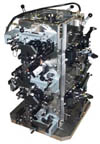
Flexible fixturing
Flexibility of today's fixtures depends on the expectations and demands of the customer. When the fixture manufacturer has a full range of locating and clamping elements in his system, flexibility is no problem. "In a support-based system, as opposed to a frame-based system, a master grid plate with a regular pattern of precision bores and tapped holes allows for the attachment of any number of fixturing elements," Ellig says. "The customer makes an investment in the master grid plate and then each new dedicated fixture is simply a single support element for each point on his part that needs to be located and clamped. These support elements also come with quick-change features allowing one fixture to handle both a two-door and a four-door side panel, for example."In spite of the full range of fixturing components available, one way to ensure flexible fixturing is to not overfixture parts. "Too many times parts are overfixtured to where the part itself can barely be measured and they do not actually measure the part and its primary datum structure," Ray says.
To ensure fixturing that can remain flexible and ensure quality, there are solid computer-aided design (CAD) systems that can design and verify custom workholding configurations for any type of part. The ability to see the solution before the design starts is beneficial-much better than just prints or 2-D data.
Future fixturing
In the future, fixturing will benefit from improvements in data storage, wireless technology, increased programming capacity and operator interface improvements. There will be more shuttle-based systems for ease and speed of inspections. Ray forecasts that robots could be used in a process to pick a part off its machining fixture, then place it into the inspection fixture. Vander Wal anticipates faster changeover with both modular and dedicated fixtures.As more problems are presented to the fixture builder, more solutions will be devised and overall quality will be aided. "If the knowledge gained in solving these problems is translated into unique modular elements, a more comprehensive modular component package will be available to both reduce the time to design a fixture, as well as to reduce the time it takes from concept to delivery," Ellig says.
For more information on the companies mentioned in this article, visit their Web sites:
- Advanced Machine & Engineering Co., www. ame.com;
- Birdsall Tool & Gage Co., www.birdsalltool.com;
- Bluco Corp., www.bluco.com;
- Omni Structures, www.omnistructures.com; and
- R&R Sales & Engineering, www.cmmfixture.com.
Tech tips
- In-line fixturing will benefit from improvements in data storage, wireless technology, increased programming capacity and user interface improvements.
- Advanced fixtures include staging functions allowing various levels of assemblies to be fixtured correctly as each element is attached.
- Locating clamping points required of the part determine the selection of modular components for the fixture design.
Links
Looking for a reprint of this article?
From high-res PDFs to custom plaques, order your copy today!