High-Volume Machines Slay the Variation Dragon
Now, however, with the help of a new breed of flexible rotary transfer machines that offer many of the benefits of multistation machining without some of the typical drawbacks, some shops are fighting back more effectively against variation. And while the variation beast can never be killed entirely, it is rearing its ugly head less often--in some shops, at least.
Among those most susceptible to variation problems are machine shops that deliver large volumes of parts to just-in-time manufacturing facilities in industries such as automotive and appliances. These shops must deploy machine tools that are agile enough to produce various parts in batches as the shops receive orders for them. Moreover, the systems must be flexible enough to run new jobs once the ever-shorter contracts common in industry today come to an end. Clearly, old-style, dedicated transfer lines that churned out the same parts day after day do not fit the bill.
For many machine shops, the strategy for offering agility at reasonable cost and risk has been to replace the dedicated machines with banks of machining centers. Another option is to insert machining centers into transfer lines. Many shops rely on a combination of both approaches.
These strategies do not come without tradeoffs, however. Although machining centers are flexible enough to cut any part that fits within their work envelopes, they are not as fast as dedicated transfer machines. Consequently, a number of them are necessary for each operation to create the required capacity.
Herein lies the quality control problem. Adding spindles increases the number of parallel streams in the production line, and more frequent changeovers multiply the number of setups. The opportunities for variation, therefore, also expand, because no two machines and no two setups can produce exactly the same part. Although diligence can keep the differences small and well within tolerance, the minute variation can be enough to complicate suppliers' efforts to adhere to the Six Sigma philosophy demanded increasingly by their customers.
The new hybrids
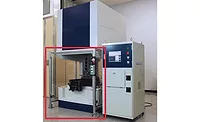
Technology advances eventually offer solutions to the problems that change brings with it. To make just-in-time production more compatible with the Six Sigma approach to quality control, some machine tool builders have developed a new breed of flexible rotary transfer machines that are essentially complete manufacturing cells made from three- to five-axis machining centers inserted into a common base. The rotary table at the center moves the parts from station to station, and a common controller coordinates all of the action. The result is a hybrid machine made by crossing the flexibility of a machining center with the economies of producing parts by transferring them among several spindles.
Among the advantages of these systems are fewer sources of error and simpler methods for controlling dimensional tolerances. Consequently, the accuracy and repeatability of these machines are typically much better than those possible from either conventional transfer machines or banks of machining centers. The reasons include fewer setups, automated material handling and software for error compensation. The rotary tables, the principal material handling device in these hybrid machines, fight error in various ways.
For one thing, they reduce the number of setups, which lessens the variation among parts that otherwise would occur when people or multiple material handling devices load parts into banks of machining centers. Automating parts handling among the sequence of operations and completing a part or a section of it on one machine without unclamping the parts eliminates an important source of stack-up error.
Despite the advantages, Arnold Jones, president of Kira America Inc. (Franks-ville, WI), a machine builder, urges engineers not to apply the single-clamping concept too slavishly. He points out that progressive clamping can be extremely competitive in mass production, as the Japanese demonstrated two decades ago when they were able to produce better cars at lower cost while moving parts manually from operation to operation. They had learned that the trick to controlling dimensions in high-volume sequential operations is to control the locating surface. "If each operation uses a unique fixture, you get the same result within millionths once you tune the station," says Jones.
He admits, however, that the need for a variety of fixtures can jinx the concept when several machining centers are performing identical operations in parallel. "You're going to have to deal with variation," he says. Minimizing the number of fixtures is one way of doing so, which is why his company also offers a hybrid machine, the Kira 4 Station CNC (computer numerical control) dial machine.
Minimize rechucks
David D'Aoust, vice president of machine builder Kaufman Manufacturing Co. (Manitowoc, WI), also recommends moderating the philosophy of chucking only once to one of rechucking parts as few times as possible. He notes that production volumes or part geometries often can preclude single-clamping operations. For example, one supplier to the automotive industry uses two of Kaufman's System 4 hybrid rotary machines to produce aluminum brake calipers. One machine performs Op 10, which is the machining of one side for locating the part for machining the other side in Op 20. "We grab the part only two times," says D'Aoust.
Jones points out another reason not to overemphasize single-clamping procedures. Unclamping parts sometimes boosts accuracy and repeatability, particularly when the machine is removing a large amount of material. "For any serious milling, unclamping is necessary to relieve stress," he says. "If you were to leave it clamped during finish machining, it would bow when it was released."
Relieving stress, however, does not necessarily mean unclamping parts, transferring them to another machine and relocating them there. Kaufman and other builders offer hydraulic and pneumatic distributors for their machines so that the CNC can vary the clamping pressure of the fixture at each station independently of the others. "We can chuck a part quite solidly during heavy roughing operations," explains D'Aoust. "When the fixture goes to the finishing stations where the chip loads are lighter, the CNC can reduce the chucking pressure."
Get a grip
The automotive industry uses this feature quite a bit for producing motor end shields and yokes for universal joints. "On the universal-joint yokes, the initial cross-drilling operation is done in solid forged steel, so you need a good grip on it," says D'Aoust about one application. "At the stations finishing the bore to size and putting in the snap-ring grooves, the CNC relieves the chucking pressure and lets the part relax." Otherwise the bore and groove will be shaped as an ellipse or have lobes once the pressure is relieved.
D'Aoust adds that the necessity of relieving stress depends upon three variables: the amount of material removed, the fragility of the remaining structure and the intensity of the clamping forces. "If you remove a lot of material, the part can spring out of shape," he says. "If you can't solve the problem by relieving the pressure, then you would have to put the part on another machine, relocating the part and rechucking it in an area that will not deform it."
Another way that the rotary tables on hybrid machines fight error is by being a simple transfer mechanism. Most no longer play a dominant role in the accuracy of rotary transfer machines, as they have in the past on conventional transfer machines. Rather than relying on the table and the position of each fixture on it, the locating accuracy comes entirely from coupling the fixture directly to the base of each machining center in the machine. The fixture typically fits into a Hirth ring or similar coupling mounted on the C-frame casting for each machining module.
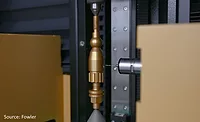
According to engineers at Hydromat Inc. (St. Louis), a rotary transfer machine builder, this design using the Power Chuck from Erowa Technology Inc. (Arlington Heights, IL), a workholding device supplier, gives Hydromat engineers' new Advanced Technology rotary transfer machine 2-micron locating accuracy, station to station. "The Erowa Power Chuck operates on the same principle as a Hirth ring coupling," explains Martin Weber, vice president of manufacturing at Hydromat. "A number of precision-ground teeth arranged in a 90-degree pattern engage and lock to provide clamping accuracy and rigidity."
Besides making the machine more accurate and less time-consuming and costly to build and set up, the Power Chuck system makes post-machining inspection simpler and more accurate because only one set of measurements is necessary. The part, or a portion of it, can come off the machine completed. This means that inspectors or automation gaging stations can check the forms, dimensions and locations of different features on the part against each other with much greater certainty than they can when required to check one feature several times to an unmachined surface. Moreover, checking the part once takes less time and often reduces the number of dedicated functional gages necessary for the job.
Software magic
Another advantage of designing the new hybrid machines from independent CNC modules is that the machines can use modern software algorithms for compensating for various types of error, such as the slight deviations in dimension caused by tool wear. Unlike the mechanical modules in conventional transfer machines, which are set manually, the CNC modules inside the new hybrid machines can respond on the fly to feedback from off-line measurement devices. Based on changes in dimensions, the program developed during process design can adjust the pertinent offsets.
For example, a process engineer might specify that the parts go to a coordinate measuring machine or gaging station immediately after coming off the machine, while they are still clamped in the same fixture used for cutting. By not unclamping it, shop personnel can get a true measurement on the part. Although many shops ask the operators to adjust the offsets manually from time to time, the open architecture of the PC-based CNCs running on some of the machines also gives users the tools to establish continuous, closed-loop feedback and make adjustments automatically.
Most hybrid machines use the same technique to compensate for the thermal growth that occurs naturally throughout the day, rather than adjusting offsets based on temperature measurements from thermocouples or resistance tem-perature detectors at strategic points inside the machine, as many machining centers do today. D'Aoust reports that, in one application, one of his company's System 2 machines holds tolerances within 20 microns while producing 450 parts an hour. Based on feedback from a gaging station, the CNC calculates the necessary offsets to compensate for thermal growth and tool wear and adjusts the motion of the axes accordingly.
Another use for compensation software is to account for the slight variations in the fixtures fastened to the pallets, much like the pitch-error and thermal-growth compensation found in many machining centers today. "Because the fixtures on the pallets can never be exactly the same, the CNC moves the tool a few tenths to compensate for those differences," says Jones. "We 'tune' the fixtures ahead of time, and the CNC remembers the offsets." Such tools give the machine ample weapons for slaying the variation dragon.
Looking for a reprint of this article?
From high-res PDFs to custom plaques, order your copy today!