Apples, Oranges and Surface Finish Parameters
Here's a question that is all too familiar to surface finish measuring equipment manufacturers these days:
"We received an order from a foreign manufacturer, and we are not familiar with the surface finish requirements on the print. They specify Rz and Rt parameters, but we use only Ra because our gage only measures Ra. Is there a correlation between Rz and Ra, and, if so, what conversion factor should be used?
Although Rz and Ra have similarities, the parameters are quite different, so engineers cannot directly substitute Rz for Ra any more than oranges could replace apples to make an apple pie. On the other hand, even if a limited number of surface finish parameters are in the cupboard, the customers' requirements must be satisfied.
Underlying Differences
As business becomes more international, equipment is often manufactured in one country, in accordance with local standards. The machine is then sold and used in another country where the standards are different. To add to the confusion, many global companies design the equipment in one country that uses one set of standards and build it in a country with a different set of standards. Because of this, those analyzing the prints may have to contend with the standards of the country where the equipment is designed, where it is manufactured, and where it will be used.
For an American company, coping with two or three different sets of surface finish standards is bad enough, but the situation is compounded by some users who have only a rudimentary understanding of parameters and procedures dictated by the company's own ASME Standard. Product designers, manufacturers and end users in Europe and Asia, governed primarily by ISO or national surface finish standards, are in the same boat; it's everyone's problem.
The basic difference between ISO standards, adopted by many European countries, and gaining acceptance in Asia, and the standards used primarily in the United States, is that the International Organization for Standardization (ISO) favors metrological purity. The ASME version, promulgated by the American Society of Mechanical Engineers, also favors metrological purity, but it leans toward more pragmatic results. If the finest, state-of-the-art measurement systems were used, then ISO standards would generate the most precise and repeatable results. Unfortunately, most medium- and low-priced skidded shop-floor gages are not built in complete accordance to the ISO standard's strict requirements. The U.S. standard is a broader document that focuses on the requirements of the measurements in the gaging lab and day-to-day shop-floor manufacturing. It defines parameters and measurement requirements that reflect practical implementation, both by the gage manufacturer and the user, and includes requirements for both "ideal" and "really practical" instruments. In the near future, the U.S. will adopt new standards that incorporate many features and parameters found in the ISO standard. However, the standards have significant differences in the way surface finish evaluations are typically implemented, and there are no plans to adopt the entirety of ISO documents as a future American standard. Because of this, reconciling the difference between the standards is vital.
Dangerous Assumptions
Manufacturing and quality control engineers, especially small machine-shop operators who can't afford to spend the money on high-end state-of-the-art systems, face a decision on accepting a part when the print requirements do not match the capabilities of the available gages. Some people assume that if a part is checked and passed using the parameter available, then it would pass other checks. In other words, they believe that a constant correlation or ratio between different parameters exists.
Converting Ra to Rz and Rz to Ra (DIN 4768-1978)
Some of them do correlate, but these cases require more than simply multiplying one result and a single conversion factor. The correlation, if there is one, is frequently more complicated than that. Before deciding what conversion factor to apply, understand what the specified parameter is really measuring. Is it height, wavelength, slope of surface irregularities or another part feature? Without this understanding, dangerous assumptions may be made. Here are a few examples.
- Historical parameter booby traps. Over the years, the definition of some parameters and the algorithms used to compute their values have evolved significantly. While the parameters changed, in some cases the symbol did not. Prints that are old or originated from different countries may specify parameters that look the same, but mean different things. A variation of this problem occurs in situations in which the parameter is defined in the same way, but the symbol was changed.
- Inconsistent conversion ratios. Sometimes correlation is possible, but the ratio may vary depending on the process used to manufacture the surface. This is the case, for example, when attempting to correlate Rq, which is root mean square roughness, and Ra, which is arithmetic average roughness. Many believe that the Rq-to-Ra ratio is 1-to-1. Some will say 1.11-to-1. In truth, the ratio could be anywhere from 1.11-to-1 to 2.10-to-1.
- Direction dependent conversions. The ratio could also depend on the direction of conversion, as is the case of Ra and Rz, when converting Ra into Rz is not the same as converting Rz into Ra.
Ra is the most specified U.S. parameter, and Rz is widely used in Europe. Ra averages all peaks and valleys of the roughness profile, therefore neutralizing the few outlying points so that they have no significant impact on the final results. Rz averages only the five highest peaks and the five deepest valleys, so extremes have a much greater influence on the final value.
Based on this understanding, a rule of thumb is if the manufacturer specifies and accepts the Rz parameter, but the customer uses the Ra parameter, the ratio Rz-to-Ra = 10-to-1 is pretty safe. However, if Ra is used as an acceptance criteria by the manufacturer, but the customer will use the Rz parameter to evaluate the part, then a safe ratio could be much higher than 10-to-1--sometimes as high as 20-to-1.
A Better Way?
Inadvertent apples to oranges comparisons can be avoided by making sure that the part designer, manufacturer and customer understand what a parameter on a print means and how various parties plan to check it. If the manufacturer or the customer uses conversion factors, then both parties should be aware of this and be comfortable with it. Good communication at the outset can avoid most surprises.
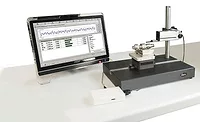
Unfortunately, as long as the disparity between surface parameters exists, there is always the prospect that incorrect assumptions will lead to unpleasant surprises. The problem has no easy solution, except to use equipment capable of correctly measuring all the parameters. Historically, this was a costly approach, particularly for shop-floor gaging. But instruments at lower price points that make accurate multiparameter measurements on the shop floor have been introduced.
If a system that makes apples-to-apples comparisons on the shop floor is not in the budget, the next best alternative is to use a multiparameter instrument to find a practical conversion ratio for a particular process once it is stable, and then use that ratio for conversion on the shop floor.
Alex Tabenkin is a surface finish and form metrology consultant for Mahr Federal Inc. (Providence, RI). He may be contacted at (401) 784-3288 or at [email protected].
RATIO OF ROOT MEAN SQUARE TO ARITHMETIC AVERAGE ROUGHNESS
Root Mean Square Roughness - Rq
Arithmetic Average Roughness - Ra
Theoretical Ratio of Sine Waves Rz-to-Ra - 1.11
Actual ratios of Rq-to-Ra for various processes:
Turning - 1.17-to-1.26
Milling - 1.16-to-1.40
Surface grinding - 1.22-to-1.27
Plunge grinding - 1.26-to-1.28
Soft honing - 1.29-to-1.48
Hard honing - 1.50-to-2.10
Electrical discharge machining - 1.24-to-1.27
Shot peening - 1.24-to-1.28
Practical first approximation of Rq-to-Ra
For most processes - 1.25
For honing - 1.45
'SKIDDED' VS. 'SKIDLESS'--WHAT'S THE DIFFERENCE?
Surface finish gages are available in two basic categories. In skidded gages, the stylus moves up and down relative to a pad, which is the skid, that is attached to the bottom of the probe that traverses along the surface of the part. Because the skid follows the general profile of the part, the stylus registers only higher-frequency roughness characteristics--in other words, tool marks. Thus, skidded gages are for roughness parameters only.
In a skidless gage, the probe moves relative to a reference surface inside the drive mechanism, so that the stylus is free to follow the full profile of the part, including low-frequency geometry characteristics such as out-of-straightness and waviness, as well as tool marks. Skidded gages may use either a velocity-sensitive or a position-sensitive transducer, while skidless gages use only position-sensitive probes.
Many skidless surface finish gages are capable of measuring up to 100 different parameters; most skidded gages can only measure a few. Mistakes can be made in purchasing, when a gage with inadequate capabilities might be selected in an unwise attempt at econ-omy. ASME B46.1 includes a useful chart that classifies surface finish gages according to their measurement capabilities.
While skidless gages were once used only in the lab, economical multiparameter versions are now being introduced for the shop floor. If putting skidless gages on the shop floor isn't feasible, a manufacturer may elect to maintain one skidless gage for manufacturing engineering and quality assurance purposes, while making several of the more economical skidded gages readily available to machinists. Once the process is established and confirmed on the skidless gage, machinists can use the skidded gages to measure parts for Ra or another roughness parameter, strictly as a means of ensuring process stability. This is often a practical approach to meeting surface finish specifications.
Looking for a reprint of this article?
From high-res PDFs to custom plaques, order your copy today!