Mirror Life Reflects Testing Extremes
When superstitious people break a mirror, they think seven years of bad luck. But when the test lab team at Schefenacker Vision Systems USA Inc. (Marysville, MI) breaks one, it usually means the company has verified the mirror will have a product life of 10 years or more.
As a global supplier of advanced technology exterior and interior automotive mirror systems, Schefenacker Vision Systems performs a series of “shake-and-bake” tests to help ensure the mirrors can tolerate the worst climate, terrain and conditions possible. Mirrors are heated to 100 C at 90% humidity and then frozen to -40 C, subjected to simulated rainstorms, heavy fog and harsh car washes, then encased in a dust environment and later saturated in a salt mist. They also are subjected to severe vibration, and some mirrors are literally pulled apart. Over a period of several weeks, the mirrors go through more severe treatment than most cars will in a lifetime.
Process control
The lab plays a critical role in new product development. When a program goes through the Design Verification Test Plan, simulated environments give preproduction samples the equivalent of 10 years on the road. More advanced than prototypes, they are subjected to environmental conditions that the production mirror will be expected to endure. Various applications and calculation procedures establish confidence and reliability levels. If any nonconformance is discovered during this design verification sequence, adjustments are made before the final tooling is complete.
Metrology
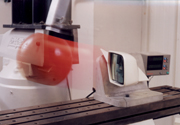
Prior to any environmental testing, metrology technicians check dimensional accuracy using coordinate measuring machines (CMMs). Generally a minimum of six pairs of mirrors are measured to ensure that case components are within the tolerances specified from the design group. The CMMs measure specific points including the opening, the location of attachment points, and the flush and gap along the edge to ensure proper fit to the car. Tolerances on surfaces that fit to a vehicle can range from ±0.5 to 1.5 millimeters.
Pretest measurements of electrically actuated mirrors include angular travel and speed of the glass movement. Each mirror is secured in a fixture and four probes attached to variable differential transducers rest against the glass. As the glass moves, data are fed into a computer workstation to determine whether a mirror meets OEM specifications for minimum and maximum speeds and degrees of movement for glass travel.
Measurement also determines the ‘effort’ needed to fold the mirror in toward the door. If the force is too great, a mirror may not fold out of harm’s way, such as when a vehicle is in a car wash. Yet if it is too little, a mirror could fold out of adjustment during highway driving. A correction to the mirror’s pivot design is sometimes necessary to bring a product within specification.
The pretest measurements serve two purposes. First, they allow the engineering group and quality group to be proactive by addressing any issues that may arise with meeting OEM specifications, and second, they establish a baseline to determine the amount of system or functionality degradation during and upon completion of a product’s cycle testing.
Destructive testing
Destructive testing is testing in which the part is rendered unusable to prove its strength. The Glass Pull-Off Test is an example. The test measures the force required to pull the glass out of the mirror, ensuring that the mirror glass does not separate from the housing except when encountering an extremely unusual force—such as a severe accident.
Another destructive test is performed using one of the lab’s two mirror impact testers. Each is a metal pendulum with a long arm connected to a massive ball, usually about the size of a softball, swung from above onto the mirror. One of these tests is conducted for testing DaimlerChrysler mirrors chilled to -22 C, and they are expected to survive the impact. The other is a European Regulation 46 Impact Tester used for certification of mirrors sold to European automakers or for vehicles exported to Europe.
Salt corrosion
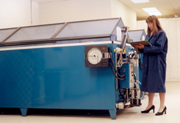
Salt corrosion takes a toll on mirrors. The expected damage from exposure to salt fog is primarily corrosion of metals, although in some instances, salt deposits may result in clogging or binding of moving parts. For these tests, two corrosion and humidity test chambers are used. With a capacity of 130 cubic feet, each chamber can test 44 mirrors (22 pairs) over a typical duration of 10 days. The lab also employs smaller chambers to perform these same tests. For corrosion testing, the chambers generate a mist that surrounds the samples with a fog that is a solution of 5% salt in purified water. Because salt corrosion is destructive testing, it is performed as a stand-alone test, using its own set of samples. One automaker’s specification requires the mirror case to be in salt corrosion for 240 continuous hours.
For most tests, including salt corrosion, the glass must continue to cycle electrically, simulating the driver working the adjustment control. To ensure proper cycling, not only is the glass monitored, so is the current draw (amperes). Some mirrors incorporate turn signals, some have approach lights on the bottom, while others incorporate power folding features. Regardless of the features and options, all must operate to OEM specifications.
Humidity, heat, temperature
The same test chambers described previously are also used for noncorrosive humidity testing to determine the resistance of equipment to the effects of exposure to a highly humid atmosphere. For this test, the chambers are usually set for 90% humidity at 100 F. This simulates a humidity fog typically encountered on a summer morning near the shore. Samples used to test performance in humidity may also go through hot, cold and other cycles.
While one type of testing simulates heavy fog, another uses water spray to simulate a heavy rainstorm or car wash. This test, designed for Ford, uses nozzles to spray the four corners of a mirror while its electrical operation performance is evaluated.
Although specifications for heat and cold vary from one automaker to another, they commonly require temperatures ranging from -40 to 100 C.
To perform these tests, two
microprocessor-controlled walk-in chambers measuring 8- by 8- by 10-feet are used. A typical test holds the temperature at -40 C for six hours, then goes to 65 C and is held constant for eight hours. These temperature shock tests are performed to determine the effect, if any, a sudden change in temperature might have on mirror operational performance.
Dust
Performance in dust is also tested in this chamber to ensure dust will not penetrate seals, clog openings, degrade electrical circuits or interfere with moving parts. For this test, cement dust of a particular grit size is circulated at a specified velocity, say 30 mph, typically for a 24-hour period. This enables the technicians to make sure that the test parts correctly work while exposed to the harmful particulate for the specified time period.
Vibration
A chamber dedicated to vibration analysis in hot, cold and humid environments, simulates how mirrors operate in different environmental extremes. These combined tests can help determine the nature and source of any issues early on, allowing engineers time to incorporate design changes prior to production.
To ensure no situation is left untested, one vibration test simulates a bumpy road. Samples are mounted in a fixture over a vibration table and tests are made using a laser that reflects light from the glass to a video camera. An analyzer determines how much the mirror vibrates relative to the amount of vibration in the vehicle itself. These tests are conducted on vibration machines that have a capacity of a maximum weight of 12.5 pounds reaching 100 g’s of acceleration. In addition to testing exterior mirrors, vibration tests are also run on interior mirrors for convertibles that mount to windshields not supported by a header.
Vibration tests for durability can last up to 20 hours. Following testing, the glass must still operate, the mirror head cannot become unhinged from the pivot point, the attachments must remain intact and the studs that hold the mirror onto the door must maintain a specified mounting torque.
Acoustics testing
When a mirror system passes the other tests, it is checked for quiet operation. A motorized mirror is set up in the anechoic chamber where a microphone records its sound as it is stepped through its motions. Software ascertains whether the mirror’s noise is acceptable—generally around 55 dB on an A weighted scale.
Mirror designs that pass this battery of tests continue in the development cycle. Later, just prior to a part going into production, it may be put through a Production Validation Test Plan to ensure continuing conformance to OEM requirements.
The environmental conditions to which the mirrors are exposed far exceed the conditions any mirror would encounter in a lifetime. OEMs and car owners alike can be confident that the mirror test lab helps ensure a product life cycle of 10 years or more in geographic regions ranging from the humidity and salt spray of Florida to the heat and sand of the Mojave Desert to the cold of the Yukon.
Tech Tips
1. The environmental conditions to which the mirrors are exposed far exceed the conditions any car would encounter in a lifetime.
2. If any nonconformance is discovered during the design verification sequence, adjustments are made before the final tooling is complete.
3. Although specifications for heat and cold vary from one automaker to another, they commonly require temperatures ranging from
-40 to 100 C.
Looking for a reprint of this article?
From high-res PDFs to custom plaques, order your copy today!