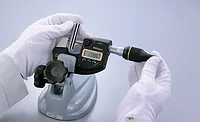
Micrometers: Tools of Choice

In many ways, the micrometer is the perfect tool. It is small, sleek and accurate and can slip into a shirt pocket or tool belt with ease. The micrometer is neck and neck with calipers as the most popular test, measurement and inspection tool in use today; this, despite the proliferation of new, advanced equipment that some might think would make the micrometer moot in modern manufacturing.
"Micrometers are relatively inexpensive and readily available to the industry," explains Michael Gabrenas, director of research and development for The L.S. Starrett Co. (Athol, MA). "Plus, users can easily be trained to operate them. Also, standard micrometers can typically fulfill the accuracy requirement for most applications. Add the fact that they are portable and easily modified for special applications and you can see why a micrometer is usually the first tool a machinist will reach for when taking a measurement."
Micrometers are often used on the shop floor to check length and outside diameters. Micrometers, however, can come in many shapes and sizes, some as big as 10-feet across, and have specific uses ranging from inside micrometers, micrometers with dial comparators, special faces, thread micrometers, depth micrometers and other tool types.
Accuracy and resolution depend on the size and type of micrometer.
"For the popular mechanical micrometers with ranges up to 4 inches or 100 millimeters, the industry standard for accuracy is ±0.0001 inch or 0.002 millimeters," says Gabrenas. "Resolution can be 0.0001 inch, 0.001 millimeter, or 0.001 inch, 0.002 millimeter."
Through the years, this venerable tool has gotten better, says Gabrenas. "Early English reading micrometers had resolutions in fractions of an inch or 0.001 inch," he says. "The early metric reading micrometers had resolutions of 0.01 or 0.02 millimeters. As the use of the micrometer increased, the vernier reading sleeve was added to magnify the resolution by 10 times. Micrometers then had resolutions of 0.0001 inch and 0.001 millimeters. With the finer resolutions, the manufacturing practices had to be refined to obtain accuracies equal to the resolution. As manufacturing processes continued to get better, the micrometers' resolutions remained the same, but the accuracies improved. Some micrometers now offer accuracies of 0.00005 inch and 0.001 millimeters."
In terms of digital vs. an analog micrometer there is not much difference in accuracy, but there is a difference in resolution. "The displays on most digital electronic micrometers ranging up to 4 inches resolve to 0.00005 inches and usually the accuracy is equal to twice the resolution or 0.0001 inch," says Gabrenas. "Typically, analog or standard mechanical micrometers with vernier graduations on the inner sleeve have resolutions as fine as 0.0001 inch or 0.001 millimeters. Stated accuracy can be 0.0001 inch/0.002 millimeter.
Repeatability can be an issue when more than one person is measuring a part, say Gabrenas and Michal Grosenbach, product specialist for Mitutoyo America Corp. (Aurora, IL). "One good way of improving repeatability," says Grosenbach, "is to make sure that all the employees are trained to use the micrometer so that everytime they measure the part they do the exact same thing. Also, there is a certain amount of momentum as the micrometer clamps down on the part. To slow the spindle down before it comes to the part, and so the reading is accurate, can be accomplished with a micrometer that features a ratchet or friction thimble."
Accuracy and repeatability might also be affected by thermal expansion caused by temperature variations. While coolant is probably running at 20 C to keep the part at a certain temperature, there could still be expansion issues because of the body's own heat, says Grosenbach. "The body is at a pretty high temperature, and the part should be 68 degrees and that difference can change the reading because of the flex of the micrometer frame. If not working with coolant, thin cotton gloves can keep the heat from the hands from traveling to the micrometer."
Shop-floor tough
Many of today's micrometers are rated for use in dusty and wet environments. Mitutoyo released its IP65-rated Coolant Proof Micrometer that also features a redesigned output cable that keeps the IP65 rating even in these hostile conditions.The IP rating system was developed by the International Electrotechnical Commission to rate tool products. Under the IP classification, a tool has a Class 6 rating for foreign matter, which indicates that the tool is protected against the entry of any dust or larger particulates. The Class 5 water protection rating means that the micrometer is not subject to adverse effects from direct jets of water dousing it from any direction. This represents a more protected tool than a IP-54 rated tool that carries a Class 5 rating, which states that it will prevent most dust, and a Class 4 rating which means that it can be used around splashing water.
"A lot of times the workers have liquid dripping from their hands after dealing with the part and you don't want that liquid to get into the micrometers electronics and damage the tool," says Grosenbach. "Dust can be bad as well. There was one application where the company made ceramic and porcelain parts and very fine dust would be created. If that fine dust gets into the tool, it can wreak havoc upon it." Q
Sidebar: Tech tips
• The industry standard for accuracy for mechanical micrometers with ranges up to 4 inches or 100 millimeters is ±0.0001 inch or 0.002 millimeters.• Resolution can be 0.0001 inch (0.001 millimeter) or 0.001 inch (0.002 millimeter).
• Repeatability issues can be overcome by using micrometers with ratchets or
friction thimbles.
• Micrometers are now available that are tested for use in dusty and wet environments.
Sidebar: Micrometer Construction
Whatever the configuration, each micrometer is made up of the following basic components:• The steel frame, which is either forged, cast or machined.
• The anvil, which is pressed into the frame as a positive stop.
• The spindle, which is the core of the tool and is available with a hardened steel surface or with a carbide or diamond film coating. The spindle has threads that are ground into the hardened and seasoned shaft.
• The stem, which has internal threads lapped to mate with the spindle.
• The graduated sleeve.
• The thimble.
• The locknut, the style of which will vary by manufacturer. Some locknuts act to push sideways against the spindle, others surround the spindle and cause it to stop spindle travel. Both styles are designed to hold the reading so that it can be more easily viewed.
• The binding ring is attached to the instrument's stem and can be adjusted to compensate for thread wear and rotation friction.
• The ratchet or friction thimble. The main difference is that the friction thimble allows more positive repeatability than the jackhammer action produced by the ratchet. Digital micrometers are typically supplied with a friction device, because the fine resolutions of 0.00005 inch are sensitive to the ratcheting action.
Source: The L.S. Starrett Co./Quality archives
Looking for a reprint of this article?
From high-res PDFs to custom plaques, order your copy today!