Quality Management: Strategic Management of Lean
The biggest mistake made by companies considering the use of lean manufacturing is to jump into the water without a strategically focused plan. That might be OK for an Olympic swimmer, but most organizations end up doing the dog paddle and are eventually worn out and decide it is just too difficult to achieve-ignoring or aborting the initiative. In some cases, they may drown. This results in wasted time, energy, credibility and money for an organization.
Many a lean transformation has failed because management failed to establish a strategic plan for implementing it. So why do these companies attempt to use lean as a strategic improvement methodology? It could be that a major customer has requested, or even demanded, that lean be used as a condition of continuing business. Or, it may be that the company has been searching for a methodology to reduce costs and improve the bottom line. Or, it may be that management has made the decision because “everyone else is doing it.” The right reason for going on the lean journey, however, is to achieve strategic results for the organization.
Regardless of the reasons for choosing lean, a company must establish a strategic plan to guide management through this fast-paced strategic improvement transformation, which can dramatically improve customer satisfaction, employee morale and the bottom line. Without a plan in place, along with a strong understanding of lean and the commitment needed for rapid cultural change, most lean initiatives will stumble during the early stages and may fail completely. In order to establish an implementation plan, a company should consider five steps.
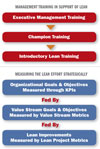
Management Understanding and Commitment
The first step in developing and implementing a solid strategic plan is to get the commitment of the organization’s executive management team. Without unanimous commitment, it is far too easy for members of management to avoid their responsibilities for driving change and not make the tough decisions needed to keep the lean initiative moving forward quickly. This commitment starts at the very top of the organization and must be spread throughout the entire management team, from the top down. The president, owner or chief executive officer must demonstrate this commitment every day, in action as well as words.Lean relies heavily on the total involvement of all employees. For most organizations today, that requires a major cultural change. Managers’ roles change dramatically, in respect to process improvement during a lean transformation. They must subscribe to the team concept, listen to what lean project teams have to say and support the changes these teams make. Without this change in both attitude and roles, it is difficult to engage the workforce in the lean effort.
Management, from the top company official down to the front line supervisor, must understand what lean is, what it can do for the company, what their role is and how results can be maximized. The greatest struggle in the quest to achieve cultural change comes from within management. That is where the greatest resistance lies, not from front-line employees. These human roadblocks, as they are often called, are driven by fear, reluctance to give up their perceived power or their lack of the soft skills required to supervise the workforce.
To combat this problem, a company should conduct introductory lean training for all levels of supervisors and management before launching an organization-wide lean initiative. In addition, Champion Training for key management personnel can instill a tremendous amount of knowledge into these management champions, which is necessary to combat resistance to change and encourage teams to continue their efforts at long-term process improvement. Some companies take the extra step of educating their executive management team as to their role as high-level champions to ensure that the effort is tirelessly lead from the top.
Alignment with Strategic Goals and Objectives
Step two requires aligning the initiative with the strategic goals and objectives of the organization. By understanding these goals and objectives as well as the key performance indicators (KPIs) used to measure them, it is possible to align the lean effort to maximize results, both culturally and financially.Without this alignment, it is much easier for project teams to lose sight of why companies conduct process improvement in the first place and to attack only the simple problems in the company. This, in turn, may hinder the cost savings, cost avoidance or increased throughput necessary to pay for the project.
Top management must determine what value streams to attack and in what order, how the overall initiative is rolled out and how fast the lean effort is spread throughout the organization. This rollout approach, coupled with strategic alignment to goals and objectives, provides overall guidance to various departments, divisions or value streams as their sub-plans are created.
Developing a plan to eliminate waste from within a value stream requires the champions and managers to stay focused on the overall KPIs. While developing this value stream plan, the managers involved must develop their own goals, objectives and metrics, which are used to show the progress of their lean efforts. These metrics should feed the KPIs. While they might be exactly the same metrics, they might also be multiple measurements, that when combined, feed into a KPI.
Then, as each lean project is implemented, the project metrics should likewise feed back into the value stream goals and objectives. Through this seamless transition of metrics from the project level all the way up to the organizational KPIs, managers at all levels, as well as front-line employees, can quickly determine how successful the lean initiative is and what impact it is making at any given time.
Train the Work Force
Step three requires training the work force. There are just as many opinions about how to teach employees to use lean tools and concepts as there are books explaining how to implement lean manufacturing. Many organizations have achieved excellent results after providing in-depth introductory training to all employees over a relatively short period of time. These organizations begin implementation in selected areas of the company after all employees in those areas have been trained. The only drawback to this strategy comes about when no lean improvement work is conducted for an extended period after training has been completed. The danger here is that employees may view the entire lean effort as the flavor of the month and lose confidence in the concept.Other companies have provided this same type of in-depth training to each area or department just before starting improvement work. Perhaps the most powerful way to spread the lean concepts, this procedure can be expensive; however, because of the fast return on investment (ROI) of lean, the invested cost is recovered quickly.
A similar strategy often used is to provide introductory training to key floor employees using either one of the previous methodologies, then the remainder of the work force will receive training as they express an interest in learning more about lean.
While some organizations opt to provide only the barest of lean overview training to employees as they are assigned to project teams, this is not the recommended training regimen because it places much more power and stress on the project facilitator.
Regardless of which of these work force training strategies is used, it is still possible to obtain excellent results after the lean implementation is started. The key is to provide some level of lean training to all employees. Without it, management will face unnecessary cultural struggles and slower results throughout the early stages of implementation.

Develop Lean Managers and Lean Facilitators
Step four is to develop lean managers and facilitators who have the skills necessary to manage the overall initiative as well as successfully run lean projects or Kaizen events. With qualified staff running the day-to-day lean initiative, a company can successfully navigate the hazards of lean implementation that other process improvement efforts do not confront, with little difficulty.In addition to formal classroom training, managers and facilitators need mentoring from an experienced Lean Master, or Sensei. Because the cultural shift from traditional project management to lean implementation is so dramatic, new lean managers and facilitators need a support system-one that will help overcome the difficulties encountered while gaining the necessary experience for successful implementation.
Support Project Teams and Let Them Work
For many managers, step five may be the most difficult part of the entire transformation. A manager in a lean organization must stand back and support lean project teams as they focus on waste elimination and process improvement. While the natural tendency of most managers is to vocalize their thoughts and opinions and lead their employees in process improvement efforts, this is not how managers should support lean efforts. If they are on the project team, these managers are team members; they have the same rights and responsibilities as any other team member…one person, one vote. If they are not on the project team, their role is to listen, provide input when asked and allow the team to conduct its project work without interfering.
However, the passive role of managers during project work does not eliminate the veto factor. Someone must have the authority to say no for legal, financial or safety reasons. In order to use this veto power correctly, the manager must provide a challenge to the team along with the “no.” The manager must challenge the team to find a legal way to make the change, a less expensive way to accomplish the change or a method that is safe.
Start with a Strategy
By developing a strategy and providing the appropriate training, companies can successfully implement lean manufacturing. Lean does require bottom-up implementation. Without a good plan and a team of managers that thoroughly understands its roles and responsibilities in regards to the transformation, the initiative may be faced with delays, disbelief by the work force or even failure. By starting out with the ultimate goal in mind, the organization will be well prepared to implement a strategically focused plan to achieve a successful lean implementation. Q
Mark A. Nash is a lean specialist, certified NIST MEP Lean trainer and managing director for Argent Global Services (Oklahoma City, OK). Sheila R. Poling is a managing partner of Pinnacle Partners Inc. (Oak Ridge, TN). For more information, call (405) 848-1682 or (865) 482-1362, or visit www.argentglobal.com or www.pinnaclepartnersinc.com.
Tech Tips
• Many a lean transformation has failed because management failed to establish a strategic plan for implementing it.• Regardless of the reasons for choosing lean, a company must establish a strategic plan to guide management through this fast-paced strategic improvement transformation.
• The first step in developing and implementing a solid strategic plan is to obtain the commitment of the organization’s executive management team.
• In addition to formal classroom training, managers and facilitators need mentoring from an experienced Lean Master.
• A manager in a lean organization must stand back and support lean project teams as they focus on waste elimination and process improvement.
Looking for a reprint of this article?
From high-res PDFs to custom plaques, order your copy today!