Case Studies: Pushing the Envelope in Press-Fit Monitoring
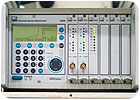
Software in the HBM amplifier provides for 100% traceability, protecting both Dana and BMW.
Source: Dana Corp.
Source: Dana Corp.
In automotive powertrain assembly, as goes the bearing press fit, so goes the torque. That is why Dana Corp.’s Traction Products Group monitors bearing press fits so carefully in their differential plant in Orangeburg, SC.
In a 24/7 operation that turns out about 800 BMW differentials a day, the plant has one of the highest quality ratings and lowest return rates among differential plants around the world. Construction on the plant began in 2002. It went fully operational in April 2004 with separate machining and assembly lines for front and rear differentials.
Advanced press-fit monitoring takes place on both assembly lines. “Both BMW and Dana see a direct relationship between accuracy of bearing press fits and performance of the differentials on the torque test downstream, and out on the road,” says Mike Parlin, plant engineer. “So it makes sense to monitor that process very thoroughly. In fact, BMW requires proof that all press fits are to a specified force.”
The front differential has four bearings and one seal that are press fit into place in a 4- to 5-second cycle for each. The rear differential has three press fits. All press fits are 100% monitored in line using the same basic HBM Inc. (Marlborough, MA) test cell, which adds up to 6,400 press fit tests a day.
Each press-fit test cell simultaneously monitors location and force on the bearing as it is pressed home. BMW specified HBM test cells based on previous experience, so systems integrator MURI followed through when they built the assembly lines, but with advanced displacement sensors.
The Relationship Matters
“Unlike most in-line tests, monitoring a press fit is a dynamic test,” explains HBM’s engineering manager Stephen Webb. “The parameter of interest is the relationship between force and displacement over time.” For the part to pass, the force-displacement curve must fit within set limits at 200 points over that brief cycle, not just at the end point. A sudden rise in force indicates bottoming. If the force does not rise at exactly the right point, it means that the bearing seat machined into the differential body is not right. Over the cycle, forces range from 0 to 15,000 Newton-meters.Thus each press-fit test station consists of a highly advanced HBM type WA quarter wave displacement transducer and an HBM force transducer mounted to the press ram. Both inputs feed to an HBM MGC plus test amplifier specially designed for press-fit monitoring. The amplifier screen displays the actual force-displacement curve and the “windows” through which it is supposed to pass. If the curve passes through all 200 windows, the part passes. If not, it is returned for rework. To pass, forces must be within 3% of nominal over the whole cycle and displacement must be accurate within 0.003 inch.
Unlike conventional half-wave displacement transducers, the WA series quarter wave transducer serves as one leg of a Wheatstone Bridge and works on the principle of an active inductive quarter bridge. The result is a displacement transducer with a characteristic curve flat within 0.1% over the entire measurement range.
For a variety of reasons, including compactness and higher accuracy, these newer types are replacing half-wave displacement transducers and LVDTs in the kind of medium-technology, medium-cost applications at Dana. A key application has been measuring piston position over long strokes in hydraulic systems.
Noise Immunity
“For each press-fit test, we’re collecting 200 data points inside of 4 to 5 seconds,” says Dana test engineer Henry Retamal, “and in an industrial environment with hundreds of interference sources. There is a high risk of false positive readings. Mainly for this reason, we specified HBM test equipment. The sensors and amplifiers are filtered and ruggedized to be virtually immune to extraneous interference.”With the MGC plus screen displaying the curve and “windows,” Dana line personnel can diagnose parts right on the spot. “This has not only avoided countless slowdowns, but also empowered our people and helped make them partners in the overall quality effort,” says Retamal. Nobody needs to call over a process engineer to make a judgment call. Software in the HBM amplifier provides for 100% traceability, protecting both Dana and BMW.
Despite the challenges inherent in press-fit monitoring, the test stations at Dana-Orangeburg have proven so stable that the periods between calibration checks can be extended from once a month to once a quarter.
Farther down both assembly lines are compact, torque-testing stations. They are built around compact HBM type T-10 torque sensors, 12 inches shorter than conventional barrel-type torque sensors. “With two or three torque sensors on each station, the space savings are significant,” says Parlin. “Stability is better as well. Readings remain virtually unchanged from calibration to calibration.”
New Principle
The HBM T-10 torque flange uses shear stress as a measure of torque, a measurement principle for which HBM has made a patent application. It also transmits the signal to the DAQ module by telemetry rather than by mechanical slip rings, so there are no electromechanical parts in the electronics circuit to wear out or go out of adjustment-a common failure mode with conventional torque flanges.The reason for such testing accuracy is the extreme torsional stiffness of the T-10 torque flange, both radially and axially. “From a measurement resolution standpoint, the torque flange functions as a pure rigid object in the testing system, eliminating several sources of system error,” explains Webb. Linearity of the torque flanges is 0.05% or better, essential for efficiency computations on drive components.
“This telemetry-based torque testing system has proven extremely stable,” adds Retamal. “We’ve never had to stop production due to failure of the torque flange or amplifier, as we would with slip-ring-type torque flanges. And even when we swap out these flanges and modules for semiannual calibration, they’ve literally never needed adjustment.”
The torque modules are hardened to withstand harsh plant environments and accommodate articulated shafts. They need less structural support than slip-ring-type torque sensors.
Measuring 3-inches long, the T-10 torque flange creates a shorter load train, saving valuable space on the test rig-and the plant floor. Conventional barrel-type torque sensors measure 1 foot or longer.
Torque testing at Dana is straightforward, completed in a 30-second floor-to-floor cycle. The operator loads the part into the test fixture, engages the torque sensors and preload motor on the drive shaft, and starts it up. The acceptable deviation is only 4 to 5%, tighter than industry norms.
“We can see a clear relationship between press-fit quality and torque test results,” says Retamal. “I believe that controlling the press fit as tightly as we do is one key to being able to hold the tolerances on torque that we do.”
HBM Inc.
(800) 578-4260
www.hbm.com
Reply 14
Sidebar: Benefits
- Despite the challenges inherent in press-fit monitoring, the test stations at Dana-Orangeburg have proven so stable that the periods between calibration checks can be extended from once a month to once a quarter.
- From a measurement resolution standpoint, the torque flange functions as a pure rigid object in the testing system, eliminating several sources of system error.
- Dana Corp. has never stopped production because of failure of the torque flange or amplifier, as they would with slip-ring type torque flanges.
Looking for a reprint of this article?
From high-res PDFs to custom plaques, order your copy today!


.webp?height=200&t=1705603301&width=200 "Automated Tensile Testers ZwickRoell Circa 1988")