Quality Magazine logo
search
cart
facebook twitter linkedin youtube
  • Sign In
  • Create Account
  • Sign Out
  • My Account
Quality Magazine logo
  • NEWS
  • PRODUCTS
    • FEATURED PRODUCTS
    • SUBMIT YOUR PRODUCT
  • CHANNELS
    • AUTOMATION
    • MANAGEMENT
    • MEASUREMENT
    • NDT
    • QUALITY 101
    • SOFTWARE
    • TEST & INSPECTION
    • VISION & SENSORS
  • MARKETS
    • AEROSPACE
    • AUTOMOTIVE
    • ENERGY
    • GREEN MANUFACTURING
    • MEDICAL
  • MEDIA
    • A WORD ON QUALITY PUZZLE
    • EBOOK
    • PODCASTS
    • VIDEOS
    • WEBINARS
  • EVENTS
    • EVENT CALENDAR
    • IMTS
  • DIRECTORIES
    • BUYERS GUIDE >
      • Supplier Insights
    • NDT SOURCEBOOK
    • VISION & SENSORS
    • TAKE A TOUR
  • INFOCENTERS
    • Digital Quality Management Systems
    • NEXT GENERATION SPC & QUALITY ANALYTICS
  • AWARDS
    • ROOKIE OF THE YEAR
    • PLANT OF THE YEAR
    • PROFESSIONAL OF THE YEAR
  • MORE
    • Expert Columns
    • NEWSLETTERS
    • QUALITY STORE
    • INDUSTRY LINKS
    • SPONSOR INSIGHTS
  • EMAG
    • eMAGAZINE
    • ARCHIVES
    • CONTACT
    • ADVERTISE
  • SIGN UP!

Quality 101: Tensile Testing
By BNP Media Staff
March 1, 2007
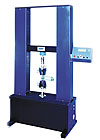
A tensile test most often involves loading a test specimen in a universal testing machine. Source: Epsilon Technology Corp.


The uniaxial tensile test is one of the most common material tests performed. It is employed most often to measure one or more of the following properties of a material: modulus, yield strength, ultimate tensile strength, Poisson’s ratio, elongation to failure and reduction of area. Several ASTM standards are available to provide guidance on performing tensile tests. Three of the most common standards are ASTM E8 for metallic materials, ASTM D3039 for polymer matrix composite materials and ASTM D638 for unreinforced and reinforced plastics.

Although there can be many variations on the standard tensile test, a tensile test most often involves loading a test specimen in a universal testing machine and applying an increasing uniaxial load to the specimen until failure occurs. The sample can be supported in the test frame any number of ways: hydraulic grips, mechanically fastened clevis grips or threaded grips. The method of gripping most often depends on the material being tested, its geometry and the capabilities of the test frame.

The test frame is designed to elongate the sample at a constant rate while accurately measuring the applied load. The load is measured using a load cell attached both to the test frame and the test specimen through a mechanical assembly. The recorded load data can be used to calculate the engineering stress using the formula:

s = F

Ao

Where:

F = the load applied to the specimen at any given time during the test, typically in units of pounds force (lbf) or newtons (N).

Ao= the original cross sectional area of the test specimen-within the gage length of the sample-before any load is applied, typically in units of in2 or m2.

s = calculated engineering stress, typically express in psi or Pa (Pascals).

For accurate measurement of the modulus, yield strength and elongation to failure, an external device called an extensometer must be used to precisely measure the deformation resulting from the applied load on the test sample. The extensometer accurately measures displacements in the gage section of the sample, which can be used to calculate the strain in the material using the formula:

e = Dl = li - lo

lo lo

Where:

Dl = change in length in the specimen’s gage length at any given time during the test, in units of inches or meters.

li = the instantaneous length of the specimen’s gage section at any given time during the test, in units of inches or meters.

lo = the original gage length of the test specimen before any load is applied, in units of inches or meters. The gage length is typically prescribed by the testing standard.

e = calculated engineering strain (in units of in/in or m/m).

Data from the universal test machine and extensometer often is recorded digitally using a PC. It also can be recorded using a chart recorder, although this option is less common with modern day systems. After the data has been recorded, standard material properties can be determined.

Metals are some of the most commonly tested materials, and the example that follows is based on data obtained from a steel alloy tensile test. Composite and plastic materials can be analyzed using similar techniques, but because they typically respond differently to uniaxial loading, refer to the appropriate standards for guidance on analyzing test results.

A standard flat, dog bone shaped sample prescribed by ASTM E8 was tested in tension. The sample had a 2-inch gage length and measured 0.5 inch wide by 0.045 inch thick. An axial extensometer was used to measure the strain in the sample in regions critical for modulus and yield strength determination. The extensometer used was a low strain version, so the test was paused and the extensometer was removed after sufficient data was recorded for these properties to be determined-although some extensometers may be left on through failure. The sample was then pulled to failure so that the ultimate tensile strength could be measured.

At very low levels of applied load, the values of stress and strain of most metallic material are proportionally related to one another through the relationship:

s = Ee

Where:

s = engineering stress

E = modulus of elasticity

e = engineering strain.

In the region where this relationship holds true, deformation of the material is called elastic deformation. If the applied load is removed from the material within this region, the specimen will return to its original shape. After yield has occurred, the material enters into the region of plastic deformation. If the applied load is removed from the material within this region, some amount of deformation will permanently remain in the sample.
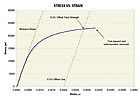


The modulus of elasticity is calculated by determining the slope of the line generated from the stress vs. strain data plotted within the elastic region. Source: Epsilon Technology Corp

The modulus of elasticity is calculated by determining the slope of the line generated from the stress vs. strain data plotted within the elastic region. The commonly prescribed method for determining the yield strength of a material is to offset the modulus curve by 0.2% along the X-axis, and record the value where the resulting offset curve crosses the stress vs. strain curve. The ultimate tensile strength is determined by recording the maximum stress reached during the test. Had an extensometer capable of measuring strain to failure been used, the elongation to failure could have been calculated from this.


The ultimate tensile strength is determined by recording the maximum stress reached during the test. Source: Epsilon Technology Corp.

Knowledge of some of these material properties is crucial to design engineers. Knowing a material’s modulus (E) allows for the calculation of deformations in the elastic region when stressed. Knowing the yield stress (sys) of a material allows for correctly designed components to avoid overstressing, which would result in permanently deformed or fractured parts. Measurement of these properties requires use load cells for accurately measuring use of load to calculate stress and extensometers to measure elongation to calculate strain.

Ken Blount is an Applications engineer at Epsilon Technology Corp. (Jackson, WY). For more information, call (307) 733-8360, e-mail [email protected] or visit www.epsilontech.com.

Share This Story

Looking for a reprint of this article?
From high-res PDFs to custom plaques, order your copy today!

Recommended Content

JOIN TODAY
to unlock your recommendations.

Already have an account? Sign In

  • 2024 Quality Rookie of the Year Justin Wise 1440x750px banner with "Quality Rookie of the Year" logo inset

    Meet the 2024 Quality Rookie of the Year: Justin Wise

    Justin Wise is an exceptional individual who has been...
    Aerospace
    By: Michelle Bangert
  • Man with umbrella and coat stands outside while it rains at night looking at a building.

    Nondestructive Testing: Is there an ethics problem?

    I was a whistleblower who exposed fraudulent activities...
    NDT
    By: Dale Norwood
  • Unraveling Deflategate: Football stadium with closeup of football on field

    Unraveling the Tom Brady Deflategate

    The Deflategate scandal erupted following the 2014 AFC...
    Measurement
    By: Greg Cenker and Henry Zumbrun
Manage My Account
  • eMagazine Subscriptions
  • Newsletters
  • Online Registration
  • Subscription Customer Service
  • Manage My Preferences

More Videos

Sponsored Content

Sponsored Content is a special paid section where industry companies provide high quality, objective, non-commercial content around topics of interest to the Quality audience. All Sponsored Content is supplied by the advertising company and any opinions expressed in this article are those of the author and not necessarily reflect the views of Quality or its parent company, BNP Media. Interested in participating in our Sponsored Content section? Contact your local rep!

close
  • Key Takeaways for Quality Leaders
    Sponsored byComplianceQuest

    Key Takeaways for Quality Leaders from the 2026 Gartner Magic Quadrant™ for QMS

  • This image shows a person seated next to a Bobcat T66 compact track loader.
    Sponsored byPolyWorks by InnovMetric

    Supercharging Digital Gauging at Bobcat North America

  • Dorsey Calibration Lab photo by Tom LaBarbera Picture this Studios
    Sponsored byDorsey Metrology International

    Ensuring Product Quality in a Competitive Manufacturing Landscape

Popular Stories

a titanium diaphragm speaker driver

The One Thing Elon Gets Right Is Designed to Scare You

This image shows a person seated next to a Bobcat T66 compact track loader.

Supercharging Digital Gauging at Bobcat North America

Dorsey Calibration Lab photo by Tom LaBarbera Picture this Studios

Ensuring Product Quality in a Competitive Manufacturing Landscape

2026 Quality Professional of the Year!

Events

June 9, 2026

Future-Proof your Quality Processes with Advanced 3D Optical CMM Technology

Discover how to effortlessly capture complex data, leverage true multi-sensor automation, and ensure continuous operation without creating inspection delays.

June 22, 2026

Automate 2026

Automate is North America's largest robotics and automation event — and the best place to take your ideas from insight to impact.
 
Our show floor features the world’s leading automation solutions, from AI and robotics to motion control, vision systems, and more. Plus, our educational conference is second to none, led by the brightest minds in automation today.
 
Ready to transform the way you work? Take the next step at Automate.
View All Submit An Event

Products

Lean Manufacturing and Service Fundamentals, Applications, and Case Studies

Lean Manufacturing and Service Fundamentals, Applications, and Case Studies

See More Products
Quality Podcast Channel Custom Content

Related Articles

  • Quality 101: Tensile Testing Basics

    See More
  • Tensile Testing 101

    See More
  • Tensile Testing Machine Basics

    See More

Related Directories

  • Mark-10 Corp.

    Mark-10 engineers and manufactures force and torque measuring gauges, systems, and accessories. From peel testing to tensile testing, from spring testing to weld strength testing, we help Quality Control and R&D professionals around the globe assess and ensure product quality. Our products are made in the USA and are covered by a 3-year warranty with free lifetime support.
  • Quality System Consultants

    We have experience developing and maintaining quality systems and have a commitment to the relentless improvement of the regulatory systems of our clients. Whether you are a startup or an established firm, Quality System Consultants can help you implement a range of quality management systems. We have: • Built inspection procedures and testing methods to improve efficiency • Achieved ISO 13485 certifications for clients ahead of schedule • Managed compliance for Class I through Class III medical devices • Averaged a 10-1 return on investment on projects we're involved with • Been voted 7th by Quality Magazine for continuous improvement to quality systems and contribution to bottom-line profitability. Unlike some of the competition, we aren't interested in stacking up billable hours at the expense of your project. We succeed when you succeed, and we're committed to solving the problems you bring to us. If you want an experienced, dedicated firm to work with you through an otherwise intimidating regulatory environment, you want to call Quality System Consultants.
×

Stay in the know with Quality’s comprehensive coverage of
the manufacturing and metrology industries.

Newsletters | Website | eMagazine

JOIN TODAY!
  • RESOURCES
    • Advertise
    • Contact Us
    • Directories
    • Manufacturing Division
    • Store
    • Want More
  • SIGN UP TODAY
    • Create Account
    • eMagazine
    • Newsletters
    • Customer Service
    • Manage Preferences
  • SERVICES
    • Marketing Services
    • Market Research
    • Reprints
    • List Rental
    • Survey/Respondent Access
  • STAY CONNECTED
    • LinkedIn
    • Facebook
    • YouTube
    • X (Twitter)
  • PRIVACY
    • PRIVACY POLICY
    • TERMS & CONDITIONS
    • DO NOT SELL MY PERSONAL INFORMATION
    • PRIVACY REQUEST
    • ACCESSIBILITY

Copyright ©2026. All Rights Reserved BNP Media, Inc. and BNP Media II, LLC.

Design, CMS, Hosting & Web Development :: ePublishing