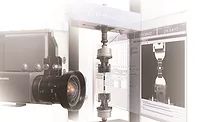
Tensile Testing Machine Basics
Learn more about testing solutions available today.
The purpose of tensile or mechanical testing is to measure the effect of force on a particular material or component, or on the adhesive or fastener that bonds two materials together. Modern universal testing machines (UTM) offer additional capabilities, including proof or creep testing, compression loading, flex or bend loading, and cyclic testing to name a few. The selection of a universal testing machine should be based upon the features it offers and ability to perform tests in accordance with a particular testing standard that may be required. Testing standards and procedures are published by a variety of standards organizations. Some of the most significant standard organizations include ASTM, ISO, Military, JIS and DIN.
A universal testing machine is a useful tool for achieving and maintaining high quality production as well as assuring vendor quality as part of the receiving inspection process. Most manufacturers of UTMs offer different types of test machines, machine dimensions and capacities, data acquisition and computer control. Recent advances in technology make in-house testing easier and more affordable and capable of generating results and analyses that were not possible a decade ago.
In mechanical testing there are two basic classes of testing machines, electromechanical and hydraulic. The electromechanical or screw driven test frames typically use an electric motor and two elevation screws to run the crosshead up and down. The electromechanical test machines offer a large range of test speeds by changing the speed of the motor. The electromechanical machines also provide for longer crosshead travel distances of up to 100 inches or more. Electromechanical machines are known for speed and position accuracy and high position resolution. Hydraulic testing machines incorporate a single or dual direction piston to move the crosshead and apply the force. Hydraulic machine test travel is limited by the length of the piston. The hydraulic machines are much more cost effective when the need arises for generating high forces, normally 60,000 pounds-force (Lbf) and more. Both hydraulic and electromechanical test machines can be computerized offering control with servo motors or servo valves controlling the machine’s test speed. Most computerized testing machines have the capability to control testing speed as measured by load rate (Lbs/min), position rate (in/min or mm/min), and strain rate (%/min). Most documented test methods call for a standardized testing speed and may give the end user a choice in meeting the specification via load rate, position rate or strain rate. The computerized UTM can also be programmed with ending test conditions, such as ending the test at a defined force or position or beak sense, a specified percentage drop from peak force.
It is important to select a testing machine with a force capacity greater that the maximum testing force expected in your test program. It is advisable to consider a larger capacity machine to allow for expansion of your current testing needs. The manufacturer’s specifications for UTM load frame and dimensions are equally important. Dimensional specifications must cover distance between columns, vertical test space and stroke to adequately handle the products being tested.
There must be enough vertical travel available to stretch the material to failure without running out of travel. For example, plastic and elastomeric materials require considerable machine travel, while metals, bonds and welds require smaller amounts of travel. The end user must consider the height of grips and fixtures which reduce the effective vertical travel of any testing machine. Also, the distance between columns is critical when incorporating very large fixtures, special grips or hot/cold chambers. Depending on capacity and physical height and weight, machines may be offered as table-top or floor standing models. The end user needs to make sure the tester will be adequately supported on an existing test bench or will fit inside the planned test location with sufficient ceiling clearance.
Knowing the standard to be met allows the user to determine which features are needed or how many channels of acquisition must be included. The simple UTM is equipped with a digital read out display unit to record the peak force acquired when the load is applied to a material or component. Most UTM manufacturers offer computer acquisition or computer controlled test systems. Knowing what results are required will help when deciding what options are necessary to successfully meet the standard or test method requirements. Tests to determine the integrity of welds, bonds, and fasteners requiring peak force or peak psi can be obtained simply with a digital read out. Test methods requiring computed peel strengths, yield values, extension values, and elongation calculations typically need a chart or computer in order to plot a stress vs strain curve or force vs machine displacement curve. The UTM will need to have additional channels to record force, crosshead travel, extensometers, linear variable displacement transducer (LVDT), or time acquisition. Most metal testing requires an extensometer attached or optically scanning or video recording to measure the strain of the material. Most manufacturers offering computerized machines have a software package with data acquisition, statistical analysis, pass/fail criteria, report generation while building a queryable data base of tested samples.
UTMs constructed with a computer interface allow more features to be offered at less expense. In the past, UTMs were been built with multiple meters used to display force, speed, displacement, extension, and time. The personal computer has replaced all of these components with a real time display containing the same information and more.
The latest breakthroughs in technology can definitely aid in making any UTM easy to use, easy to support, and an important asset to own. Available internet applications offer video chat and real time test recording for witness testing and archiving of the actual tested part. Illustrations and photographs depicting distinct test configurations can be linked to a particular test method to ensure the operator is able to properly set up any required test fixtures and properly perform the test to completion.
On-line video resources can help ensure correct setups and provide guidance on how to test certain components and materials. Web conferencing is another important support resource, and internet-based remote access can allow manufacturers and other users to train, provide support, and troubleshoot tester problems via the internet.
The knowledgeable user in search of a testing solution today will benefit from recent advances in modern tensile testers and accessories offered by multiple manufacturers. The key to making the correct machine purchase decision starts with defining your current testing requirements and allowing for a realistic estimate of future goals and expansion.
Looking for a reprint of this article?
From high-res PDFs to custom plaques, order your copy today!