Five Steps to Selecting Styli

Choosing an appropriate stylus for an application means the difference between meeting the application’s needs and missing them. The stylus delivers the measurement or form information to the probe.
“It could simply be the difference between failure and success,” states John Horwell, senior metrologist at Hexagon Metrology Inc. (Fond du Lac, WI). “If one chooses styli material that is similar to the material of the test piece, then galling is almost certain to occur. This will cause increased friction and pickup of the material onto the stylus. Neither condition is acceptable.”
In other words, if a manufacturer invests in an expensive coordinate measuring machine (CMM), it is to his benefit to purchase the most effective stylus for the application-otherwise, a highly accurate CMM will not stand up to its capabilities.

Operators should be well versed in their application before buying a stylus. Source: Hexagon Metrology Inc.
Researching styli and asking vendors questions about the products available can help a manufacturer make an informed buying decision. Many considerations come into play when choosing a stylus-and many choices often are guided by the existing equipment’s guidelines. Manufacturers shopping around for a handheld probe stylus vs. CMM stylus will have different requirements and needs, which will further help operators make a satisfactory purchase. Here are several factors to contemplate-and to help ensure manufacturers choose the most appropriate styli for the application:

1. Know the Application
“I ask that customers understand the application before we design a stylus. Each stylus is not created equal because it depends on what you are trying to do,” says Dennis Bobo, business development and senior application engineer at Renishaw Inc. (Hoffman Estates, IL). Ask questions such as, “What exactly do I need to measure? How accurate do I need to get? How deep do I need to go into the feature?” The answers will depend on the application and will help determine the type of styli to consider.In addition, say experts, operators need to read the manuals and parameters for their probe heads. Each piece of equipment has weight requirements and other stipulations that will guide the operator in the right direction in terms of what will and won’t work for the equipment.
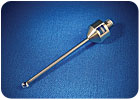
Diamond tip styli do not wear out with hard, rough materials and soft materials don’t create buildup-making it a fitting alternative for many applications, including glass. Source: Carl Zeiss IMT Corp.
2.Take the Temperature
Temperature changes can cause differences in measurements-making the choice of stylus material an important decision particularly if the application’s environment is not temperature regulated.“If your equipment is in a non-environmentally controlled area like a shop floor and you calibrate in the morning when it’s cool and use it later in the day, your measurements will be affected,” says Clint Clark of Q-Mark Manufacturing Inc. (Mission Viejo, CA). Changes in measurements may be minimal, but if the application’s tolerances are tight, such changes could make all the difference.
When it comes to thermal stability in styli, ceramic stems are relatively unaffected by temperature changes and carbon fiber stems also are extremely thermally stable, Clark says.
Manufacturer Carl Zeiss IMT Corp. (Maple Grove, MN) offers a stylus stem line called Thermofit, designed specifically for environments where temperature stability is a challenge. The line of styli is built to maximize both rigidity and thermal stability.
For applications where temperature is unstable, factoring in thermal stability of the styli material is imperative to completing the measurement application.
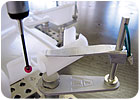
A plastic automotive part held on a fixture is measured with an M2 ruby ball stylus with a carbon fiber shank. Source: Paul W. Marino Gages
3. Choose the Stem Wisely
“In the olden days-if we went back 10 years-everyone said that styli shouldn’t be longer than say 50 millimeters long and if went go longer, you’d have issues,” recalls Jonathan Dove, regional applications manager at Hexagon Metrology Inc.While experts agree to the general rule that the shorter and thicker the stem or shank, the better due to less deflection and more accurate measurements-the advancements in technology including better sensors and more evolved materials have made it possible for manufacturers to use longer, thinner probes for certain applications.
Today’s operators can find themselves faced with many material choices, including stainless steel, carbon fiber, ceramic and tungsten carbide. Accuracy, length, diameter and other details of the specific application will help a manufacturer narrow down the choices.
Clark of Q-Mark says that stainless steel is the most popular stem material among his customers, primarily for its price and relatively light weight. However, for customers needing more rigidity, carbide often is a safe bet, he says.
“Carbide is common for an application calling for rigidity. You can get relatively long stem lengths and relatively large diameters. And from an economic standpoint, it’s the most cost effective when you need rigidity,” Clark says.
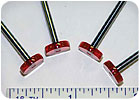
Disk styli are ideal for applications with undercuts or large diameters. Source: Q-Mark Manufacturing Inc.
If, for example, an operator needs to reduce weight, he could choose carbon fiber stems over carbide stems, Horwell says.
“Every styli bends in microns. As the styli get longer and longer, it bends more and more and produces decreased accuracy,” Dove relates. He says carbon fiber is light and durable while ceramic is relatively stiffer, however, ceramic also is fragile and can break easily.
But Linda Marino, vice president of Paul W. Marino Gages Inc. (Warren, MI), says that a hard metal, but fragile stem is ideal compared with a softer, less rigid stem. “In my opinion, steel is the least popular because it’s one of the softest materials and it’s magnetic. A brittle but rigid stem is better broken during measurement than having a stem that bends,” she adds. Ceramic and carbon fiber stems are not only non-magnetic, they offer minimal deflection and maximum rigidity-making both materials ideal choices for high-speed CMM applications.
Stem choice, however, often comes down to the capabilities of the probing system-which often will help determine weight, thread size and length of the stem. “Your probing system will dictate your thread size,” Marino reminds. “Larger systems and portable arms take larger thread sizes, allowing for more robust, non-magnetic and lightweight shank materials like titanium to be an ideal option in large ball diameters for less deflection, and more weight tolerance.”
For applications that call for highly accurate results, experts recommend not only maximizing the styli by choosing a rigid material, but also employing a tapered stem to further minimize deflection as well-and at the same time allowing for the stiffness to be near the probe unit and the stylus tip to be lighter and perform better.

Ceramic styli are stable, brittle and relatively lightweight. Source: itpstyli LLC
4. Reassess Roundness
Material. When choosing the ball or sphere for the stylus, material, weight, mounting method and grade are all factors to consider. While ruby is generally the least expensive and most popular sphere material for a stylus, manufacturers must take into account the application and material being measured to determine the most appropriate ball material.“If the workpiece is hard, ceramic steel would be a better choice, as abrasive material can cause flats on the ball,” says Chrysee Bollon, styli and accessories business manager at Carl Zeiss IMT Corp. Too soft of a workpiece and build-up can occur on the ball, she adds. “Because of the risk of build-up, people go to another ball material such as ceramic. The properties of ceramic make it a better choice than the traditional ruby ball. Measuring hard materials creates a wear spot and soft materials create build-up on the ball,” Bollon says.
For aluminum applications, many experts say that due to the transfer or build-up that ruby balls may endure, a material such as silicon nitride is a good fit. “The chemical composition of silicone nitride substantially reduces the accumulation of aluminum particles as compared to ruby, so the adhesive wear is far lower,” Schlafly notes.
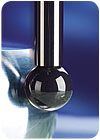
A CMM stylus with a silicon nitride ball can be used for extreme aluminum applications, but can show wear with stainless steel and cast iron applications. Source: Q-Mark Manufacturing Inc.
Diamond styli tips were developed by engineers at Carl Zeiss. The material does not wear out with hard, rough materials and soft materials do not create build-up, according to Bollon.
“It’s important to remember that the biggest factor for selecting the ball material is to choose the best fit for the specific application,” Dove recommends.
Grade. Another factor to be aware of when choosing a ball for the stylus, is the grade of the sphere. The lower the grade number, the rounder the ball. For example, a grade 3 ball is rounder and considered superior to a grade 10.
“Pay attention to the roundness of the ball. If you have a grade 5 vs. a grade 10, that would affect your point of measurement,” Bobo explains.
Some suppliers only offer grades 3 and 5. However, grades 10 and above are available and, according to Clark, a grade 25 ball is just fine for most general shop jobs. “The only time the grade becomes really important is a highly accurate machine to measure microns. When the grade goes down, the price goes up,” Clark says.

For applications that call for long stem lengths, manufacturers should choose a stiff, lightweight material. Source: Hexagon Metrology Inc.
Paul W. Marino Gages supplies both types of ball mounts, however, Marino recommends only peg-mounted, also called pivot-mounted, balls from 0.5 millimeter to 6 millimeters in diameter. Pivot-mounted [balls] last longer and are more reliable than the glued solid sphere construction,” she says. The only possible drawback of the pivot-mount, according to Marino, is that such a mount is not available or feasible for all styli sizes and materials.

Ruby spheres are a material of choice due to price and overall satisfactory performance. Source: Renishaw Inc.
5. Configure Wisely
Some applications need special configurations to meet measurement goals. This might include star, disk, cylindrical styli, or even custom-designed styli to measure a certain angle or reach a certain length. A key consideration a manufacturer must face when purchasing a stylus is finding the appropriate configuration for the application. “That’s why there are thousands of different configurations dimensionally,” Schlafly says. “Our customer service group spends the majority of its time helping metrologists find or configure the most appropriate probing for the part they are measuring.”“Not all styli are designed for the same application,” Dove says. For example, disks or stars are best for applications with undercuts or large diameters. While balls are general purpose, cylinders are ideal for sheet metal and blade applications.
The general rule when choosing a stylus is to read the guidelines of the equipment and buy the stiffest, lightest probe possible while still allowing enough access to the part, and meeting the accuracy and weight requirements.
“Choosing the correct styli depends really on the level of accuracy you need to achieve,” Dove advises. “If you need to be within a few microns, then worry about everything.” Q
For more information on the companies mentioned in this article, please visit:
- Carl Zeiss IMT Corp., www.zeiss.com/imt
Hexagon Metrology Inc., www.hexagonmetrology.net
itpstyli LLC, www.itpstyli.com
Paul W. Marino Gages Inc., www.pmargage.com
Q-Mark Manufacturing Inc., www.cmms.com
Renishaw Inc., www.renishaw.com
Quality Online
For more information on styli, visit www.qualitymag.com to read these articles:Tech Tips
Looking for a reprint of this article?
From high-res PDFs to custom plaques, order your copy today!


