Keep Granite Surface Plates Calibrated
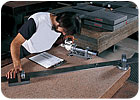
An effective inspection program should include regular checks with an autocollimator, providing actual calibration of overall flatness traceable to NIST. Source: Starrett
For many shops, inspection rooms and laboratories, precision granite surface plates are relied on as the basis for accurate measurement. Because every linear measurement depends on an accurate reference surface from which final dimensions are taken, surface plates provide the best reference plane for work inspection and layout prior to machining. They also are ideal bases for making height measurements and gaging surfaces. Further, a high degree of flatness, stability, overall quality and workmanship make them a good choice for mounting sophisticated mechanical, electronic and optical gaging systems. For any of these measurement processes, it is imperative to keep surface plates calibrated.
Repeat Measurements and Flatness
Both flatness and repeat measurements are critical to ensure a precision surface. Flatness can be considered as all points on the surface being contained within two parallel planes, the base plane and the roof plane. The measurement of distance between the planes is the overall flatness of the surface. This flatness measurement commonly carries a tolerance and may include a grade designation.The flatness tolerances for three standard grades are defined in the federal specification as determined by the following formula:
Laboratory Grade AA = (40 + diagonal² / 25) x 0.000001 inch (unilateral)
Inspection Grade A = Laboratory Grade AA x 2
Tool Room Grade B = Laboratory Grade AA x 4
In addition to flatness, repeatability must be ensured. A repeat measurement is a measurement of local flatness areas. It is a measurement taken anywhere on the surface of a plate that will repeat within the stated tolerance. Controlling local area flatness to a tighter tolerance than overall flatness guarantees a gradual change in surface flatness profile, thereby minimizing local errors.
To ensure a surface plate meets both the flatness and repeat measurement specifications, manufacturers of granite surface plates should use Federal Specification GGG-P-463c as a basis for their specifications. This standard addresses repeat measurement accuracy, material properties of surface plate granites, surface finish, support point location, stiffness, acceptable methods of inspection and installation of threaded inserts.
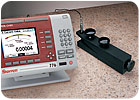
Before a surface plate has worn beyond specification for overall flatness, it will show worn or wavy posts. Monthly inspection for repeat measurement errors using a repeat reading gage will identify wear spots. A repeat reading gage is a high-precision instrument that detects local error and can be displayed on a high magnification electronic amplifier. Source: Starrett
Checking Plate Accuracy
By following a few simple guidelines, an investment in a granite surface plate should last for many years. Depending on plate usage, shop environment and required accuracy, frequency of checking the surface plate accuracy varies. A general rule of thumb is for a new plate to receive a full recalibration within one year of purchase. If the plate is used frequently, it is advisable to shorten this interval to six months.Before a surface plate has worn beyond specification for overall flatness, it will show worn or wavy posts. Monthly inspection for repeat measurement errors using a repeat reading gage will identify wear spots. A repeat reading gage is a high-precision instrument that detects local error and can be displayed on a high magnification electronic amplifier.
An effective inspection program should include regular checks with an autocollimator, providing actual calibration of overall flatness traceable to National Institute of Standards and Technology (NIST). Comprehensive calibration by the manufacturer or an independent company is necessary from time to time.
Variations Between Calibrations
In some cases, there are variations between surface plate calibrations. Sometimes factors such as surface change resulting from wear, incorrect use of inspection equipment or use of noncalibrated equipment can account for these variations. The two most common factors, however, are temperature and support.One of the most important variables is temperature. For instance, the surface might have been washed with a hot or cold solution prior to calibration and not allowed sufficient time to normalize. Other causes of temperature change include drafts of cold or hot air, direct sunlight, overhead lighting or other sources of radiant heat on the surface of the plate.
There also can be variations in the vertical temperature gradient between winter and summer. In some cases, the plate is not allowed sufficient time to normalize after shipment. It is a good idea to record the vertical gradient temperature at the time the calibration is performed.
Another common cause for calibration variation is a plate that is improperly supported. A surface plate should be supported at three points, ideally located 20% of the length in from the ends of the plate. Two supports should be located 20% of the width in from the long sides, and the remaining support should be centered.
Only three points can rest solidly on anything but a precision surface. Attempting to support the plate at more than three points will cause the plate to receive its support from various combinations of three points, which will not be the same three points on which it was supported during production. This will introduce errors as the plate deflects to conform to the new support arrangement. Consider using steel stands with support beams designed to line up with the proper support points. Stands for this purpose are generally available from the surface plate manufacturer.
If the plate is properly supported, precise leveling is only necessary if an application specifies it. Leveling is not necessary to maintain the accuracy of a properly supported plate.

It is important to keep the plate clean. Airborne abrasive dust is usually the greatest source of wear and tear on a plate, as it tends to embed in workpieces and the contact surfaces of gages. Cover plates to protect them from dust and damage. Wear life can be extended by covering the plate when not in use. Source: Starrett
Extend Plate Life
Following a few guidelines will reduce wear on a granite surface plate and ultimately, extend its life.First, it is important to keep the plate clean. Airborne abrasive dust is usually the greatest source of wear and tear on a plate, as it tends to embed in workpieces and the contact surfaces of gages.
It also is important to cover plates to protect it from dust and damage. Wear life can be extended by covering the plate when not in use.
Rotate the plate periodically so that a single area does not receive excessive use. Also, it is recommended to replace steel contact pads on gaging with carbide pads.
Avoid setting food or soft drinks on the plate. Many soft drinks contain either carbonic or phosphoric acid, which can dissolve the softer minerals and leave small pits in the surface.
Where to Relap
When a granite surface plate needs re-surfacing, consider whether to have this service performed on-site or at the calibration facility. It is always preferable to have the plate relapped at the factory or a dedicated facility. If, however, the plate is not too badly worn, generally within 0.001 inch of the required tolerance, it can be resurfaced on-site. If a plate is worn to the point where it is more than 0.001 inch out of tolerance, or if it is badly pitted or nicked, then it should be sent to the factory for grinding prior to relapping.A calibration facility has the equipment and factory setting providing the optimum conditions for proper plate calibration and rework if necessary.
Great care should be exercised in selecting an on-site calibration and resurfacing technician. Ask for accreditation and verify the equipment that the technician will use has a NIST-traceable calibration. Experience also is an important factor, as it takes many years to learn how to correctly lap precision granite.
Critical measurements start with a precision granite surface plate as a baseline. By ensuring a reliable reference by using a properly calibrated surface plate, manufacturers have one of the essential tools for reliable measurements and better quality parts. Q
Checklist for Calibration Variations
1. The surface was washed with a hot or cold solution prior to calibration and was not allowed sufficient time to normalize.2. The plate is improperly supported.
3. Temperature change.
4. Drafts.
5. Direct sunlight or other radiant heat on the surface of the plate. Be sure that overhead lighting is not heating the surface.
6. Variations in the vertical temperature gradient between winter and summer. If at all possible, know the vertical gradient temperature at the time the calibration is performed.
7. Plate not allowed sufficient time to normalize after shipment.
8. Improper use of inspection equipment or use of noncalibrated equipment.
9. Surface change resulting from wear.
Tech Tips
Looking for a reprint of this article?
From high-res PDFs to custom plaques, order your copy today!


