Quality Test & Inspection: Strength in Numbers
Digitizing test samples allows for measureable improvements in process, productivity and quality.
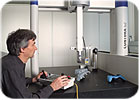
Developed more than 60 years ago out of necessity to measure precision components in the military, the coordinate measuring machine (CMM) has undergone several facelifts since its inception. Its first big transition was the shift from two to three axes, followed by the introduction of computer control. Nowadays, these machines are available in a number of different configurations, such as portable, benchtop, handheld and freestanding versions.
Just as the sizes and shapes of CMMs have evolved over time, so have the inspection methods used with these machines. Conventional touch probes that are mechanically moved are still regarded as highly accurate; however, emerging trends in scanning technology-probes that drag along the surface of the manufactured part to collect points-are progressing rather quickly.
An example of this would be laser scanning, in which a laser line is projected over the surface to collect three-dimensional (3-D) data points that are then reflected to a vision sensor mounted in the scanner. The technology is similar to that of a paintbrush dipped in paint and being dragged across the part.
These data points are then transferred to a computer-aided design (CAD) program that works to create a 3-D replica of the physical part. A color map of the point cloud data overlaid on the CAD model shows geometry deviation in different colors across the entire surface of the part. This helps alleviate measurement time because after the inspector has the entire digital model of the part, there is no need to go back and scan other surface points.
A go/no-go result is given and the data is stored for future use if further inspection is required later down the line. This saves the machine operator time and money while gaining flexibility to run a more detailed inspection on the digital copy without having to have the test part present.
“The core of the inspection with laser scanning is the color map,” says Jay Elepano, business development manager, Nikon Metrology (Brighton, MI). “It is a very simplified report. If machine operators want to reverse engineer, it is important to understand what the part is. If it is a plastic injection mold that may have curves, and there are no prismatic features, maybe the operator just wants to make a freemarker template file-that is called a dumb model. There are very simple packages that do that. In addition, there is the ability to create a prismatic part drawing CAD rendering.”
Elepano uses the example of a birthday cake with candles on it in a circle. If an analog scan is taken of this shape, how would the machine operator know if it is a birthday cake with a bunch of candles on it or if it is a car rotor with studs sticking out of it? The rough general shape of each is the same.
Other advantages, according to Eric Hollenbeck, business manager North America, portable products, Hexagon Metrology (North Kingstown, RI) include instant graphical feedback.
“This is extremely valuable, particularly in the early stages of production to verify the component is being manufactured correctly,” says Hollenbeck. “It also is useful in mature products so that a problem can be identified early, before shipments are made to customers with faulty, out-of-tolerance parts.”

In addition, there are limitations when it comes to freeform components and soft or fragile parts, which present the potential for the probe to collide with the part or CMM. Shrinkage and spring back are other issues that may affect quality inspections.
Orlando Perez, director of product management, Faro (Lake Mary, FL), adds that there is a huge momentum in the industry moving toward scanning and noncontact inspection. More and more manufacturers want to use this technology to speed up their processes. Faster capture rates for increased speed, higher density point clouds to capture greater detail are some of the emerging and evolving trends. From the software side, 64-bit computing to boost efficiency, automatic feature recognition and real-time comparisons between the captured scan data and the design intent are becoming more popular.
Pearson says that the inspection method has evolved from a relatively simple diode laser sensor (DTS), which functions as a noncontact touch trigger probe, to the long trace profiler (LTP)–a scanning triangulation-based laser–to the scanning laser line sensor, which has three axes of rotation at the sensor. This is ideal for the complex geometries encountered in the automotive industry.
An example would be gap and flush inspection between the doors and bodies of assembled cars. This determines a vehicle’s overall fuel efficiency and aerodynamic performance. Using a laser scanner, the inspector can digitize the entire spine that falls between the hood and front fender.
As newer innovations with software and laser scanning are released to the market, the design-to-manufacturing process has become more simplified and flexible for the technician.
“One of the most exciting things happening now in software is point cloud feature extraction,” says Hollenbeck. “Instead of a technician scanning a part and then manually defining features from the point cloud, software can automatically recognize features, such as hole slots and edges, which makes the process of detailed, feature-based inspection much more automated.”
“Manufacturing quality is improved by giving the operator the ability to gather and evaluate more data in a shorter period of time, which translates to a more thorough inspection and corresponding tighter control over process variation,” says John Pearson, technical sales engineer, Carl Zeiss Industrial Metrology (Maple Grove, MN).
For freeform shapes, single laser scanners are ideal since they are fast and accurate and are often the choice for retrofits. When it comes to more complex surfaces that have holes and slots, a cross scanner is the best solution since it eliminates the use of both a laser scan and touch probe.
Another critical factor is setup. According to Perez, proper setup is important in any digital imaging process. Making sure the equipment is properly calibrated greatly reduces noise and other performance degradation factors. Glossy or shiny surfaces and darker colors are always challenging, regardless of the device being used so machine operators can always expect that the best quality scans will be achieved when capturing light color objects with dull or matte finishes.
Although traditional touch probes on CMMs remain the standard in metrology because of their high accuracy, there is no getting around the time-consuming inspection process and limited ability to scan freeform applications. For the aerospace and automotive industries, the use of 3-D laser scanning has alleviated these constraints by allowing operators to have a complete inspection of large-scale projects in a matter of minutes. Q
“3-D Laser Scanning Accelerates Inspection”
“Replace Film with Digital Radiography”
“Take a Closer Look at Laser Scanning”
The core of the inspection with laser scanning is the color map.
A laser line is projected over the surface to collect 3-D data points that are reflected to a vision sensor that is mounted in the scanner.
Making sure the equipment is properly calibrated greatly reduces noise and other performance degradation factors.
A laser line is projected over the surface to collect 3-D data points that are reflected to a vision sensor that is mounted in the scanner. Source: Carl Zeiss Industrial Metrology
Developed more than 60 years ago out of necessity to measure precision components in the military, the coordinate measuring machine (CMM) has undergone several facelifts since its inception. Its first big transition was the shift from two to three axes, followed by the introduction of computer control. Nowadays, these machines are available in a number of different configurations, such as portable, benchtop, handheld and freestanding versions.
Just as the sizes and shapes of CMMs have evolved over time, so have the inspection methods used with these machines. Conventional touch probes that are mechanically moved are still regarded as highly accurate; however, emerging trends in scanning technology-probes that drag along the surface of the manufactured part to collect points-are progressing rather quickly.
An example of this would be laser scanning, in which a laser line is projected over the surface to collect three-dimensional (3-D) data points that are then reflected to a vision sensor mounted in the scanner. The technology is similar to that of a paintbrush dipped in paint and being dragged across the part.
These data points are then transferred to a computer-aided design (CAD) program that works to create a 3-D replica of the physical part. A color map of the point cloud data overlaid on the CAD model shows geometry deviation in different colors across the entire surface of the part. This helps alleviate measurement time because after the inspector has the entire digital model of the part, there is no need to go back and scan other surface points.
A go/no-go result is given and the data is stored for future use if further inspection is required later down the line. This saves the machine operator time and money while gaining flexibility to run a more detailed inspection on the digital copy without having to have the test part present.
“The core of the inspection with laser scanning is the color map,” says Jay Elepano, business development manager, Nikon Metrology (Brighton, MI). “It is a very simplified report. If machine operators want to reverse engineer, it is important to understand what the part is. If it is a plastic injection mold that may have curves, and there are no prismatic features, maybe the operator just wants to make a freemarker template file-that is called a dumb model. There are very simple packages that do that. In addition, there is the ability to create a prismatic part drawing CAD rendering.”
Elepano uses the example of a birthday cake with candles on it in a circle. If an analog scan is taken of this shape, how would the machine operator know if it is a birthday cake with a bunch of candles on it or if it is a car rotor with studs sticking out of it? The rough general shape of each is the same.
Other advantages, according to Eric Hollenbeck, business manager North America, portable products, Hexagon Metrology (North Kingstown, RI) include instant graphical feedback.
“This is extremely valuable, particularly in the early stages of production to verify the component is being manufactured correctly,” says Hollenbeck. “It also is useful in mature products so that a problem can be identified early, before shipments are made to customers with faulty, out-of-tolerance parts.”
When it comes to more complex surfaces that have holes and slots, a cross scanner is the best solution since it eliminates the use of both a laser scan and touch probe. Source: Nikon Metrology Inc.
Innovation
When it comes to metrology, there is an increasing need for higher quality inspections at faster turn-around times. To help achieve this and reduce CMM inspection time, laser scanning is often a preferred method. While physical inspection is still highly accurate because optics are not weighed into the equation, it can be tedious and there may not be enough data present.In addition, there are limitations when it comes to freeform components and soft or fragile parts, which present the potential for the probe to collide with the part or CMM. Shrinkage and spring back are other issues that may affect quality inspections.
Orlando Perez, director of product management, Faro (Lake Mary, FL), adds that there is a huge momentum in the industry moving toward scanning and noncontact inspection. More and more manufacturers want to use this technology to speed up their processes. Faster capture rates for increased speed, higher density point clouds to capture greater detail are some of the emerging and evolving trends. From the software side, 64-bit computing to boost efficiency, automatic feature recognition and real-time comparisons between the captured scan data and the design intent are becoming more popular.
Pearson says that the inspection method has evolved from a relatively simple diode laser sensor (DTS), which functions as a noncontact touch trigger probe, to the long trace profiler (LTP)–a scanning triangulation-based laser–to the scanning laser line sensor, which has three axes of rotation at the sensor. This is ideal for the complex geometries encountered in the automotive industry.
An example would be gap and flush inspection between the doors and bodies of assembled cars. This determines a vehicle’s overall fuel efficiency and aerodynamic performance. Using a laser scanner, the inspector can digitize the entire spine that falls between the hood and front fender.
As newer innovations with software and laser scanning are released to the market, the design-to-manufacturing process has become more simplified and flexible for the technician.
“One of the most exciting things happening now in software is point cloud feature extraction,” says Hollenbeck. “Instead of a technician scanning a part and then manually defining features from the point cloud, software can automatically recognize features, such as hole slots and edges, which makes the process of detailed, feature-based inspection much more automated.”
“Manufacturing quality is improved by giving the operator the ability to gather and evaluate more data in a shorter period of time, which translates to a more thorough inspection and corresponding tighter control over process variation,” says John Pearson, technical sales engineer, Carl Zeiss Industrial Metrology (Maple Grove, MN).
Critical Factors
When machine operators choose to 3-D scan a part, they should first ask themselves, “What do I want to do with the data?” For example, a car door has to fit together perfectly. They might want to inspect it for surface irregularities or compare it to CAD model. Another person might want to reverse engineer it.For freeform shapes, single laser scanners are ideal since they are fast and accurate and are often the choice for retrofits. When it comes to more complex surfaces that have holes and slots, a cross scanner is the best solution since it eliminates the use of both a laser scan and touch probe.
Another critical factor is setup. According to Perez, proper setup is important in any digital imaging process. Making sure the equipment is properly calibrated greatly reduces noise and other performance degradation factors. Glossy or shiny surfaces and darker colors are always challenging, regardless of the device being used so machine operators can always expect that the best quality scans will be achieved when capturing light color objects with dull or matte finishes.
Although traditional touch probes on CMMs remain the standard in metrology because of their high accuracy, there is no getting around the time-consuming inspection process and limited ability to scan freeform applications. For the aerospace and automotive industries, the use of 3-D laser scanning has alleviated these constraints by allowing operators to have a complete inspection of large-scale projects in a matter of minutes. Q
QUALITY ONLINE
For more information on digital inspection, visit www.qualitymag.com to read the following articles:Tech tips
Looking for a reprint of this article?
From high-res PDFs to custom plaques, order your copy today!


