Quality Magazine logo
search
cart
facebook twitter linkedin youtube
  • Sign In
  • Create Account
  • Sign Out
  • My Account
Quality Magazine logo
  • NEWS
  • PRODUCTS
    • FEATURED PRODUCTS
    • SUBMIT YOUR PRODUCT
  • CHANNELS
    • AUTOMATION
    • MANAGEMENT
    • MEASUREMENT
    • NDT
    • QUALITY 101
    • SOFTWARE
    • TEST & INSPECTION
    • VISION & SENSORS
  • MARKETS
    • AEROSPACE
    • AUTOMOTIVE
    • ENERGY
    • GREEN MANUFACTURING
    • MEDICAL
  • MEDIA
    • A WORD ON QUALITY PUZZLE
    • EBOOK
    • PODCASTS
    • VIDEOS
    • WEBINARS
  • EVENTS
    • EVENT CALENDAR
    • IMTS
  • DIRECTORIES
    • BUYERS GUIDE >
      • Supplier Insights
    • NDT SOURCEBOOK
    • VISION & SENSORS
    • TAKE A TOUR
  • INFOCENTERS
    • Digital Quality Management Systems
    • NEXT GENERATION SPC & QUALITY ANALYTICS
  • AWARDS
    • ROOKIE OF THE YEAR
    • PLANT OF THE YEAR
    • PROFESSIONAL OF THE YEAR
  • MORE
    • Expert Columns
    • NEWSLETTERS
    • QUALITY STORE
    • INDUSTRY LINKS
    • SPONSOR INSIGHTS
  • EMAG
    • eMAGAZINE
    • ARCHIVES
    • CONTACT
    • ADVERTISE
  • SIGN UP!

Brain Teasers: Are Robots Predictable?

By Dr. Sophronia Ward
November 1, 2006
Anyone who has faced a production problem with a need to solve it by using production data can relate to the notion of a brain teaser. The brain teasers presented here are based on real-world situations encountered by workers in manufacturing environments. The brain teasers have three parts: (1) the situation, (2) available data or other supporting information and (3) questions that various workers need answered for continual improvement.


Situation

Melinda has just been promoted to the newly created position of quality director at a small robot manufacturing company. She is accountable for all data provided to customers about the critical characteristics of the manufactured robots. One customer has requested that Melinda provide process behavior charts with all shipments; she is evaluating some new software that will make the charts automatically. One feature that was emphasized by the software provider is that the limits on the charts will be updated every time a new data point is added. In her past experience, Melinda has used charts where limits were held constant until a significant process change was made for the better. She wants the option to be able to determine a range of data values for calculating the limits and then keeping these limits until they need to be changed. The software provider said that this cannot be done with their product.


Available Data

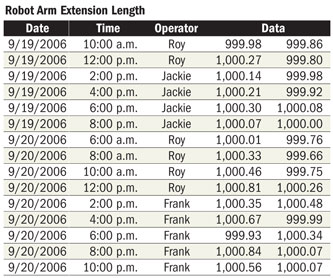
Melinda has some data for several critical characteristics of the robots her company sells to this specific customer. One of these characteristics is the extension length of the robot's arm. This extension length has a specification of 1,000 millimeters ±1 millimeter. In the table, "Robot Arm Extension Length," Melinda has summarized the data for production on September 19 and 20, 2006. At the end of the first day, she set up the software and calculated the limits with the available data. During production on the second day, data were entered automatically into the software from the measuring instrument and the chart was updated with a new set of limits based on all of the data.


Questions

1. What is the behavior of the robot arm extension length after the first day?

2. As each new set of data is used and new limits are calculated, how does the robot arm extension length behave?

3. What would Melinda have noticed if the limits on the process behavior chart had not been recalculated each time there was new data 4. What are the consequences of continually recalculating limits as new data are collected?


Answers to October Brain Teaser

Juan manages the department in charge of repairing and replacing failed computer parts and is under pressure to reduce costs. He decided to focus on the costs associated with the time to isolate the failure and make the repair. The guaranteed turnaround time for returned components is 24 hours. In many situations, Juan sends the customer an identical part that was previously repaired or a new one from current production. The data he collected to study the costs includes number of units returned, repair time, number of new parts used, percentage of returned parts not repairable and percentage of parts OK.


Q: What is the behavior of the returns and repair processes for hard drives?

A: Both the number of parts returned and the percentage that could not be repaired were unpredictable. For the number of parts returned, the first five weeks showed a wide, zigzag behavior with the last eight weeks of the quarter showing a predictable process with an average of 139.6 and natural process limits of 121 to 158. The repair time was predictable at an average of 51.2 minutes with natural process limits of 16 to 86. Both the number of new parts used in the returns and the percent of returned parts OK were predictable. The number of new parts used averaged 72 with natural process limits of 36 to 108 while the percentage of returned parts OK averaged 6.3 with an upper natural process limit of 14. See the charts, "Number of Parts Returned" and "Time to Identify and Repair Failure."


Q: How does understanding process behavior help Juan to evaluate possible ways to reduce costs?

A: Process behavior is key to making management decisions because of the critical difference between predictable and unpredictable processes. An unpredictable process has exceptional behavior that might distort the costs at one or more time periods. Identifying and eliminating the causes of exceptional behavior can lead to opportunities to reduce costs. Predictable processes are essentially locked into a behavior that may be detrimental to reducing costs. In such cases, a fundamental change will be necessary if costs are to be reduced. For example, the time to find and make a repair to a faulty part is currently predictable. Finding faster ways to identify the failure and make the repair could lower labor costs, but this would require a fundamental change in the way the failures are identified and fixed.


Q: Based on the data available, what might Juan work on first to reduce costs?

A: Reduction of time to identify and repair the units, as well as the number of new parts used, are two areas for investigation and both of these processes are predictable. Reducing the time and the number of new parts used could reduce costs in this department.

Q: What additional data and analyses could help Juan take actions to reduce costs in his department?

A: Juan could step out of the current box and compare the costs of the current approach for handling returned parts with the costs associated with a certain amount of improvement in the time and use of new parts. For example, if the time to identify and repair the faulty parts could be cut in half and the number of new parts used also cut in half, what would be the reduction in costs? Also, Juan might compare the current costs with a completely different approach such as always sending a new part in return for a faulty one-do not repair the faulty part. His department would still need to determine the failure for feedback to production in order to work on eliminating the faulty parts in the future.

Dr. Sophronia Ward is a continual improvement specialist and Six Sigma Senior Master Black Belt and coach. Brain teasers are now incorporated in the new training programs, Six Sigma Training for Champions, Black Belts and Green Belts, offered by Dr. Ward and her associates at Pinnacle Partners Inc. For more information, call (865) 482-1362 or visit www.pinnaclepartnersinc.com.

Share This Story

Looking for a reprint of this article?
From high-res PDFs to custom plaques, order your copy today!

Qm0620 clmn ask the expert author sophronia ward 0620

Dr. Sophronia Ward, a PhD statistician and continual improvement specialist, has extensive experience in manufacturing, service and health CARE. [email protected], www.pinnaclepartnersinc.com, or (865) 310-2973.

Recommended Content

JOIN TODAY
to unlock your recommendations.

Already have an account? Sign In

  • 2024 Quality Rookie of the Year Justin Wise 1440x750px banner with "Quality Rookie of the Year" logo inset

    Meet the 2024 Quality Rookie of the Year: Justin Wise

    Justin Wise is an exceptional individual who has been...
    Aerospace
    By: Michelle Bangert
  • Man with umbrella and coat stands outside while it rains at night looking at a building.

    Nondestructive Testing: Is there an ethics problem?

    I was a whistleblower who exposed fraudulent activities...
    NDT
    By: Dale Norwood
  • Unraveling Deflategate: Football stadium with closeup of football on field

    Unraveling the Tom Brady Deflategate

    The Deflategate scandal erupted following the 2014 AFC...
    Measurement
    By: Greg Cenker and Henry Zumbrun
Manage My Account
  • eMagazine Subscriptions
  • Newsletters
  • Online Registration
  • Subscription Customer Service
  • Manage My Preferences

More Videos

Sponsored Content

Sponsored Content is a special paid section where industry companies provide high quality, objective, non-commercial content around topics of interest to the Quality audience. All Sponsored Content is supplied by the advertising company and any opinions expressed in this article are those of the author and not necessarily reflect the views of Quality or its parent company, BNP Media. Interested in participating in our Sponsored Content section? Contact your local rep!

close
  • Key Takeaways for Quality Leaders
    Sponsored byComplianceQuest

    Key Takeaways for Quality Leaders from the 2026 Gartner Magic Quadrant™ for QMS

  • This image shows a person seated next to a Bobcat T66 compact track loader.
    Sponsored byPolyWorks by InnovMetric

    Supercharging Digital Gauging at Bobcat North America

  • Dorsey Calibration Lab photo by Tom LaBarbera Picture this Studios
    Sponsored byDorsey Metrology International

    Ensuring Product Quality in a Competitive Manufacturing Landscape

Popular Stories

a titanium diaphragm speaker driver

The One Thing Elon Gets Right Is Designed to Scare You

This image shows a person seated next to a Bobcat T66 compact track loader.

Supercharging Digital Gauging at Bobcat North America

Dorsey Calibration Lab photo by Tom LaBarbera Picture this Studios

Ensuring Product Quality in a Competitive Manufacturing Landscape

2026 Quality Professional of the Year!

Events

June 9, 2026

Future-Proof your Quality Processes with Advanced 3D Optical CMM Technology

Discover how to effortlessly capture complex data, leverage true multi-sensor automation, and ensure continuous operation without creating inspection delays.

June 22, 2026

Automate 2026

Automate is North America's largest robotics and automation event — and the best place to take your ideas from insight to impact.
 
Our show floor features the world’s leading automation solutions, from AI and robotics to motion control, vision systems, and more. Plus, our educational conference is second to none, led by the brightest minds in automation today.
 
Ready to transform the way you work? Take the next step at Automate.
View All Submit An Event

Products

Lean Manufacturing and Service Fundamentals, Applications, and Case Studies

Lean Manufacturing and Service Fundamentals, Applications, and Case Studies

See More Products
Quality Podcast Channel Custom Content

Related Articles

  • Brain Teasers: Are Your Answers the Same as Mine?

    See More
  • Brain Teasers: Are Sales Decreasing?

    See More
  • Brain Teasers: Are Current Measurements Good Enough for Tighter Specifications?

    See More

Related Products

See More Products
  • Quality Brain Teasers: Real World Challenges to Build Your Manufacturing Skills (ebook)

See More Products
×

Stay in the know with Quality’s comprehensive coverage of
the manufacturing and metrology industries.

Newsletters | Website | eMagazine

JOIN TODAY!
  • RESOURCES
    • Advertise
    • Contact Us
    • Directories
    • Manufacturing Division
    • Store
    • Want More
  • SIGN UP TODAY
    • Create Account
    • eMagazine
    • Newsletters
    • Customer Service
    • Manage Preferences
  • SERVICES
    • Marketing Services
    • Market Research
    • Reprints
    • List Rental
    • Survey/Respondent Access
  • STAY CONNECTED
    • LinkedIn
    • Facebook
    • YouTube
    • X (Twitter)
  • PRIVACY
    • PRIVACY POLICY
    • TERMS & CONDITIONS
    • DO NOT SELL MY PERSONAL INFORMATION
    • PRIVACY REQUEST
    • ACCESSIBILITY

Copyright ©2026. All Rights Reserved BNP Media, Inc. and BNP Media II, LLC.

Design, CMS, Hosting & Web Development :: ePublishing