Emerging X-ray Applications
Discover the trends in high-energy X-ray nondestructive testing.
Nondestructive testing and inspection using high-energy X-ray technology, commonly referred to as high-energy radiography, began in the late 1950s with the first commercially available linear accelerators. These early systems were expensive and often custom manufactured to fulfill specialized requirements for the examination of thick and dense materials. Recent technological advancements have improved the capabilities of these systems and broadened their applications to new industries.
Certainly, tube-based X-ray sources are effective for many applications, but thicker or denser materials such as turbine blades or heavy castings require the substantially greater penetration possible with X-ray accelerator technology. X-ray linear accelerators produce high dose rates (flux) and have energy outputs in the megavolt range.
While 1 mega electron volt (MeV) to 9 MeV accelerators will meet most inspection requirements, higher energy accelerators now are available with the capability to image thick and dense objects such as heavy equipment castings and rocket motors. With X-ray outputs available exceeding 15 MeV, these machines can penetrate 18 inches of steel or more, and are typically used by organizations such as NASA to examine large rocket motors.
Even with such massive energy outputs, these large X-ray machines are available with focal spot sizes in the 1 to 4 millimeter range and can operate continuously for hours without interruption. Motorized collimators can be attached and remotely controlled to alter the beam shape to match the desired imaging profile. This is particularly important when using digital detector arrays because careful alignment of the beam to the detector system significantly reduces the amount of unwanted scatter affecting the image.
The optimal performance of digital detectors requires additional design considerations, primarily based on their intended application. For example, the array may be mechanically configured for use at a specific distance from the source, allowing each discrete detector board to maintain a consistent focal distance. Additional design considerations include overall size and spatial orientation, temperature control for noise reduction, the use of special detector assemblies such as coupling CdWO4 scintillators to Si photodiodes‚ and optimizing the detector pitch to match the collimated opening.
A 2 MeV CT system is available wherein both the source and detectors move vertically while the object under inspection rotates. This system can image engine blocks and other intricate objects allowing for prototype verification, reverse engineering and the recognition of hidden defects.
The growing popularity of industrial CT and security scanning applications, which require digital detector technology, has resulted in more cost-effective digital detector products and led the conversion away from film-based imaging. Current detectors offer higher resolution, faster speeds, lower cost and increased sensitivity in comparison to products available just a few years ago. This trend should continue, accelerating the transition from film-based to digital systems.
A number of new and exciting high-energy X-ray inspection and testing applications are emerging because of the confluence of three technologies-linear accelerators, high-energy detectors and computerized image processing. Collectively, these technologies should continue to grow and add a new dimension to the field of nondestructive testing. Thus, practitioners will find new tools and techniques available that offer greater value to the nondestructive testing marketplace.
This is an X-ray scan of a SUV scanned from a fixed-site system. Source: Varian
Nondestructive testing and inspection using high-energy X-ray technology, commonly referred to as high-energy radiography, began in the late 1950s with the first commercially available linear accelerators. These early systems were expensive and often custom manufactured to fulfill specialized requirements for the examination of thick and dense materials. Recent technological advancements have improved the capabilities of these systems and broadened their applications to new industries.
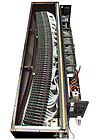
The digital detector array shown here is mechanically configured for use at a specific distance from the source, allowing each discrete detector board to maintain a consistent focal distance. Source: Varian
High-Energy X-ray Systems
Traditional X-ray tubes commonly used to image small objects provide a solution for many nondestructive testing applications. However, the physical properties of most X-ray tubes limit their output to about 450 kilovolts (kV) and a continuous dose rate of 15 to 30 rads/minute at 1 meter. At these maximum kilovolt energies and dose combinations, effective penetration through steel remains well under 4 inches. For example, a typical 250 kV output equates to a half value layer through steel of 0.25 inch, allowing for effective imaging of a 2 to 2.5 inch thick steel section (ref. ANSI Standard E94-00).Certainly, tube-based X-ray sources are effective for many applications, but thicker or denser materials such as turbine blades or heavy castings require the substantially greater penetration possible with X-ray accelerator technology. X-ray linear accelerators produce high dose rates (flux) and have energy outputs in the megavolt range.
While 1 mega electron volt (MeV) to 9 MeV accelerators will meet most inspection requirements, higher energy accelerators now are available with the capability to image thick and dense objects such as heavy equipment castings and rocket motors. With X-ray outputs available exceeding 15 MeV, these machines can penetrate 18 inches of steel or more, and are typically used by organizations such as NASA to examine large rocket motors.
Even with such massive energy outputs, these large X-ray machines are available with focal spot sizes in the 1 to 4 millimeter range and can operate continuously for hours without interruption. Motorized collimators can be attached and remotely controlled to alter the beam shape to match the desired imaging profile. This is particularly important when using digital detector arrays because careful alignment of the beam to the detector system significantly reduces the amount of unwanted scatter affecting the image.
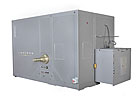
A 15 MeV accelerator with motorized collimator is shown here. Motorized collimators can be attached and remotely controlled to alter the beam shape to match the desired imaging profile. Source: Varian
High-Energy Digital Detectors
While film has been the mainstay of X-ray imaging since its origins, the recent trend has been to convert to digital detectors, particularly for kilovolt energy X-ray systems. Although many quality engineers continue to prefer using traditional film images, digital images have proven to be equal or better contenders for most industrial applications. However, for high-energy applications, the introduction of digital imaging has been more challenging and complex. High-energy digital detectors must be carefully designed to withstand X-ray impingement that would otherwise damage the electronics at each detector site. Because the damage occurs primarily as a function of the cumulative dose that is absorbed by the detector electronics, engineers have developed a number of novel design techniques to address these issues. For example, designers have used alternative spatial orientation, special shielding and fiber optics to reduce the quantity and impact of accumulated dose, creating robust detector systems.The optimal performance of digital detectors requires additional design considerations, primarily based on their intended application. For example, the array may be mechanically configured for use at a specific distance from the source, allowing each discrete detector board to maintain a consistent focal distance. Additional design considerations include overall size and spatial orientation, temperature control for noise reduction, the use of special detector assemblies such as coupling CdWO4 scintillators to Si photodiodes‚ and optimizing the detector pitch to match the collimated opening.
CT Applications
Computed tomography (CT) of large objects such as car engines or even entire cars has become possible due to the confluence of three technologies. In addition to linear accelerators, which provided the necessary energy to penetrate dense objects, and digital X-ray detectors, which capture immense amounts of data and store it in computer files, the third technology is computational power and associated software. This allows for many sophisticated features such as detailed 3-D image construction, section highlighting, density colorization and defect recognition. These applications require specially designed computers and software packages that often use multiple hardware graphics chips and networked processors to perform the parallel processing required for real-time or near real-time imaging. Other software applications are available that provide tools for X-ray metrology to accurately measure internal artifacts, clearances and defects that cannot be measured in any other way. In addition, systems are becoming available that automate this process for seamless operation in automated manufacturing operations.A 2 MeV CT system is available wherein both the source and detectors move vertically while the object under inspection rotates. This system can image engine blocks and other intricate objects allowing for prototype verification, reverse engineering and the recognition of hidden defects.
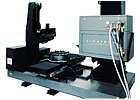
This 2 MeV Industrial CT system can image engine blocks and other intricate objects allowing for prototype verification, reverse engineering and the recognition of hidden defects. Source: Varian
Large Object Examination
While high-energy radiography may be used to examine relatively small objects such as some gas turbine blades, it is particularly valuable for larger objects such as heavy equipment castings, rocket motors and entire vehicles for design analysis or security inspection. Traditionally, large objects were X-rayed in sections, applying film to individual areas and making a series of exposures, carefully documenting the area that corresponded to each film. This time-consuming process has been replaced with the advent of digital detector arrays, allowing an entire truck-sized object to be examined at once. Mechanically, this requires a more complex system, requiring both the X-ray source and the detector array to move together across the object or, alternatively, the object can be moved through a fixed imaging assembly.The growing popularity of industrial CT and security scanning applications, which require digital detector technology, has resulted in more cost-effective digital detector products and led the conversion away from film-based imaging. Current detectors offer higher resolution, faster speeds, lower cost and increased sensitivity in comparison to products available just a few years ago. This trend should continue, accelerating the transition from film-based to digital systems.
A number of new and exciting high-energy X-ray inspection and testing applications are emerging because of the confluence of three technologies-linear accelerators, high-energy detectors and computerized image processing. Collectively, these technologies should continue to grow and add a new dimension to the field of nondestructive testing. Thus, practitioners will find new tools and techniques available that offer greater value to the nondestructive testing marketplace.
Looking for a reprint of this article?
From high-res PDFs to custom plaques, order your copy today!