Eight Leak Testing Tips
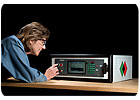
This multi-channel leak flow tester cycles through simultaneous tests at the push of a button. Source: Uson
Must quality engineers and product managers always be at odds? The former seeks perfection while the latter pushes for greater throughput. With the latest improvements in leak detection devices, both agendas can be served, as the best examples of this testing equipment help speed the quality control process without sacrificing accuracy.
Particularly when manufacturing for critical applications, where every single product must be tested, the consequences for component failure can come back to haunt the manufacturer in the form of expensive liability claims. Armed with some advanced knowledge about what to look for in leak detection devices, test engineers can increase the odds that all products will roll off the production line with absolute quality assurance without acting as an anchor to production schedules.
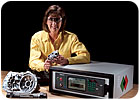
Some units offer a simple programming process with a high-resolution color graphic interface and provide accurate measurement of minute pressure and flow changes. Source: Uson
1. Insist on Application Specificity
A one-size-fits-all approach only succeeds at being universally mediocre. Leak testing equipment demands attention to detail because even very small leaks can mean the difference between product success or failure in critical applications. Any test equipment must be designed so that it can be adapted to accurately meet the needs of the quality check at hand.For particularly challenging applications, the experience of the test equipment vendor accounts for the bulk of successfully channeling a leak tester’s capabilities for the benefit of a specific product. The vendor should consider each unique case, and then maximize the potential of the test equipment to fit that need through a redesign of the tester or by reconfiguring it-with custom-designed pneumatic circuits, for example-to integrate within the manufacturer’s production system.
2. Look for Equipment that Automates the Testing Process as Much as Possible
Ideally, test equipment must feature semi-automatic or fully automated leak detection systems that streamline product delivery, sealing, clamping, testing and marking.Timesaving features such as infills-which reduce volumes and allow for varying container sizes to be tested in the same chamber with minimum changeover time and expense-PLC connectivity and remote-start input, can greatly speed the testing process.
Additionally, the latest multi-channel testers, some of which can run up to 10 channels, automatically cycle through all the tests at the push of a button.
3. Examine Ease of Operation
A leak tester, no matter how capable its performance, is nothing if the human-machine interface lacks ready comprehension. Programming should be simplified by software with preformatted test configurations easily modified to each application.Leak testers that work within the Windows environment also lend themselves toward instant, intuitive operation. Added features to look for include touch-screen input, large graphical displays, selectable engineering units, built-in diagnostics and remote troubleshooting.
4. Check for Fixturing that Fits the Product
Partly a product of application specificity, the physical process of affixing the product to the leak tester is extremely important, as failures here can quickly undo all other attempts at accuracy and expediency.At a minimum, leak detection testers should have attributes such as automatic clamping, sealing and interlocking guards that perfectly match the dimension orifices of the part under test. When speed counts, “quick connect” or “auto coupling” pneumatic self-sealing devices can be specified.
Some leak testers have the potential-by way of custom volume filling inserts-to accommodate industrial components ranging from lumens measured in millimeters, all the way up to 4.5-inch diameter orifices.
On the other hand, when complicated products, such as those with unusual geometry or multiple orifices, require testing, then a vendor who manufactures custom couplings must be located. Find one that will arrange custom computer numerical control work to create fixtures to handle square and other odd-shaped orifices.
5. Hold Out for Options in Output
When it comes to certifying a manufacturing process, there is nothing like a good paper trail. A complete leak detection system must include options for documenting the testing process.At a minimum, the tester should be able to input leak rates and other results right into a database such as Access or spreadsheet such as Excel, for archival purposes.
Other industry options for downloading data include RJ-45 Ethernet connectors, RS-232 serial ports, PCMCIA card slots, digital I/O cards and 24-volt reference outputs. Also helpful are screens that display results at the control unit for interrogation by a supervisor as required. Marking capabilities, whether by ink, percussion or laser, also speed and reinforce the documentation process.
6. Consider Repeatability
A test has no meaning unless it can be repeated with the same results.Unlike reliance on the memory of an operator to initiate a sequence of tests, the automation of leak-detection actually improves repeatability because the testing process becomes non-subjective. Innate to some leak detection equipment, the ability to automatically compensate for temperature and humidity changes also helps ensure consistent product quality.
7. Demand Good Support from the Supplier
Like most any other sophisticated piece of equipment, a leak tester is only as good as the support it gets after it leaves the factory. Here again, the number of years a supplier has been in business counts for a lot, as this adds to its knowledge base in following up on challenging applications.Look for a supplier that offers custom system design, installation and commissioning services. Also, some suppliers provide online tools to help test engineers dial in their testing parameters such as quick calculations for hole diameter to flow rate calculation; leak correlation for one gas relative to another; leak rate to pressure drop relationship; flow rate conversion; conversion for volume; conversion for pressure; and hole/size/flow rate approximation.
8. Seek System Flexibility for Future Upgrades
Nothing is constant. Product variations, specification changes and the introduction of new components all mandate changes in testing parameters. A quality leak tester can accommodate such changes, saving the expense of having to buy a totally new piece of equipment.A modular design suits future needs particularly well, as operators can choose only those features that may be needed for initial requirements, but later expand the same unit to add capabilities for more complicated applications easily and economically. NDT
Looking for a reprint of this article?
From high-res PDFs to custom plaques, order your copy today!