Understanding Camera Interfaces
Various camera interfaces are available today, each with unique specifications.
Camera interface standards-including analog, Camera Link, FireWire, USB and Gigabit Ethernet (GigE)-all provide features suited to different applications.There is no perfect one-size-fits-all solution, so standards have sprung up, each offering something different, whether it is long cable lengths, as with GigE, or higher resolution, as with Camera Link.
But in addition to the features available today, it is important to consider tomorrow’s anticipated needs when making a selection. Some standards have a roadmap to increase resolution in the future, as application needs may change.
Factors to consider when choosing a suitable camera interface type include frame rate and bandwidth requirements, data transfer reliability, cable length and, of course, cost. As with Goldilocks, usually there is one interface that fits just right for the application. Today each standard has a place at the table.

GigE Vision is a camera interface standard developed using the Gigabit Ethernet communication protocol that allows for fast image transfer using low-cost standard cables. The Automated Imaging Association (AIA) oversees the ongoing development and administration of the standard.
Universal Serial Bus (USB) meanwhile is the lowest cost solution and it is easy to integrate a USB camera into the system-the advantage being that every computer has USB ports. Though USB has certain strengths, it has a 5-volt power limit and requires external power for high- performance charge-coupled device (CCD) cameras.
Camera Link is considered to offer the highest performance product with the fewest pieces, though it too has limitations, including cable length.
Of course, deciding on the best camera interface for the application is highly specific, but some general guidelines about each standard may prove helpful in making a decision.
Early on, customers had to wade through which camera to connect frame grabbers, Kinney says, and Camera Link sought to address this first. Among the standards, Camera Link offers the highest performance product with the fewest pieces, Kinney says.
Camera Link cable lengths, possibly considered a limiting factor, can be extended now, Kinney says, and it is generally seen as 10 meter length needed to meet the full standard, though some applications have used longer cables successfully.
Cable length is one of the deciding factors when choosing a camera interface. If long cable lengths are needed, look no further than GigE, which offers cable lengths up to 100 meters.
“We’re all selling GigE cameras,” Kinney says, “and most people in the industry, and industry users, will tell you that GigE will replace the FireWire market. Eventually it will level off or decrease, whereas GigE will increase significantly.”
Camera Link adds value to the system that has high resolution and high frame rate, such as those typically used in the semiconductor electronics industry, as well as those used for solar inspection. When you need high resolution and high speed, it is an excellent option, Kinney says.
But for those looking to implement something from scratch, it is easier to choose a new technology when there is not as much legacy hardware to update, allowing companies to start fresh without worrying about old equipment. The future points to digital, however, as companies look at the availability of cameras to support them in the future. And in some cases, the latest and greatest capabilities also may prompt a switch.
After customers are able to do something, they wonder what else they can do, which may push them to the next level of performance and the next interface.
JAI aims to help customers with the analog to digital transition. Customers would like to avoid maximum redesign of their systems, so JAI tries to make everything look as common and seamless to them by providing similar features and components on the cameras.
Tiarks explains that GigE is easier to integrate into the application than other standards, as everything is based on standard GigE components, making it easy to get the components together. Most of these components are commercially available, making it cheaper to design in GigE from a commercial standpoint. From a technical standpoint, Tiarks adds, with up to a 100-meter cable length, GigE offers more flexibility in terms of cable length with 10 times more length than Camera Link and more than 20 times more than FireWire.
Another argument for GigE, Tiarks says, is that it easily puts more than one camera in the same system. GigE is already made for networks, making it easier to have more cameras running, while FireWire and Camera Link are not targeted specifically toward networking.
Despite the benefits, those who have applications programmed to FireWire will continue to use it because of the system coding changes involved; the prospect of doing additional coding is not appealing to many.
GenICam, a generic programming interface used for GigE, can be used for other interfaces as well, including Camera Link, FireWire and USB. It is administered by the European Machine Vision Association (EMVA).
The GigE roadmap provides for 1 gigabit today, and aims for 10 gigabits adoption in the future, and eventually 100 gigabits. These scheduled changes make it an interesting interface to follow, Kinney says. Today it remains costly to get components for 10 GigE, so low-cost 10 GigE is not ready to be used just yet, but as 10 GigE becomes more common, GigE Vision will be the fastest connection in the industry, according to the AIA.
“FireWire, in the long term, not mid-term, will be fully replaced by GigE, probably Camera Link too, in certain applications,” Tiarks says, “but we also design new product lines on Camera Link due to the fact that Camera Link has certain strengths above GigE.”
For customers looking for more data and higher bandwidth, Camera Link is the answer.
There is not a big difference between FireWire and GigE when only comparing cameras. If more than one camera is needed-a common scenario-GigE offers cost advantages against FireWire, because one can use off-the-shelf systems.
One of the biggest advantages of GigE is the Ethernet technology already has mechanisms to address devices with IP addresses, and it is easier to add more cameras to a system. FireWire, on the other hand, requires that one camera is used with one PC, in a 1 to 1 ratio. When using more than one camera, FireWire requires use of more than one interface card, Tiarks explains. With GigE, one card can handle up to four cameras.
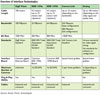
When guiding customers through the maze of camera interface options, Buttress says data transfer bandwidth (frame resolution x frame rate x bytes per pixel) may eliminate certain interfaces. Normally the interface selection process starts with the bandwidth requirements, then factors in other requirements, including the distance between the camera and host processor.

A Camera Link committee is in place now. “We’re continuing an effort to revise the standard to better describe the cable,” Fryman says. “That work is progressing.”
Though GigE is still new, launched at the Vision Show East in April 2006, it has been slated for updates. GigE Vision 1.1 is slated for release this month for an incremental update and better documentation. Version 1.2 will be another incremental update, possibly with minor feature adjustments. Version 2.0 will be the future-new, better and faster-and a committee is working to define what that means, Fryman says.
While GigE is the exciting new kid on the block, Camera Link remains a reliable option.
“Both standards have their advantages,” Fryman says. “They each have a niche, if you will. GigE for its ease of use, networking capability, its flexibility,” he says. “Camera Link for its feature richness and quality. I always consider Camera Link to be the higher end.”
Fryman described GigE Vision as a practical solution for the masses. Camera Link is an excellent solution as long as you do not want to go further than 10 meters, Fryman says. But for applications requiring cable lengths of longer than 10 meters, GigE is there.
Whether the application specifications call for analog, Camera Link, FireWire, USB or GigE, it is important that the interface standard fits the application, both today and tomorrow. Keeping up-to-date on standards development also is critical, as they are constantly being addressed and improved. And while manufacturers today have more complicated choices than those faced by Goldilocks, they should still be able to find something that fits just right. V&S
For more information on the organizations mentioned in this article, visit
• Automated Imaging Association (AIA), www.machinevisiononline.org
• Basler Vision Technologies, www.baslerweb.com
• European Machine Vision Association (EMVA), www.emva.org
• JAI, www.jai.com
• Sony, www.sony.com/videocameras
Editor’s note: Those interested in becoming involved with standards development should contact Jeffrey Fryman at [email protected].
- Camera Link uses a dedicated cable connection and a standardized communications protocol. This standard connection allows cameras and frame grabbers complying to the standard to freely exchange data.
- FireWire offers real-time capability through isochronous data channels, and asynchronous data transfer for setting camera parameters.
- USB is a low-cost, easy to implement solution, though it is not recommended for use in high-performance machine vision.
- Analog is still king in terms of market share, though it has been losing ground to digital.
Camera interface standards-including analog, Camera Link, FireWire, USB and Gigabit Ethernet (GigE)-all provide features suited to different applications.There is no perfect one-size-fits-all solution, so standards have sprung up, each offering something different, whether it is long cable lengths, as with GigE, or higher resolution, as with Camera Link.
But in addition to the features available today, it is important to consider tomorrow’s anticipated needs when making a selection. Some standards have a roadmap to increase resolution in the future, as application needs may change.
Factors to consider when choosing a suitable camera interface type include frame rate and bandwidth requirements, data transfer reliability, cable length and, of course, cost. As with Goldilocks, usually there is one interface that fits just right for the application. Today each standard has a place at the table.
This GigE connector is used on the newer cameras, with indicator lights and thumbscrew holes for secure connections in industrial environments. Source: JAI
Overview
Analog provided a base for the industry, and while it is still on top in terms of sheer volume, its numbers are decreasing. The writing on the wall, as one may have guessed, does not point to the future of analog. However, experts are quick to point out that analog still works and it is being used in many applications today.GigE Vision is a camera interface standard developed using the Gigabit Ethernet communication protocol that allows for fast image transfer using low-cost standard cables. The Automated Imaging Association (AIA) oversees the ongoing development and administration of the standard.
Universal Serial Bus (USB) meanwhile is the lowest cost solution and it is easy to integrate a USB camera into the system-the advantage being that every computer has USB ports. Though USB has certain strengths, it has a 5-volt power limit and requires external power for high- performance charge-coupled device (CCD) cameras.
Camera Link is considered to offer the highest performance product with the fewest pieces, though it too has limitations, including cable length.
Of course, deciding on the best camera interface for the application is highly specific, but some general guidelines about each standard may prove helpful in making a decision.
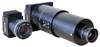
The Camera Link interface, used on these cameras, offers the highest performance product with the fewest pieces. Source: Basler Vision Technologies
Camera Link
Steve Kinney, JAI (San Jose, CA) director of technical presales and support and chairman of the Camera Link committee since its inception, is deeply involved with Camera Link, GigE Vision and other interfaces. Although JAI supplies a broad range of interfaces including GigE Vision, Camera Link, Mini-Camera Link, analog, low-voltage differential signaling (LVDS) and RS-422, the company is banking on GigE vision and Camera Link, Kinney says. While analog is still king in terms of market share, it is no secret that most of the world is going digital.Early on, customers had to wade through which camera to connect frame grabbers, Kinney says, and Camera Link sought to address this first. Among the standards, Camera Link offers the highest performance product with the fewest pieces, Kinney says.
Camera Link cable lengths, possibly considered a limiting factor, can be extended now, Kinney says, and it is generally seen as 10 meter length needed to meet the full standard, though some applications have used longer cables successfully.
Cable length is one of the deciding factors when choosing a camera interface. If long cable lengths are needed, look no further than GigE, which offers cable lengths up to 100 meters.
“We’re all selling GigE cameras,” Kinney says, “and most people in the industry, and industry users, will tell you that GigE will replace the FireWire market. Eventually it will level off or decrease, whereas GigE will increase significantly.”
Camera Link adds value to the system that has high resolution and high frame rate, such as those typically used in the semiconductor electronics industry, as well as those used for solar inspection. When you need high resolution and high speed, it is an excellent option, Kinney says.
Analog
Though analog technology has not progressed as rapidly as the digital standards, in many cases it is a question of how rapidly the companies want to change everything, Kinney says, the idea being “if it ain’t broke, don’t fix it.”But for those looking to implement something from scratch, it is easier to choose a new technology when there is not as much legacy hardware to update, allowing companies to start fresh without worrying about old equipment. The future points to digital, however, as companies look at the availability of cameras to support them in the future. And in some cases, the latest and greatest capabilities also may prompt a switch.
After customers are able to do something, they wonder what else they can do, which may push them to the next level of performance and the next interface.
JAI aims to help customers with the analog to digital transition. Customers would like to avoid maximum redesign of their systems, so JAI tries to make everything look as common and seamless to them by providing similar features and components on the cameras.
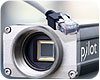
GigE Vision is a camera interface standard that allows for fast image transfer using low-cost standard cables. This pilot camera is pictured with a Gigabit Ethernet cable. Source: Basler Vision Technologies
GigE
GigE Vision is becoming more and more popular, experts agree, with a fast growth rate and many new designs based on GigE, says Henning Tiarks, product manager for Basler Components (Ahrensburg, Germany). Basler has different product lines in order to leverage different interface standards, including Camera Link, GigE and FireWire.Tiarks explains that GigE is easier to integrate into the application than other standards, as everything is based on standard GigE components, making it easy to get the components together. Most of these components are commercially available, making it cheaper to design in GigE from a commercial standpoint. From a technical standpoint, Tiarks adds, with up to a 100-meter cable length, GigE offers more flexibility in terms of cable length with 10 times more length than Camera Link and more than 20 times more than FireWire.
Another argument for GigE, Tiarks says, is that it easily puts more than one camera in the same system. GigE is already made for networks, making it easier to have more cameras running, while FireWire and Camera Link are not targeted specifically toward networking.
Despite the benefits, those who have applications programmed to FireWire will continue to use it because of the system coding changes involved; the prospect of doing additional coding is not appealing to many.
GenICam, a generic programming interface used for GigE, can be used for other interfaces as well, including Camera Link, FireWire and USB. It is administered by the European Machine Vision Association (EMVA).
The GigE roadmap provides for 1 gigabit today, and aims for 10 gigabits adoption in the future, and eventually 100 gigabits. These scheduled changes make it an interesting interface to follow, Kinney says. Today it remains costly to get components for 10 GigE, so low-cost 10 GigE is not ready to be used just yet, but as 10 GigE becomes more common, GigE Vision will be the fastest connection in the industry, according to the AIA.
FireWire (IEEE 1394)
Customers are forcing manufacturers to provide cheaper cameras, Tiarks says, and not all standards will survive the next step. He predicts that not every interface will withstand the demand for cheaper products.“FireWire, in the long term, not mid-term, will be fully replaced by GigE, probably Camera Link too, in certain applications,” Tiarks says, “but we also design new product lines on Camera Link due to the fact that Camera Link has certain strengths above GigE.”
For customers looking for more data and higher bandwidth, Camera Link is the answer.
There is not a big difference between FireWire and GigE when only comparing cameras. If more than one camera is needed-a common scenario-GigE offers cost advantages against FireWire, because one can use off-the-shelf systems.
One of the biggest advantages of GigE is the Ethernet technology already has mechanisms to address devices with IP addresses, and it is easier to add more cameras to a system. FireWire, on the other hand, requires that one camera is used with one PC, in a 1 to 1 ratio. When using more than one camera, FireWire requires use of more than one interface card, Tiarks explains. With GigE, one card can handle up to four cameras.
Source: Basler Vision Technologies
Selection
Sony Visual Imaging Products (Park Ridge, NJ) offers 1394.b, Camera Link, analog, and soon, GigE cameras, says product manager Drew Buttress. Camera interface selection may depend on a variety of factors, including deterministic data transfer. In other words, “If the application cannot tolerate varying latencies in the data transfer between camera and processor, Camera Link would be a better interface option than GigE,” Buttress says. “Camera Link is deterministic, while Ethernet is not.”When guiding customers through the maze of camera interface options, Buttress says data transfer bandwidth (frame resolution x frame rate x bytes per pixel) may eliminate certain interfaces. Normally the interface selection process starts with the bandwidth requirements, then factors in other requirements, including the distance between the camera and host processor.
This fluorescent tube inspection system, built by one of JAI’s customers, shows standard CAT6 Ethernet cable connected to a standard GigE interface. Source: JAI
Standards Development
Standards, of course, do not materialize out of thin air, and no one knows this better than Jeffrey Fryman, director of standards development at the AIA (Ann Arbor, MI). During Fryman’s tenure at the AIA-he has been with the organization since 1996-he has seen many changes in camera interface standards as well as new standards, and says that the standards continue to evolve.A Camera Link committee is in place now. “We’re continuing an effort to revise the standard to better describe the cable,” Fryman says. “That work is progressing.”
Though GigE is still new, launched at the Vision Show East in April 2006, it has been slated for updates. GigE Vision 1.1 is slated for release this month for an incremental update and better documentation. Version 1.2 will be another incremental update, possibly with minor feature adjustments. Version 2.0 will be the future-new, better and faster-and a committee is working to define what that means, Fryman says.
While GigE is the exciting new kid on the block, Camera Link remains a reliable option.
“Both standards have their advantages,” Fryman says. “They each have a niche, if you will. GigE for its ease of use, networking capability, its flexibility,” he says. “Camera Link for its feature richness and quality. I always consider Camera Link to be the higher end.”
Fryman described GigE Vision as a practical solution for the masses. Camera Link is an excellent solution as long as you do not want to go further than 10 meters, Fryman says. But for applications requiring cable lengths of longer than 10 meters, GigE is there.
Whether the application specifications call for analog, Camera Link, FireWire, USB or GigE, it is important that the interface standard fits the application, both today and tomorrow. Keeping up-to-date on standards development also is critical, as they are constantly being addressed and improved. And while manufacturers today have more complicated choices than those faced by Goldilocks, they should still be able to find something that fits just right. V&S
For more information on the organizations mentioned in this article, visit
• Automated Imaging Association (AIA), www.machinevisiononline.org
• Basler Vision Technologies, www.baslerweb.com
• European Machine Vision Association (EMVA), www.emva.org
• JAI, www.jai.com
• Sony, www.sony.com/videocameras
Editor’s note: Those interested in becoming involved with standards development should contact Jeffrey Fryman at [email protected].
Tech Tips
- GigE Vision offers uncompromised data transfer up to 100 meters in length. Its high bandwidth allows large uncompressed images to be transferred quickly in real time.- Camera Link uses a dedicated cable connection and a standardized communications protocol. This standard connection allows cameras and frame grabbers complying to the standard to freely exchange data.
- FireWire offers real-time capability through isochronous data channels, and asynchronous data transfer for setting camera parameters.
- USB is a low-cost, easy to implement solution, though it is not recommended for use in high-performance machine vision.
- Analog is still king in terms of market share, though it has been losing ground to digital.
Looking for a reprint of this article?
From high-res PDFs to custom plaques, order your copy today!