A Camera's Computer Connection
The analog camera has not gone the way of the horse and buggy-or the VCR to be more apt-but its popularity has waned as the digital camera has become more prominent and the data collected during machine-vision operations has expanded.
While analog cameras still continue to play a pivotal role in many machine-vision operations, and will most likely continue to do so, the digital camera and the interfaces that tie it to the computer and eliminate the need for frame grabbers have gained prominence.
“It is not surprising that with everything going digital, camera interfaces are moving to digital also,” explains Valerie Bolhouse, a machine vision expert formerly of Ford Motor Co. Bolhouse is the author of the book, Fundamentals of Machine Vision, and a frequent speaker. “With a digital interface you eliminate the digital to analog and the analog to digital converters. The digital information gets transferred directly into the computer.”
To move the image data from the camera, or cameras in a multi-camera setup, to the host computer are interfaces that act fast and are more flexible in where and how they are used. These interfaces have sprung from the consumer electronics well, in the case of USB and FireWire, as well as from the industrial world in terms of the Camera Link specification and the GigE Vision standard.
Choosing the camera interface for test, measurement and inspection applications requires the operator to understand his needs and knowledge set. Will a lone camera be needed or multiple cameras? How far away will the cameras be from a PC or repeating technology? What are the production speeds and cycle times and how will that determine frames per second requirements? Will the camera be required for real-time inspection, sample inspection or simply to collect data for future data mining analysis?
Realizing this myriad of application possibilities, camera manufacturers have flooded the market with new products in each interface category. Often the same model of camera can be retrofitted to be compliant with different standards. These can range from cameras with high megapixel resolution to high frames per second rates and from compact cameras to thermal imagers. Software developers too have tailored their products to seamlessly integrate with the appropriate interfaces.
Gigabit Ethernet
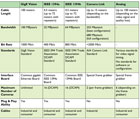
Of all the digital interfaces, GigE, or Gigabit Ethernet, has generated the most excitement despite its low market penetration, says Bolhouse. Primarily, this is because of the transfer rates and cable distances.GigE Vision is a camera interface standard developed by the Automated Imaging Association (AIA) that uses the Gigabit Ethernet communication protocol, according to a white paper by George Chamberlain, president of Pleora Technologies (Kanata, Canada), and a leader in the standard’s development. It features transfer rates of up to 1,000 megabits per second of data using standard cables in lengths up to 100 meters. The standard allows hardware and software from different vendors to interoperate seamlessly over GigE connections.
‘‘Using a standard interface allows component manufacturers to bring their products to market faster by eliminating the time-consuming steps of multi-vendor integration,” says Jeffrey Fryman, AIA’s director of standards. “An industry-adopted standard means real cost savings for component manufacturers, freeing up funds for innovation in R&D, and makes entry into new markets easier. Additionally, the interface is plug-and-play making it easy to use, a real benefit to end users.”
Growth in GigE Vision camera sales is anticipated to be strong, according to Paul Kellett, AIA’s director of market analysis. ‘‘GigE camera sales represented just 0.7% of the market in 2005 and we forecast that to grow to 26.4%, or $34 million in 2010,” he says.
Use of the standard may grow with the addition of the GenICam standard developed by the European Machine Vision Association. It provides a standardized programming interface to machine vision cameras. While initially focused on the GigE standard, GenICam will be able to provide a generic programming interface for all kinds of cameras no matter what interface technology.
Basler Vision Technologies (Exton, PA), for instance, has launched more than 30 new GigE vision cameras since 2006 and many were launched with an eye to GenICam. Henning Tiarks, product manager for Basler Vision Components, says: “We see tremendous demand for GigE-based cameras in the machine vision industry because of the long cable lengths and increased bandwidth that GigE Vision affords.” Tiarks adds that because certain Basler cameras, including the Scout and Pioneer lines, adhere to GenICam, “customers are assured that our cameras are easy to use and economical to implement into their vision systems.”
The highly scalable interface will follow the growth of Ethernet bandwidth. As 10 GigE becomes a mainstream protocol, GigE Vision will be the fastest connection in the industry.

Camera Link
Camera Link is a specification managed by the AIA that defines bi-directional high-speed links over specialized cabling between cameras and PCs.The maximum cable distance is 10 meters, and connections are strictly point-to-point. Camera Link defines three configurations: base, medium and full with bandwidths of 2,380 megabits per second, 4,760 megabits per second, and 7,140 megabits per second.
Camera Link, says Bolhouse, was designed specifically for digital video from the camera to the computer. It is not a general-purpose protocol and requires installing a board inside an expansion slot. It provides the highest speed data transfer rate of 250 megabytes per second in the base mode.
“The data transfer does not require CPU time. In addition, Camera Link provides deterministic timing so you know exactly how long the data transfer time will be,” says Bolhouse.
A recent upgrade to the Camera Link standard is in regards to bringing power to the camera. The AIA’s Camera Link committee has added Power over Camera Link (PoCL) capabilities for cameras operating in the base mode. According to a white paper from Dorval, Canada-based Matrox Imaging, the difference between the original Camera Link standard and PoCL is the pin re-assignment. The original design dedicated pins 1, 13, 14 and 26 to ground. In the new design, pins 1 and 26 are redesigned for power and deliver up to 4W.
Fire Wire
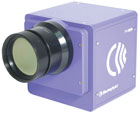
IEEE 1394, or FireWire, was originally developed by Apple for use on its Macintosh computers, and its standardization was finished in 1995. The first version was 1394a and that version transmitted data at 100, 200 or 400 megabits per second and featured a packet-based transmission protocol. The peer-to-peer communication interface uses standard cables and connectors.The IEEE 1394b was an upgrade from the earlier FireWire standard of 1394a, and it provides twice the speed, 800 megabits per second vs. 400. The good news for companies already using 1394a cameras is that the 1394b version is backward- compatible with 1394a devices. 1394b also has an increased maximum cable length of 100 meters, while 1394a was restricted to a 4.5-meter cable. The data transfer has low CPU overhead and provides for deterministic data transfer to the computer.
Because it came from the consumer side, a FireWire port is available on most PCs, and low-cost interface cards can be installed for multiple camera use. Because there is an industry standard for FireWire called DCAM, there is interchangeability for cameras in a system, meaning that a company can swap out one FireWire camera for another camera sold by a different supplier and it will work without software changes. A single, low-cost cable provides camera control, data transfer and power.
FireWire offers real-time capability through isochronous data channels, and asynchronous data transfer for setting camera parameters. A maximum of 64 devices can be attached to each IEEE 1394 bus and the buses can be connected to each other with a maximum of 64,449 devices on 1023 buses. In industrial applications, a maximum of four cameras is normal for a single bus.
USB
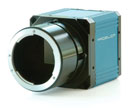
Universal Serial Bus (USB) is a connectivity specification developed by Intel and other technology industry leaders. Arguably the most successful interconnect in computing history, it has many consumer and industrial uses. While some of this technology would not be used in the machine-vision arena, many camera supplier have released cameras with USB technology.Recently, USB 2.0 was released as an upgrade to USB 1.1. The 2.0 version provides a data transfer of 480 megabits per second over standard 4-pin connector. A maximum 5-meter cable is allowed. According to Bolhouse, “The data transfer relies on the CPU for its bandwidth so it is not recommended for use in high performance machine vision.
One of USB’s strengths is that it is so well-known in the industry and the marketplace as a whole. GigE Vision too has its strengths, as do Camera Link and FireWire. Each one will fit and be exceedingly useful if placed in the best place to succeed. Because of this, camera manufacturers have developed a number of cameras and plan to continue to release the cameras that take the best advantage of each of these standards’ pluses and minuses.
Looking for a reprint of this article?
From high-res PDFs to custom plaques, order your copy today!