Six Steps to Sensor Success
How fast is fast? What does it mean to have a fast laser sensor? Either it measures, or it doesn’t, right? It depends what is meant by measure. Is the operator looking to measure a specific point on the part, high point, low point or get an average?
With competition so fierce, application engineers have to dig deep and ask all the correct questions to solve even what are considered simple applications. On the other hand, engineers need to do their homework and decide what attributes the laser will need before they begin the search for a displacement sensor. When equating research and proof of concept testing time to real dollars, it makes more sense to zero in on a possible solution as soon as possible. Many a time has an application engineer sent a design engineer back to the drawing board to reconfigure a tool either because he asked too much of the sensor or did not ask the application engineer enough questions. Often times, it is that little bit of information we fail to uncover that makes the difference between a solid solution and a waste of time.
For example, suppose you are a machine builder and are bidding on a job to measure eccentricity on bicycle tires to ensure the quality. In bidding on the job, you do your homework. You find that the customer is currently using a contact sensor. The contact sensors are discontinued and the manufacturer went out of business. They are on their last few spares. The project engineer in charge wants a noncontact solution in order to increase the quality of the tires while at the same time increasing the cycle time. The speed is not overly fast. The tolerances they want to hold seem overkill for the latest and greatest generation of laser displacement sensors. The environment is fairly clean and dust free. The temperature in the plant is constant. As for the measurement data, the customer would like to log it for statistical process control. Time wise, there is only one month the get the system designed, installed and validated.
Now, suppose you have exhausted all of the questions. Both you and your customer decide on a particular displacement sensor and software package that follows all the criteria and they buy it. One week later, the machine is built. Your technician travels to the job site to do the installation. However, later that same day, he calls with a problem. You ask, “How can I help you?” He says, “Can this sensor measure at a 45 degree angle?” You ask why, and he says, “The contact sensors we are replacing are 2 inches long. Our sensor with the cable is 3 inches long. We don’t have enough room.”
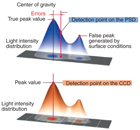
The laser displacement sensors are divided into two groups according to the device used for the light-receiving element: CCD and PSD. The CCD type offers more accurate measurement because it can measure the true peak position of the received light waveform. The prerequisite of the measurement is that the light reflected from the target returns to the receiver at optimum light intensity. The important point for achieving high performance is to provide good feedback of the light intensity. Source: Keyence
The steps
When choosing laser displacement sensors, many engineers never look beyond the specifications page. The stated resolution, accuracy, stand-off and measuring range sometimes do not tell the whole story. There are other factors to consider that depend solely on the particular application at hand. This is part of the prequalification process. Some common steps exist for many applications:1. What exactly is to be measured? Just saying height needs to be measured is not good enough. Is it height in a particular place, peak height or possibly an average height across the top of the part?
2. What is the nature of the target? What is it made of? What is the surface like? How big is it? Will the laser have trouble stably detecting the surface? Different types of laser detectors will sense some materials differently and some not at all. They generally will fall into three categories:
• Position Sensing Diode (PSD). This uses a position sensing diode as the detector. A PSD determines distance by determining where on a light sensitive diode a beam of light hits.
• Charge-Coupled Device (CCD). This uses a charge-coupled device as the detector much in the same way a CCD camera works. The difference is that there will be one or two rows of detectors instead of a whole array. Distance is determined by which particular CCD element the beam of light hits.
• Complementary Metal Oxide Semiconductor (CMOS). A complementary metal oxide semiconductor detector is very similar to a CCD. It also determines distance by which element the light beam is incident on.
Make sure, whichever type of sensor is chosen, that it will stably detect the target surface. For some sensors, black or glass targets are a problem. For others, highly porous materials are troublesome. Even beam spot size may be an issue for small surface areas.
3. What tolerances are you trying to hold? “As accurate as possible” is not a good answer. Laser displacement sensors tend to get more expensive as the accuracy increases. A clear statement of tolerances and accuracy is needed or one could be headed for a big waste of time.
When asking about accuracy, make sure to clarify the difference between accuracy and resolution. Normally resolution is the smallest change in displacement a sensor will see under ideal conditions. Accuracy can be thought of as how close to the true measurement the sensor will measure. The tolerance should never be the stated resolution. If so, be prepared for many sleepless nights. A good rule of thumb is to take the tolerance and divide it by 10. This value should be the accuracy of the sensor. When in doubt, test, test and test again.
4. Given the tolerance and accuracy needed, is it still in budget? This may be the quickest path to plan B. Keep in mind the reason for the measurement. If extreme accuracy is not needed, why spend the money?
5. Is the target moving or stationary? It is far easier to stably measure a nonmoving target. If the part is moving, this is where maximum line speed, target length, distance between targets, sampling frequency and response speed come into play.
Sampling rate is important because one will want to get as many measurements on the surface of the part as possible. The more measurements made, the more averaging one can employ and the more stable the measurement will be. Response speed is important because operators will need to discern between one measurement and the next. If the response speed is too slow, the system may not be able to react before the next part is ready to be measured. In cases of a slow response speed, one may have to increase the distance between targets, slowing down the cycle time.
6. In what environment will the sensor perform? Large temperature swings over or under the rated temperature specification can shorten the life of a laser displacement sensor. Are there harsh chemicals present that can damage the sensor? If needed, can the laser measure through clear protective material?
By following these six simple guidelines, not only can a more educated decision on choosing a laser displacement sensor be made, but you could save yourself and some unsuspecting application engineer some unnecessary grief. V&S
Tech Tips
- When asking about accuracy, make sure to clarify the difference between accuracy and resolution.- Normally resolution is the smallest change in displacement a sensor will see under ideal conditions. Accuracy can be thought of as how close to the true measurement the sensor will measure.
- The tolerance should never be the stated resolution. A good rule of thumb is to take the tolerance and divide it by 10.
Looking for a reprint of this article?
From high-res PDFs to custom plaques, order your copy today!


