LED: Smart Lighting for Machine Vision
Smart, integrated, machine vision design warrants serious consideratino of LED lighting.
Continuing improvements in efficiency, maximum optical power and cost reduction have been providing opportunities for smarter, improved sensing and control for machine vision applications.
The rate of light-emitting diode (LED) improvements is similar to the rate of improvements of silicon-based IC devices. Light output per LED has doubled about every two years since 1970 (Haitz’s Law), reminiscent of Moore’s Law for doubling of the number of transistors (on an integrated circuit) about every two years.
Similarly, this translates into more applications, larger production volumes and expanding markets. This pattern drives continuing efforts to improve performance, reduce costs and further expand applications. Performance improvements in several product areas strongly suggest consideration of their use in machine vision applications.
LED lighting has attractive features for many vision and sensing applications:
1. Rapid switching capability
2. Availability in many colors plus white in different geometries
3. Long life and low ongoing maintenance costs
4. Cool-literally and figuratively-operation with seriously reduced auxiliary cooling requirements
5. Small, flexible units
LED lighting is being applied in many areas, such as machine vision and sensing, automobile and traffic lights, camera flash units, digital displays, flashlights, room lighting and visual inspection. In particular, LED illumination can produce more visible light for a given electrical power level, with lower replacement and maintenance costs than old standbys, such as incandescent and fluorescent lighting. This has resulted in continuing replacement of these old standbys by LEDs.
The demonstrated improvements (Haitz’s Law) provide strong economic motivation for continuing growth in lighting, machine vision, sensing and other applications.
Use of rapid switching of LEDs can eliminate the need for a separate switching shutter or fast camera. It has advantages over dedicated strobes in terms of size, heat and need for input filters.
This rapid switching capability also has safety applications for automotive stop lights: LEDs can be turned on up to 0.5 second faster than thermally heated incandescent bulbs, which at higher speeds can be the equivalent of stopping a speeding car one car-length sooner. Accident statistics appear to support this claim.
There also are more surprising and exciting possibilities that may be obvious with 20/20 hindsight. For example, there is an LED communication system that sends information on the position of a scalpel in a brain during surgery to a local computer and superposes the scalpel position onto a 3-D image of the brain for viewing by the surgeon. The microsecond LED switching speed permitted use of standard telecom components. This system is currently being used in hospitals and is being sold by a major medical instrument corporation.
Spectral discrimination has many applications. This provides application to machine vision where the objects of interest have different spectral characteristics from background objects. This effectively converts many cluttered images into simple one-color images with critical features being the only objects imaged. It also is another means to reduce effects of background light.
Machine vision and sensing applications have included on-line detection of defects, labels and bottle caps, liquid level and food mold. This can include changes due to defects and foreign materials. It can also provide high signal-to-noise for effects of process variations.
For example, thermal treatment of critical components often results in color changes of the component. This has been used to determine the completion of the annealing process, after removal from the oven, for brake linings used on railroad trains; incomplete annealing means that the brake lining would most likely disintegrate after just a few stops.
The different geometries, such as linear, area, spot and curved surfaces, into which commercially available LEDs can be mounted simplify their use for different geometrical defects, as well as different transport and handling methods.
In addition to replacing ring lights (bright-field, dark-field, back illumination), broad area and spot illumination, LEDs can be used with other optical elements, including imaging fiber-optic endoscopes for optical access into bodies and articulated tubes.
For visual use, light source efficiency depends on how sensitive the human eye is to the color produced. The comparison is usually done in terms of lumens, which is optical power in the light output corrected for how sensitive the eye is to that color.
Infrared light sources produce zero lumens because the eye is not sensitive to infrared light, even though the infrared light might be the most effective wavelength for the task at hand.
From a visual standpoint, both LEDs and compact fluorescent bulbs have visual efficiencies-lumens per input electrical energy-that overlap, depending on the product. LEDs appear to be gaining in this regard from reported developments, new products and long-term history.
Both LEDs and compact fluorescent bulbs have significantly higher visual efficiencies than incandescent bulbs. Both are generally much better than incandescent lighting from the standpoint of green technology.
In comparison, a 40-watt incandescent lamp has an expected life span of 1,000 hours.
A 17- to 36-watt fluorescent lamp has a rated average life of 2,880 to 7,200 hours-better than an incandescent, but not as good as some current LEDs. This also can depend on how often the fluorescent lamp unit is switched on and off.
However, LED output can degrade slowly and, if operated at higher temperatures, will degrade somewhat faster but still be usable for very long periods of time.
Comparison tables suggest substantially lower costs for long-term use of LED light sources than for fluorescent and incandescent light sources.
In summary, LED performance continues to grow at about the same rate as semiconductor device performance and area have increased. Smart, integrated, machine vision design suggests serious consideration of LED lighting. V&S
LED lighting is being applied in many areas, such as machine vision and sensing, automobile and traffic lights, camera flash units, digital displays, flashlights, room lighting and visual inspection.
It can produce more visible light for a given electrical power level, with lower replacement and maintenance costs than old standbys, such as incandescent and fluorescent lighting.
The demonstrated improvements provide strong economic motivation for LED’s continued growth in lighting, machine vision, sensing and other applications.
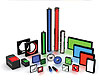
The different geometries into which commercially available LEDs can be mounted simplify their use for different geometrical defects, as well as different transport and handling methods. This illustrates some of the colors and geometries available. Source: Banner Engineering
Continuing improvements in efficiency, maximum optical power and cost reduction have been providing opportunities for smarter, improved sensing and control for machine vision applications.
The rate of light-emitting diode (LED) improvements is similar to the rate of improvements of silicon-based IC devices. Light output per LED has doubled about every two years since 1970 (Haitz’s Law), reminiscent of Moore’s Law for doubling of the number of transistors (on an integrated circuit) about every two years.
Similarly, this translates into more applications, larger production volumes and expanding markets. This pattern drives continuing efforts to improve performance, reduce costs and further expand applications. Performance improvements in several product areas strongly suggest consideration of their use in machine vision applications.
LED lighting has attractive features for many vision and sensing applications:
1. Rapid switching capability
2. Availability in many colors plus white in different geometries
3. Long life and low ongoing maintenance costs
4. Cool-literally and figuratively-operation with seriously reduced auxiliary cooling requirements
5. Small, flexible units
LED lighting is being applied in many areas, such as machine vision and sensing, automobile and traffic lights, camera flash units, digital displays, flashlights, room lighting and visual inspection. In particular, LED illumination can produce more visible light for a given electrical power level, with lower replacement and maintenance costs than old standbys, such as incandescent and fluorescent lighting. This has resulted in continuing replacement of these old standbys by LEDs.
The demonstrated improvements (Haitz’s Law) provide strong economic motivation for continuing growth in lighting, machine vision, sensing and other applications.
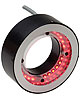
This single lighting module can provide bright-field and dark-field illumination; they can be used independently. Source: Advanced Illumination
1. Rapid Switching
LEDs can be switched on and off in less than 1 microsecond. This strobe effect provides the capability to capture sharp images of moving objects for machine vision applications in gaging, defect detection, code and document reading, among others. It also provides a means to reduce or eliminate ambient light effects when the LEDs deliver greater energy in a shorter exposure than the ambient light delivers to a camera with a shortened exposure time (for example, 1 millisecond or 1,000 microseconds).Use of rapid switching of LEDs can eliminate the need for a separate switching shutter or fast camera. It has advantages over dedicated strobes in terms of size, heat and need for input filters.
This rapid switching capability also has safety applications for automotive stop lights: LEDs can be turned on up to 0.5 second faster than thermally heated incandescent bulbs, which at higher speeds can be the equivalent of stopping a speeding car one car-length sooner. Accident statistics appear to support this claim.
There also are more surprising and exciting possibilities that may be obvious with 20/20 hindsight. For example, there is an LED communication system that sends information on the position of a scalpel in a brain during surgery to a local computer and superposes the scalpel position onto a 3-D image of the brain for viewing by the surgeon. The microsecond LED switching speed permitted use of standard telecom components. This system is currently being used in hospitals and is being sold by a major medical instrument corporation.
2. Availability in Many Colors and Geometries
LED units are commercially available from the ultraviolet to the near-infrared plus white. In particular, lighting modules are available in UV at 395 nanometers (nm), blue (470 nm), green (520 nm), yellow (590 nm), orange (625 nm), red (660 nm), infrared (880 nm) and white.Spectral discrimination has many applications. This provides application to machine vision where the objects of interest have different spectral characteristics from background objects. This effectively converts many cluttered images into simple one-color images with critical features being the only objects imaged. It also is another means to reduce effects of background light.
Machine vision and sensing applications have included on-line detection of defects, labels and bottle caps, liquid level and food mold. This can include changes due to defects and foreign materials. It can also provide high signal-to-noise for effects of process variations.
For example, thermal treatment of critical components often results in color changes of the component. This has been used to determine the completion of the annealing process, after removal from the oven, for brake linings used on railroad trains; incomplete annealing means that the brake lining would most likely disintegrate after just a few stops.
The different geometries, such as linear, area, spot and curved surfaces, into which commercially available LEDs can be mounted simplify their use for different geometrical defects, as well as different transport and handling methods.
3. Small, Flexible
The units generally make effective use of space. When color and switching speed or space requirements are involved, then the LEDs also can replace other components. This can simplify and reduce hardware, software and costs.In addition to replacing ring lights (bright-field, dark-field, back illumination), broad area and spot illumination, LEDs can be used with other optical elements, including imaging fiber-optic endoscopes for optical access into bodies and articulated tubes.
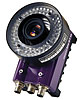
LED lighting is being applied in many areas, including machine vision. This is a smart camera with an LED ring light. Source: Matrox Imaging and Advanced Illumination
4. Cool Operation
For perspective, recall that transistors were developed to provide electronic amplifiers without requiring heated filaments. LEDs are the light producing equivalent in that they are solid-state devices without a heated filament, or surface-destroying energetic ions as in fluorescent bulbs. Of course, they also produce some heat. The actual relative efficiency depends on application and use.For visual use, light source efficiency depends on how sensitive the human eye is to the color produced. The comparison is usually done in terms of lumens, which is optical power in the light output corrected for how sensitive the eye is to that color.
Infrared light sources produce zero lumens because the eye is not sensitive to infrared light, even though the infrared light might be the most effective wavelength for the task at hand.
From a visual standpoint, both LEDs and compact fluorescent bulbs have visual efficiencies-lumens per input electrical energy-that overlap, depending on the product. LEDs appear to be gaining in this regard from reported developments, new products and long-term history.
Both LEDs and compact fluorescent bulbs have significantly higher visual efficiencies than incandescent bulbs. Both are generally much better than incandescent lighting from the standpoint of green technology.
5. Long Life and Low Maintenance Costs
The life span of LEDs is often quoted at about 50,000 hours.In comparison, a 40-watt incandescent lamp has an expected life span of 1,000 hours.
A 17- to 36-watt fluorescent lamp has a rated average life of 2,880 to 7,200 hours-better than an incandescent, but not as good as some current LEDs. This also can depend on how often the fluorescent lamp unit is switched on and off.
However, LED output can degrade slowly and, if operated at higher temperatures, will degrade somewhat faster but still be usable for very long periods of time.
Comparison tables suggest substantially lower costs for long-term use of LED light sources than for fluorescent and incandescent light sources.
In summary, LED performance continues to grow at about the same rate as semiconductor device performance and area have increased. Smart, integrated, machine vision design suggests serious consideration of LED lighting. V&S
Tech Tips
Looking for a reprint of this article?
From high-res PDFs to custom plaques, order your copy today!