Scaled Down Videoscopes
LED technology has made a dramatic impact to videoscope products on the market today.
The need to visually inspect areas the eye cannot normally see is not a new problem by any means. The field of remote visual inspection (RVI) is decades old and has seen many iterations of equipment and tools for a given job. Applications where rigid borescopes and fiberscopes were once the dominant players have increasingly seen a switch to videoscope technology as the preferred choice, as the need to store and process images has increased.
Some fiberscope operators utilized a kit of adapters and cameras which, in place of their eye, allowed the attachment of a film camera to a borescope or fiberscope eyepiece so images could be captured and reviewed at a later time. Not until a small charged coupled device (CCD) camera was placed into the distal end of a fiberscope was the videoscope truly born.
Some of the earliest videoscopes on the market were bulky units, which required A/C power to drive high wattage bulbs and light sources, as well as CCD camera controllers and TV monitors. As far as the insertion tube and control units, many of these systems actually closely resembled some of the fiberscopes they evolved from, with articulation systems, which worked in nearly identical manners to their fiberscope ancestors. However, these systems lacked the typical eyepiece found on a fiberscope and instead displayed the image on a CRT TV monitor.
As time passed, advances in technology have allowed both incremental and dramatic changes to videoscope products, making them steadily more useful than the fiberscope products they were once derived from.
Piece by piece, these videoscope systems have been improved to add new features and remove points of pain the typical operator experiences. Dramatic reductions in the size and weight and additions of digital storage media from floppy drives to USB storage have occurred, as well as additions of measurement tip adapters and software, which have helped make RVI a more quantitative inspection than the subjective one it once was.

LEDs are highly efficient sources of light that come in a variety of sizes and configurations. They have significantly longer life spans than a typical bulb while consuming a fraction of the power.
The efficiency of LEDs is one of the first features that have had a dramatic secondary impact on the way videoscopes are designed. While batteries for bulb-based videoscopes were previously available, they were rarely less than 30 pounds (13.6 kilograms), which made portability of the videoscope system difficult and unpractical. Thanks to the highly efficient, low-power consumption properties of LEDs, modern videoscope systems have been able to incorporate more reasonably sized batteries and not require A/C cords for long-term operation.
Given that the bulb consumed the vast majority of the videoscopes power, the introduction of LEDs also has allowed the size of the internal power supply circuitry to be scaled down, further reducing the size and weight of the system.
Another advantage of LED-based videoscope systems revolves around the fact that LEDs produce considerably less heat than traditional bulbs. Less heat means that less action must be taken to cool the system’s internal temperature to a normal operating level.
 While the vast majority of bulb-based systems included cooling fans to reduce heat, LED-based systems more often than not do not require these active cooling fans to maintain a normal working temperature. In many cases, LED-based videoscopes use heat sinks in place of fans, which allow the units to be sealed off and avoid sucking in any foreign debris or moisture from the outside via the fan vents. This ability to seal the units is the key to meeting many of the stringent standards for high-end videoscopes, such as IP-65 and MIL-STD 810F, and allow the videoscope to be used in environments such as rain or very high humidity, which previously would have debilitated a fan-based system.
Some LEDs are actually small enough and yet still bright enough for multiple units to be placed on the distal end of a videoscope in the tip adapter to provide light for the scope. These types of LED configurations completely replace the older method of transmitting light from a bulb in the main unit through a light guide bundle and out the distal end and provide further secondary benefits to the system. One of the greatest benefits of this configuration is the fact that the light guide bundle is no longer needed and can be removed entirely.
 Light guide bundles often can be the Achilles’ heel of the insertion tube in a bulb-based system, as the individual fibers can break if stepped on or bent too tightly, reducing the light output of the system. If the inspector applies too much weight to any portion of the insertion tube or gets the tube caught inside an engine, it is possible to break a large percentage of fibers all at once.
Furthermore, since these fibers cannot be repaired individually, the only option is to replace the entire bundle should the light output diminish to an unacceptable level. As such, the elimination of the fiber bundle within the insertion tube has significant cost benefits over the course of the life of the videoscope.
Compound this with the added lifespan of LEDs vs. bulbs which will need to be repeatedly replaced, and the cost of operating the system over time is reduced with LED-based systems.
Another advantage of LED-based systems in which no fiber bundle present is in long scope applications. In conventional systems, as the insertion tube gets longer, the light output is reduced due to losses in the fiber bundles, which are directly related to length. In LED-based systems where the LEDs are at the distal end, a 2-meter scope and an 18-meter scope have the exact same brightness; only the electrical wires supplying the LEDs power must be extended instead of the lossy fiber bundle.
There is no doubt that LED technology will continue to improve and be incorporated into future generations of videoscope systems. Because many of today’s videoscopes package the LEDs within the tip adapter of the videoscope, upgrading to a future generation of LEDs with an existing videoscope is as easy as swapping out a tip adapter.
LED technology also is migrating downward, and light source systems which are specifically designed for use with borescope and fiberscope systems also are beginning to incorporate the technology. As more and more products which feature LED technology are introduced into the market, it is quickly becoming apparent that LEDs are perhaps one of the most exciting and important innovations in RVI since the CCD chip.
LEDs are highly efficient sources of light that come in a variety of sizes and configurations.
LED-based systems often do not require active cooling fans to maintain a normal working temperature.
The elimination of the fiber bundle within the insertion tube has cost benefits over the course of the life of the videoscope.
The need to visually inspect areas the eye cannot normally see is not a new problem by any means. The field of remote visual inspection (RVI) is decades old and has seen many iterations of equipment and tools for a given job. Applications where rigid borescopes and fiberscopes were once the dominant players have increasingly seen a switch to videoscope technology as the preferred choice, as the need to store and process images has increased.
Some fiberscope operators utilized a kit of adapters and cameras which, in place of their eye, allowed the attachment of a film camera to a borescope or fiberscope eyepiece so images could be captured and reviewed at a later time. Not until a small charged coupled device (CCD) camera was placed into the distal end of a fiberscope was the videoscope truly born.
Some of the earliest videoscopes on the market were bulky units, which required A/C power to drive high wattage bulbs and light sources, as well as CCD camera controllers and TV monitors. As far as the insertion tube and control units, many of these systems actually closely resembled some of the fiberscopes they evolved from, with articulation systems, which worked in nearly identical manners to their fiberscope ancestors. However, these systems lacked the typical eyepiece found on a fiberscope and instead displayed the image on a CRT TV monitor.
As time passed, advances in technology have allowed both incremental and dramatic changes to videoscope products, making them steadily more useful than the fiberscope products they were once derived from.
Piece by piece, these videoscope systems have been improved to add new features and remove points of pain the typical operator experiences. Dramatic reductions in the size and weight and additions of digital storage media from floppy drives to USB storage have occurred, as well as additions of measurement tip adapters and software, which have helped make RVI a more quantitative inspection than the subjective one it once was.
Internals of an automotive part are illuminated with a LED equipped videoscope. Source: Olympus NDT
LEDs
In the past five to 10 years, another technology has made a dramatic impact to videoscope products on the market today. In turn, the introduction of this technology has paved the way for other improvements which would not have otherwise been possible. This technology is the light emitting diode or LED.LEDs are highly efficient sources of light that come in a variety of sizes and configurations. They have significantly longer life spans than a typical bulb while consuming a fraction of the power.
The efficiency of LEDs is one of the first features that have had a dramatic secondary impact on the way videoscopes are designed. While batteries for bulb-based videoscopes were previously available, they were rarely less than 30 pounds (13.6 kilograms), which made portability of the videoscope system difficult and unpractical. Thanks to the highly efficient, low-power consumption properties of LEDs, modern videoscope systems have been able to incorporate more reasonably sized batteries and not require A/C cords for long-term operation.
Given that the bulb consumed the vast majority of the videoscopes power, the introduction of LEDs also has allowed the size of the internal power supply circuitry to be scaled down, further reducing the size and weight of the system.
Another advantage of LED-based videoscope systems revolves around the fact that LEDs produce considerably less heat than traditional bulbs. Less heat means that less action must be taken to cool the system’s internal temperature to a normal operating level.
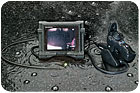
Reduced size and weight allows more operator flexibility with videoscope positioning as well as tight access applications. Source: Olympus NDT
Some LEDs are actually small enough and yet still bright enough for multiple units to be placed on the distal end of a videoscope in the tip adapter to provide light for the scope. These types of LED configurations completely replace the older method of transmitting light from a bulb in the main unit through a light guide bundle and out the distal end and provide further secondary benefits to the system. One of the greatest benefits of this configuration is the fact that the light guide bundle is no longer needed and can be removed entirely.
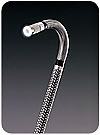
A tip adapter contains LEDs for illumination. Source: Olympus NDT
Furthermore, since these fibers cannot be repaired individually, the only option is to replace the entire bundle should the light output diminish to an unacceptable level. As such, the elimination of the fiber bundle within the insertion tube has significant cost benefits over the course of the life of the videoscope.
Compound this with the added lifespan of LEDs vs. bulbs which will need to be repeatedly replaced, and the cost of operating the system over time is reduced with LED-based systems.
Another advantage of LED-based systems in which no fiber bundle present is in long scope applications. In conventional systems, as the insertion tube gets longer, the light output is reduced due to losses in the fiber bundles, which are directly related to length. In LED-based systems where the LEDs are at the distal end, a 2-meter scope and an 18-meter scope have the exact same brightness; only the electrical wires supplying the LEDs power must be extended instead of the lossy fiber bundle.
There is no doubt that LED technology will continue to improve and be incorporated into future generations of videoscope systems. Because many of today’s videoscopes package the LEDs within the tip adapter of the videoscope, upgrading to a future generation of LEDs with an existing videoscope is as easy as swapping out a tip adapter.
LED technology also is migrating downward, and light source systems which are specifically designed for use with borescope and fiberscope systems also are beginning to incorporate the technology. As more and more products which feature LED technology are introduced into the market, it is quickly becoming apparent that LEDs are perhaps one of the most exciting and important innovations in RVI since the CCD chip.
Tech Tips
Looking for a reprint of this article?
From high-res PDFs to custom plaques, order your copy today!


