Ultimate Ultrasonics
Handheld ultrasonic thickness gages have come a long way.

Precision ultrasonic nondestructive thickness gages have been in use for more than 50 years. Early ultrasonic units were large and bulky, but effective with their measurement capabilities. Precision ultrasonic thickness gages have been effectively used to nondestructively measure an extremely wide range of materials and applications. Some of the many applications may be surprising but they are not limited to the following: coil steel, automotive body panels, rubber tires, hoses and radiant heat tubing, golf club heads, plastic bottles, light bulbs, fiberglass including storage tanks and boat hulls, truck liners and bodies as well as gel coating, composites and paint over composites, copper tubing, ceramic and glass parts.
Ultrasonic thickness gages are a preferred device when access to only one side of an object is possible. Ultrasound can be used on most engineering materials such as steel, aluminum, glass, plastics, composites and rubber.
Ultrasound means high frequency sound. In the case of conventional ultrasonic thickness gages, the sound does not pass through air. As such, a fluid, known as couplant, must be applied to the test surface much like the gel used in medical ultrasound to image babies. In some cases, dry couple or no couplant can be preformed but conditions must be ideal such as a homogeneous material and a flat and smooth surface.
Also, due to the millions of cycles per second, ultrasound is generally not applicable to wood, concrete or porous materials due to the air pockets. The formula to calculate one-sided ultrasonic thickness measurements is as follows: V X t/2 where (T) is thickness, (V) is the acoustic sound velocity of the test material and (t) is the transit time. Divide by 2 to represent the round trip in the test material.
Early gages only displayed the numeric value representing the thickness of the test part, for example 0.250 inch. Later gages offered additional innovative features such as probe recognition, increased frequency (bandwidth) for thinner materials and stored setups.
Today’s modern engineering materials are always being challenged to make parts such as planes and automobiles stronger and lighter, employing less materials and even multiple layers. Some modern ultrasonic gages can use advanced Fast Fourier Transfer (FFT) calculations to separate barrier layers that are not normally detectable. As an example, plastic beer bottles use a multilayer material usually referred to as EVOL, which is very thin but has a specific function in terms of remaining carbonation and bottle strength. Using frequencies above 20 Megahertz (20 million cycles per second) allows echoes to be detected that are very close to one another.
Many times, quality control managers need to measure many different materials with varying sound speeds and setup information. Today’s gages typically have stored setup for reproducibility and dataloggers to document tested materials to be sent to their clients.
A simple example can be equated to those who like to fish. A thickness gage with numbers only can be viewed as a depth finder while a thickness gage with a live waveform would be similar to a fish finder. In that, it is implied that more information about the test piece can be learned with more information (waveform). If a depth finder displayed the depth of the ocean as 20 feet, is it really 20 feet or is there a whale under the boat? A fish finder would show the profile of the ocean as well as the fish underneath.
The same is true of an ultrasonic thickness gage with a live A-Scan. The most sophisticated gages now use live color waveforms. These small gages can be considered an oscilloscope (live color waveform), thickness gage and computer (100K datalogger with direct export to Microsoft Excel).
Other applications where live waveforms are critical are where large delaminations are possible such as in fiberglass. A delamination is a void inside the material. Another potential area of use for gages with waveforms is where dis-bonds can occur. A dis-bond occurs between the interface of two materials such as rubber bonded to steel. In some instances, a gage with a live waveform can detect both delaminations and dis-bonds.
In some of these applications, thickness gages with live waveforms can be used but they should not be considered as a replacement for ultrasonic flaw detectors, which have much higher pulser power, scanning speeds, bandwidth and gain control. Flaw detectors operate differently in terms of signal scan speed, vertical linearity and code compliance such as American Welding Society (AWS) or American Society of Mechanical Engineers (ASME).
Lobe skipping is another common error that can occur on a conventional digital thickness gage. The waveform is extremely useful to alert the operator when half cycles on the valid echo are being undetected leading to erroneous thickness values. Another problem area that can occur in conventional thickness gaging is the ability to detect the presence of mode-converted echoes. A mode--converted echo is an echo that has changed its initial mode of compressional waves to shear waves mostly based on geometry. Sometimes between the first and second received longitudinal waves, a smaller shear wave (mode converted echo) exists. By using the waveform, an operator can easily correct and adjust from this echo being detected by adjusting the gain and blanks. There are multiple precision units on the market that offer these features.
The latest breakthrough in handheld ultrasonic thickness gages is to employ the use of a color display for the A-Scan. By employing the use of color in a handheld unit, the operator can easily and quickly tie the color of the waveform to problem areas. Some simple tests require the operator to only know if a thickness is above or below a pre-determined value. If a thickness reading goes below a certain thickness value, the use of color can quickly change from a green echo to a red echo indicating an alarm. This is obvious and simple to see.
Another common test is to view the RF waveform to detect a phase reversal change on bonded materials. By using color, the operator can easily and quickly know if a dis-bond condition exists because the color would change from green (good bond) to red (bad bond).
Another technique that is enhanced through the use of color is to superimpose the echoes of old readings and compare them to the current waveform. As an example, a waveform from a six-month-old test can be displayed in less contrast in one color while the live current waveform for the test at the exact same location can be superimposed over one another to compare signal degradation and potential wall thickness loss. Other advantages of color include easy-to-read displays, multiple font choices, increased pixel resolution (220 by 270 vs. 64 by 128), backlight for indoor applications, direct sunlight readability, custom color palettes, and large font sizes to view the thickness readings and waveform from several feet away. Given the choice between monochrome and color, and given the small price difference, most customers would choose the color display.
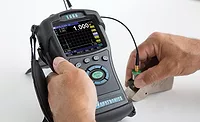
Ultrasonic thickness gages are a preferred device when access to only one side of an object is possible. Source: Danatronics
Precision ultrasonic nondestructive thickness gages have been in use for more than 50 years. Early ultrasonic units were large and bulky, but effective with their measurement capabilities. Precision ultrasonic thickness gages have been effectively used to nondestructively measure an extremely wide range of materials and applications. Some of the many applications may be surprising but they are not limited to the following: coil steel, automotive body panels, rubber tires, hoses and radiant heat tubing, golf club heads, plastic bottles, light bulbs, fiberglass including storage tanks and boat hulls, truck liners and bodies as well as gel coating, composites and paint over composites, copper tubing, ceramic and glass parts.
Ultrasonic thickness gages are a preferred device when access to only one side of an object is possible. Ultrasound can be used on most engineering materials such as steel, aluminum, glass, plastics, composites and rubber.
Ultrasound means high frequency sound. In the case of conventional ultrasonic thickness gages, the sound does not pass through air. As such, a fluid, known as couplant, must be applied to the test surface much like the gel used in medical ultrasound to image babies. In some cases, dry couple or no couplant can be preformed but conditions must be ideal such as a homogeneous material and a flat and smooth surface.
Also, due to the millions of cycles per second, ultrasound is generally not applicable to wood, concrete or porous materials due to the air pockets. The formula to calculate one-sided ultrasonic thickness measurements is as follows: V X t/2 where (T) is thickness, (V) is the acoustic sound velocity of the test material and (t) is the transit time. Divide by 2 to represent the round trip in the test material.
Early gages only displayed the numeric value representing the thickness of the test part, for example 0.250 inch. Later gages offered additional innovative features such as probe recognition, increased frequency (bandwidth) for thinner materials and stored setups.
Today’s modern engineering materials are always being challenged to make parts such as planes and automobiles stronger and lighter, employing less materials and even multiple layers. Some modern ultrasonic gages can use advanced Fast Fourier Transfer (FFT) calculations to separate barrier layers that are not normally detectable. As an example, plastic beer bottles use a multilayer material usually referred to as EVOL, which is very thin but has a specific function in terms of remaining carbonation and bottle strength. Using frequencies above 20 Megahertz (20 million cycles per second) allows echoes to be detected that are very close to one another.
Many times, quality control managers need to measure many different materials with varying sound speeds and setup information. Today’s gages typically have stored setup for reproducibility and dataloggers to document tested materials to be sent to their clients.
Ultrasonics Today
Today’s handheld precision gages are equipped with 50,000 to 100,000 reading dataloggers, 1 micron resolution or 0.0001 inch, stored setup and increased bandwidths to make thickness readings as thin as 0.004 inch of steel. By using the latest technology and microprocessors, today’s gages also can be equipped with live color A-scans or waveforms. Live A-Scans are required to verify that the detected echo is valid.A simple example can be equated to those who like to fish. A thickness gage with numbers only can be viewed as a depth finder while a thickness gage with a live waveform would be similar to a fish finder. In that, it is implied that more information about the test piece can be learned with more information (waveform). If a depth finder displayed the depth of the ocean as 20 feet, is it really 20 feet or is there a whale under the boat? A fish finder would show the profile of the ocean as well as the fish underneath.
The same is true of an ultrasonic thickness gage with a live A-Scan. The most sophisticated gages now use live color waveforms. These small gages can be considered an oscilloscope (live color waveform), thickness gage and computer (100K datalogger with direct export to Microsoft Excel).
Other applications where live waveforms are critical are where large delaminations are possible such as in fiberglass. A delamination is a void inside the material. Another potential area of use for gages with waveforms is where dis-bonds can occur. A dis-bond occurs between the interface of two materials such as rubber bonded to steel. In some instances, a gage with a live waveform can detect both delaminations and dis-bonds.
In some of these applications, thickness gages with live waveforms can be used but they should not be considered as a replacement for ultrasonic flaw detectors, which have much higher pulser power, scanning speeds, bandwidth and gain control. Flaw detectors operate differently in terms of signal scan speed, vertical linearity and code compliance such as American Welding Society (AWS) or American Society of Mechanical Engineers (ASME).
Lobe skipping is another common error that can occur on a conventional digital thickness gage. The waveform is extremely useful to alert the operator when half cycles on the valid echo are being undetected leading to erroneous thickness values. Another problem area that can occur in conventional thickness gaging is the ability to detect the presence of mode-converted echoes. A mode--converted echo is an echo that has changed its initial mode of compressional waves to shear waves mostly based on geometry. Sometimes between the first and second received longitudinal waves, a smaller shear wave (mode converted echo) exists. By using the waveform, an operator can easily correct and adjust from this echo being detected by adjusting the gain and blanks. There are multiple precision units on the market that offer these features.
The latest breakthrough in handheld ultrasonic thickness gages is to employ the use of a color display for the A-Scan. By employing the use of color in a handheld unit, the operator can easily and quickly tie the color of the waveform to problem areas. Some simple tests require the operator to only know if a thickness is above or below a pre-determined value. If a thickness reading goes below a certain thickness value, the use of color can quickly change from a green echo to a red echo indicating an alarm. This is obvious and simple to see.
Another common test is to view the RF waveform to detect a phase reversal change on bonded materials. By using color, the operator can easily and quickly know if a dis-bond condition exists because the color would change from green (good bond) to red (bad bond).
Another technique that is enhanced through the use of color is to superimpose the echoes of old readings and compare them to the current waveform. As an example, a waveform from a six-month-old test can be displayed in less contrast in one color while the live current waveform for the test at the exact same location can be superimposed over one another to compare signal degradation and potential wall thickness loss. Other advantages of color include easy-to-read displays, multiple font choices, increased pixel resolution (220 by 270 vs. 64 by 128), backlight for indoor applications, direct sunlight readability, custom color palettes, and large font sizes to view the thickness readings and waveform from several feet away. Given the choice between monochrome and color, and given the small price difference, most customers would choose the color display.
The Future
Future gages will continue to employ the latest in display and DSP technology. As a result, most manufacturers will capitalize on the technology used in other industries such as those used in cell phones. Look for manufacturers to continue to be innovative and offer competitive solutions with unique features. Color displays will drive this new demand for ultrasonic thickness gages with live A-Scans. Customers also can look for smaller packages, faster microprocessors and the latest in measurement algorithms to ensure each and every measurement, critical or routine will be backed by the latest in available technology to ensure quality thickness measurements, increased production and, most importantly, safety. ndtLooking for a reprint of this article?
From high-res PDFs to custom plaques, order your copy today!