Choose the Correct RVI Equipment
Consider these specifications when selecting remote visual inspection equipment for your application.
Remote visual inspection (RVI) equipment such as borescopes, fiberscopes and videoscopes have many basic specifications that need to be understood in order to select the most appropriate inspection equipment for your application. If an inspector understands basic concepts of these instruments such as diameter, working length, depth of field and field of view, he will choose the most appropriate inspection instrument every time.
Diameter
The diameter of a borescope, fiberscope or videoscope is probably the first and easiest specification to determine when selecting the most appropriate remote visual inspection instrument. With a clear understanding of inner dimensions of the area that needs to be accessed, choose an instrument that will be able to navigate and wind its way to the inspection point with ease. Keep in mind that 90-degree bends will typically require a 2 to 1 ratio of area being navigated, such as the inner diameter of a pipe to the outer diameter of the remote visual inspection instrument.
Working Length
The working length of a borescope, fiberscope or videoscope is one of the most important considerations. If the instrument selected is not long enough to reach the inspection point, then it is of no value. On the other hand, if the instrument selected is too long, then it may be difficult to handle and more easily damaged.
Use the shortest fiberscope, videoscope or borescope possible. The longer a remote visual inspection instrument is, the weaker the articulation, light output is lessened and the instrument is more susceptible to damage from being stepped on, bent or kinked.
Flexible or Rigid
The term borescope is often used as a generic description for both flexible and rigid borescope instruments. It is important to understand if a remote visual inspection application requires a flexible or rigid working length. A simple inspection that does not involve any twists or bends can usually be done by a rigid borescope. When twists and turns are involved to snake the fiberscope or videoscope to the inspection point, a flexible working length is required.
Articulation
Articulation may be described as all-way or four-way. Articulation is simply the ability of a videoscope to manipulate the tip of the scope at the bending neck. Today, most videoscopes 25 feet or less have the ability to articulate. Beyond this length there tends to be too much tension on the articulation cables, and subsequently, they are not capable of effectively manipulating the tip of a videoscope.
Direction of View
The direction of view may be in a fixed position or can be changed with the addition of different side view objective lenses. The majority of borescopes, fiberscopes and videoscopes have forward-view capability as a standard. Rigid borescopes may offer several offset directions of view such as 90, 70, 45 and 30 degrees. Fiberscopes and videoscope may offer side-viewing options (90 degrees).
An example of when direction of view is important would be during the inspection of orbital welds in a pipe. The only way to view the entire weld would be with a 90-degree side view objective lens.
Depth of Field
The depth of field (DOF) is the portion of an area being inspected that appears acceptably sharp in the image. Videoscopes typically offer a variety of objective lenses to provide the optimum depth of field for just about every application. For example, a depth of field of 15 to 125 millimeters will not be useful when the borescope will be physically closer or farther away from the target.
When the inspector places the borescope, fiberscope or videoscope outside the depth of field for the instrument, the image will become blurry (too close) or grainy (too far). The best image will be obtained when the depth of field falls within the tip to target range of the borescope, fiberscope or videoscope.
Field of View
In the world of remote visual inspection, field of view is an important concept to understand. The field of view is the angular extent of the observable inspection area that is seen at any given moment. Borescopes, fiberscopes, videoscopes, pipe inspection cameras and other remote visual inspection equipment should all list field of view in their specifications. The field of view of a video borescope or fiberscope determines how large of an area can be seen at a given distance during a remote visual inspection. A wide field of view may allow someone conducting a turbine inspection to complete each section in one pass while a narrow field of view may require the inspector to inspect the same section of turbine blades twice and take more time to conduct the inspection.
Most industrial-grade videoscopes, fiberscopes and borescopes have the option to change different objective lenses. Each videoscope objective lens will have a unique depth of field and field of view. Choose the one that is most suitable for your inspection.
The diameter of a borescope, fiberscope or videoscope should be the first specification to determine when selecting a remote visual inspection instrument.
The best image will be obtained when the depth of field falls within the tip to target range of the borescope, fiberscope or videoscope.
The field of view of a video borescope or fiberscope determines how large of an area can be seen at a given distance during a remote visual inspection.<
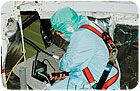
Borescope inspection of the retract link assembly on the orbiter's main landing gear door is shown here. Source: Advanced Inspection Technologies Inc.
Remote visual inspection (RVI) equipment such as borescopes, fiberscopes and videoscopes have many basic specifications that need to be understood in order to select the most appropriate inspection equipment for your application. If an inspector understands basic concepts of these instruments such as diameter, working length, depth of field and field of view, he will choose the most appropriate inspection instrument every time.
Diameter
The diameter of a borescope, fiberscope or videoscope is probably the first and easiest specification to determine when selecting the most appropriate remote visual inspection instrument. With a clear understanding of inner dimensions of the area that needs to be accessed, choose an instrument that will be able to navigate and wind its way to the inspection point with ease. Keep in mind that 90-degree bends will typically require a 2 to 1 ratio of area being navigated, such as the inner diameter of a pipe to the outer diameter of the remote visual inspection instrument.
Working Length
The working length of a borescope, fiberscope or videoscope is one of the most important considerations. If the instrument selected is not long enough to reach the inspection point, then it is of no value. On the other hand, if the instrument selected is too long, then it may be difficult to handle and more easily damaged.
Use the shortest fiberscope, videoscope or borescope possible. The longer a remote visual inspection instrument is, the weaker the articulation, light output is lessened and the instrument is more susceptible to damage from being stepped on, bent or kinked.
Flexible or Rigid
The term borescope is often used as a generic description for both flexible and rigid borescope instruments. It is important to understand if a remote visual inspection application requires a flexible or rigid working length. A simple inspection that does not involve any twists or bends can usually be done by a rigid borescope. When twists and turns are involved to snake the fiberscope or videoscope to the inspection point, a flexible working length is required.
Articulation
Articulation may be described as all-way or four-way. Articulation is simply the ability of a videoscope to manipulate the tip of the scope at the bending neck. Today, most videoscopes 25 feet or less have the ability to articulate. Beyond this length there tends to be too much tension on the articulation cables, and subsequently, they are not capable of effectively manipulating the tip of a videoscope.
Direction of View
The direction of view may be in a fixed position or can be changed with the addition of different side view objective lenses. The majority of borescopes, fiberscopes and videoscopes have forward-view capability as a standard. Rigid borescopes may offer several offset directions of view such as 90, 70, 45 and 30 degrees. Fiberscopes and videoscope may offer side-viewing options (90 degrees).
An example of when direction of view is important would be during the inspection of orbital welds in a pipe. The only way to view the entire weld would be with a 90-degree side view objective lens.
Depth of Field
The depth of field (DOF) is the portion of an area being inspected that appears acceptably sharp in the image. Videoscopes typically offer a variety of objective lenses to provide the optimum depth of field for just about every application. For example, a depth of field of 15 to 125 millimeters will not be useful when the borescope will be physically closer or farther away from the target.
When the inspector places the borescope, fiberscope or videoscope outside the depth of field for the instrument, the image will become blurry (too close) or grainy (too far). The best image will be obtained when the depth of field falls within the tip to target range of the borescope, fiberscope or videoscope.
Field of View
In the world of remote visual inspection, field of view is an important concept to understand. The field of view is the angular extent of the observable inspection area that is seen at any given moment. Borescopes, fiberscopes, videoscopes, pipe inspection cameras and other remote visual inspection equipment should all list field of view in their specifications. The field of view of a video borescope or fiberscope determines how large of an area can be seen at a given distance during a remote visual inspection. A wide field of view may allow someone conducting a turbine inspection to complete each section in one pass while a narrow field of view may require the inspector to inspect the same section of turbine blades twice and take more time to conduct the inspection.
Most industrial-grade videoscopes, fiberscopes and borescopes have the option to change different objective lenses. Each videoscope objective lens will have a unique depth of field and field of view. Choose the one that is most suitable for your inspection.
Tech Tips
Looking for a reprint of this article?
From high-res PDFs to custom plaques, order your copy today!


