Management
Lean Manufacturing Processes Have Measurable Results
American and Asian manufacturers view the lean philosophy differently.
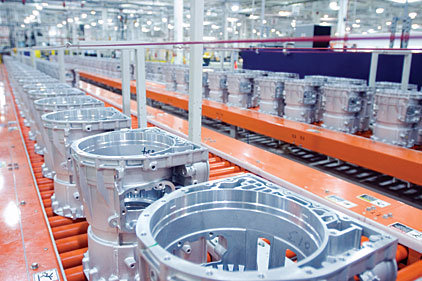 How do you eat an elephant? You take one bite at a time. At first blush, this riddle may appear simple but it accurately describes how to implement the lean process in any manufacturing environment.
“This is a big elephant,” said Jim Smith a quality expert with more than 45 years working with lean manufacturing. “Work at it in bite-size increments.”
According to Smith, lean is not just for manufacturing but it is a philosophy that can be applied to any environment to reduce waste. Lean manufacturing is a production practice that considers spending resources on anything other than the creation of value for the end customer to be wasteful. Therefore, the goal of lean manufacturing is to eliminate waste.
Waste or muda in Japan is defined as anything that is not being done effectively the first time.
Waste is built into the manufacturing function. In a typical manufacturing work environment, waste is most of the work being done because it does not add value to the product or service.
“In all the literature I’ve come across over the years, I see 80 - 95% waste,” said Ellen Sieminski, lean leader at Littelfuse. “I find that hard to believe. In my 12 years of creating value stream maps and helping others create them, that percentage seems to be closer to 98% or 99% most of the time.”
There is required waste and pure waste.
“Required waste has to be done for one reason or another. For example, waste mandated by the company or required by law. Pure waste is just that – something you should stop doing immediately, because it adds no value in the eyes of the customer,” said Sieminski.
Lean experts are always challenged to think of new ways to cut waste.
“Anytime I’m busy thinking, ‘There has to be a better way.’ Whether I can pinpoint the specific waste at that point in time or not, I know there is waste,” said Sieminski.
“It might take some process mapping, value stream mapping, or going through an A3 to really get to what the root cause is and to be able to define it, but recognizing that there is an issue is an important first step.”
In contrast, value added activities are anything that the customer would be willing to pay for the manufacturer to do.
“It is any activity that transforms or shapes, for the 1st time, rework does not count, material or information to meet customer requirements,” said Sieminski.
In addition to eliminating waste, the lean process includes no inventory and no unevenness or mura. This focuses on improving the flow or smoothness of operation.
When implementing a lean approach, Smith recommends trust, champion, infrastructure, measure, meet, and train.
Trust
Gaining the trust of the employees is the first step in any lean process. According to Smith, some methods of reducing waste also result in reducing the number of employees.
“It didn’t take people long to realize they were eliminating their own jobs which resulted in distrust,” said Smith.
“At Caterpillar we needed to have all ideas to reduce waste and cost. We guaranteed no one will lose their employment. They may have shifted jobs but will not lose their jobs. This program received many national awards,” said Smith.
Champion
Have a champion, preferable someone from top management. According to Smith, if this component is not in place, it will not be viewed as important to the other employees and they will not be on board. Joseph M. Juran, who was the architect of quality and one of the greatest quality giants along with William Edwards Deming, supported the belief that management drives the initiative.
Infrastructure-Meet-Measure
The infrastructure is supported by the person who is in charge of implementing the project. This person reports to the champion on a regular basis, preferable about once a month. According to Smith, meeting more frequently does not give enough time between for new developments. Less frequent meeting, such as once a quarter, allows too much time to elapse to fix a problem.
Smith, who refers to himself as a Juranite, said, “What gets measured gets managed.”
He recommends simple metrics, no more than five that everyone understands, with consistent reviews. This process takes discipline.
Train
The training process includes everyone in the organization from the highest to the lowest positions. Encourage all employees to look for waste reduction and submit their ideas and be flexible in implementing new ideas.
According to Smith, American manufacturers typically do not embrace all the waste reduction ideas submitted by employees.
“Lean initiatives are failing in the application because management has their paradigms already set on the manufacturing floor,” said Smith. “You can get improvement anywhere but management is looking for the bottom line results.”
This is the reason the Japanese manufacturing companies have taken lean to a higher level, said Smith.
Smith sites this example. A file cabinet that an employee uses several times a day may be 5 feet away. They walk to that cabinet 20 times a day. The time it takes to do that, multiplied by the number of times it is done each day, multiplied by the number of days and employees doing it in a year. The time and cost is measurable but according to Smith because the waste reduction does not amount to a half of a person, it is perceived as not adding any value.
Moving the file cabinet 90 degrees would allow the person much quicker access, therefore saving time. According to Smith, the Japanese companies view the time saved as being used to do something else constructive for the company. While the American paradigm doubts or does not trust the worker to be more efficient with the added time. Consequently, the office layout people determine the file cabinet cannot be moved. As a result, the employee may have other ideas but will not share them because their first idea was not accepted.
On the other hand, Sieminski, who implements lean for their facilities in Asia, classifies one of her best lean examples as involving no implementation and no obstacles.
She said, “Years ago, I was working with a gentleman, who used an ink pad and stamp to mark all parts prior to putting them in a machine. He had been through lean training. I shadowed him to evaluate where he could eliminate waste from his process. We determined there was a better place to store the ink pad and stamp. This required him to take fewer steps for each cycle. When I returned to his department a couple days later to check in with him, the ink pad and stamp were not where we had moved them. I asked, ‘What happened?’
He said, ‘Well, where we put it the other day was good, but I found a spot that is even better and saves more time.’”
“That is really what lean is all about – empowering associates so that they can implement improvement opportunities on their own, whether the idea is big or small.”
The journey of a thousand miles starts with a single step. In the colossal journey of lean manufacturing, these steps include trust, a champion, a supportive and nimble infrastructure, easily understood metrics, consistent review, and training of all the employees. When these steps are implemented in even the smallest of doses, the results are measurable.
Looking for a reprint of this article?
From high-res PDFs to custom plaques, order your copy today!


