The High-Speed Trend
Automating Manufacturing Processes with High-speed 3D vision improves quality and drives down costs.
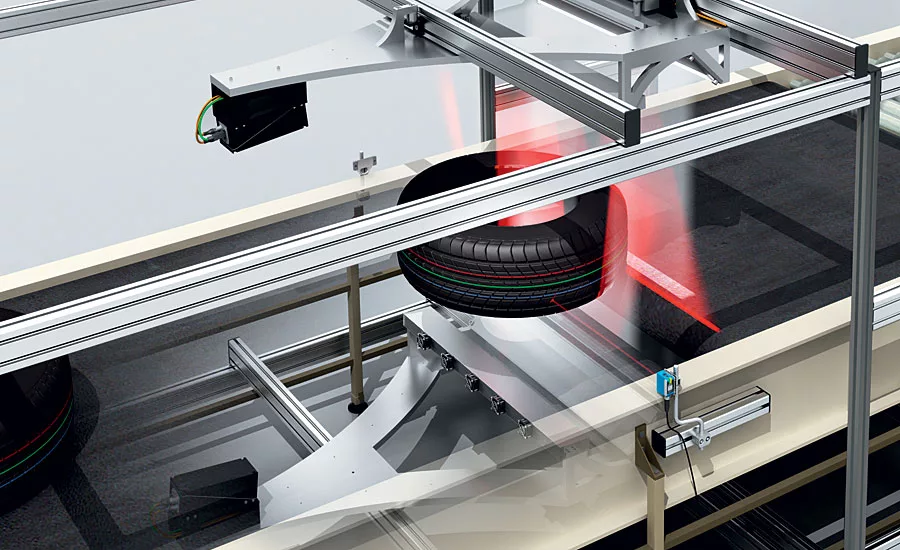
While human inspectors on assembly lines visually inspect parts to judge the quality of workmanship, machine vision systems use cameras and image processing software to perform the same evaluations tirelessly and with greater precision. Source: SICK
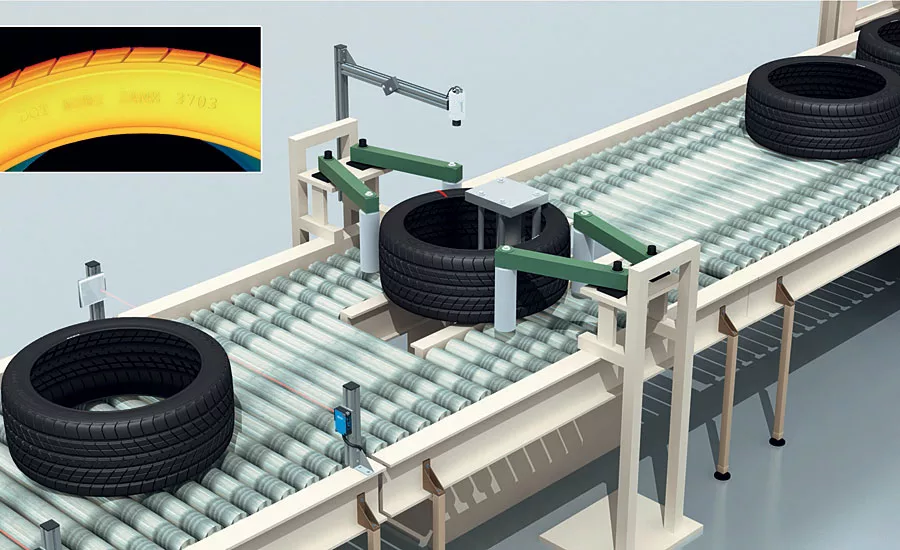
Tire manufacturing requires technology capable of inspecting and measuring objects that are black-on-black. Source: SICK
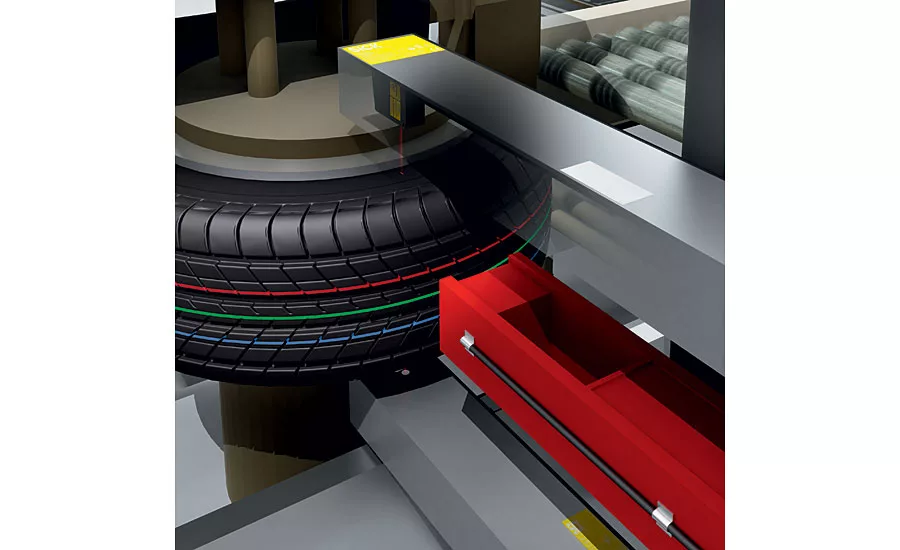
In a growing number of applications, customers are looking to add 3-D information to the mix of data used to differentiate objects and to classify different types of defects. Source: SICK
Pass-through defects are anything but uncommon in manufacturing. Regardless of the variables involved, it is imperative to ensure that all products are correctly manufactured and assembled. By utilizing robust inspection solutions in manufacturing processes, companies are able to ensure the highest level of quality in their products.
For years, OEMs and precision machine builders from many industries such as automotive, rubber and tire, transportation, factory automation, wood and lumber, have trusted high-performance 3-D inspection solutions to reduce time-to-market and increase profitability.
Compared to 2-D vision systems (which are vulnerable to environmental changes, including part color or contrast usually due to lighting changes), in many cases a 3-D system can be more reliable, simpler to use and more affordable to own. When designing a 3-D system, or any vision inspection system, the following four goals can prove beneficial: (1) minimize the effects of process noise, such as ambient light and part color/contrast; (2) keep the system as simple as possible; (3) use redundant information at all opportunities to increase the confidence in the inspection; and (4) log information for future data mining. When these principles are followed, it is easier for all involved to address a myriad of problems that may arise in production processes.
Quality control during the tire production process has traditionally been performed manually by machine operators. This process is time-consuming and lacks the precision that modern state-of-the-art vision systems offer. Using 3-D vision systems increases measurement precision, identifies errors earlier, ensures tire consistency, and helps reduce labor costs. Advances in technology such as automating tire manufacturing processes can drive down costs. Quality counts in the tire business and making improvements to the quality process while producing tires more efficiently will positively affect both the top and bottom lines for tire manufacturers.
TRADITIONAL INSPECTION SOLUTIONS – VARIABLE RESULTS
Regardless of how it is performed, tire inspection is—and must be—inherent to the assembly process. Assuming the subcomponents are the correct shapes and sizes, manual quality checks typically involve ensuring that the layers of steel belts are properly aligned and that the splices have no gaps or overlaps. Other manual checks include looking for contamination and guiding rubber pieces during the layering process. Manual inspection places the onus on the operator to ensure the tire’s subcomponents are assembled properly, in the correct sequence, and that they are properly aligned. If the tire is not assembled properly or not thoroughly inspected, the tire could have quality issues. Also, operators have different skill and experience levels. Because no two operators assemble or inspect tires exactly the same way, inspection results will likely vary. Furthermore, different operators work at different speeds. An individual operator may not work at the same speed each day or even throughout a single shift.
Using 2-D vision to perform tire inspections that were traditionally done manually isn’t necessarily an improvement because 2-D camera operation is based on contrast. Backlighting an object creates a high-contrast shadow, which works for edge detection. While 2-D works well for measuring the width of a piece of rubber using edge detection and identifying bar codes, 2-D does not work very well in the absence of high-contrast features. Tire manufacturing requires technology capable of inspecting and measuring objects that are black-on-black. Because layers of black rubber are placed on black rubber, 2-D systems cannot see targets because the objects do not have the necessary contrast. To ensure reliability and consistency, 3-D cameras detect objects and features of black-on-black targets that 2-D cameras cannot.
TIRE INSPECTION GOES HIGH-SPEED 3-D
A typical 3-D vision system uses laser triangulation to capture images by projecting a laser line across the surface of each target object while a high-speed camera captures an image of the laser line as an elevation profile. The system builds a 3-D image of the target object based on the position of the laser line in relation to the object. Generally, triangulation is based on the relationship between two constants: camera angle and laser position. The operating principle requires the presence of a known angle between the laser and the camera’s receiving element.
For a specific angle, the sensed laser light’s position on the receiving element determines the measured height of the target object. The 3-D vision system uses software to search for light-to-dark transitions created by the laser line as it scans the object. A 3-D image is created by combining the results of determining the width and height of the laser line as it scans the object.
Using laser triangulation in 3-D vision systems is not new. The technology has been available for years. However, 3-D vision cameras that incorporate laser triangulation tools to measure height, width, shape, and volume on black targets—and obtaining these profiles at a high speed—are a different story. Creating full three-dimensional images at high speed requires specialized hardware and software that can process this complex vision information much faster than traditional cameras. The faster a system can create these complex 3-D profiles, the better it suits quality inspections in tire manufacturing.
DRIVE DOWN MANUFACTURING COSTS BY AUTOMATING INDUSTRIAL PROCESSES
While human inspectors on assembly lines visually inspect parts to judge the quality of workmanship, machine vision systems use cameras and image processing software to perform the same evaluations tirelessly and with greater precision. Machine vision inspection plays an important role in achieving 100% quality control in manufacturing, reducing costs, and ensuring a high level of customer satisfaction. Machine vision systems not only provide product tracking by way of barcodes and text to create traceable production histories, but can also guide products through automated operations, match products with labels and packaging, and compare product features to expected shapes, colors, fill levels, and sizes. Meanwhile, in a growing number of applications, customers are looking to add 3-D information to the mix of data used to differentiate objects and to classify different types of defects.
The push for more 3-D inspection tools has led to a need for a more cohesive standard for the data produced by a 3-D camera. Recently, new versions of all the machine vision standards were discussed at the International Vision Standards Meeting. There the discussion of support for 3-D vision was centered on GenICam. The GenTL transport layer within version 3.0 supports both area-scan and line-scan 3-D cameras, as well as supporting multiple data values (such as 3-D co-ordinate and pixel intensity) for each pixel. This standardization of how the data from a 3-D camera will be transmitted into the software for analysis allows software vendors to create tools in a general way and give support to more types of inspections, without having to create special interfaces and functions for all different camera manufacturers.
In many product quality inspection problems, the shape of the object is commonly used as the basis of quality inspection. When compared to traditional 2-D vision, 3-D vision can acquire 3-D coordinates of the object directly, so that the inspection can be accomplished that is difficult to do with 2-D vision. As the systems used to create 3-D data become even more standard, we will see more 3-D vision products that work to make the inspection of parts using real 3-D data as simple as a sensor. This will lead to even more people looking at 3-D as the solution for many new applications. V&S
Jim Anderson is a machine vision product manager at SICK. For more information, call (800) 325-7425, email [email protected] or visit www.sickusa.com.
Looking for a reprint of this article?
From high-res PDFs to custom plaques, order your copy today!