WEB EXCLUSIVE
Functional PVD Coatings Improve Medical Device Performance and Life
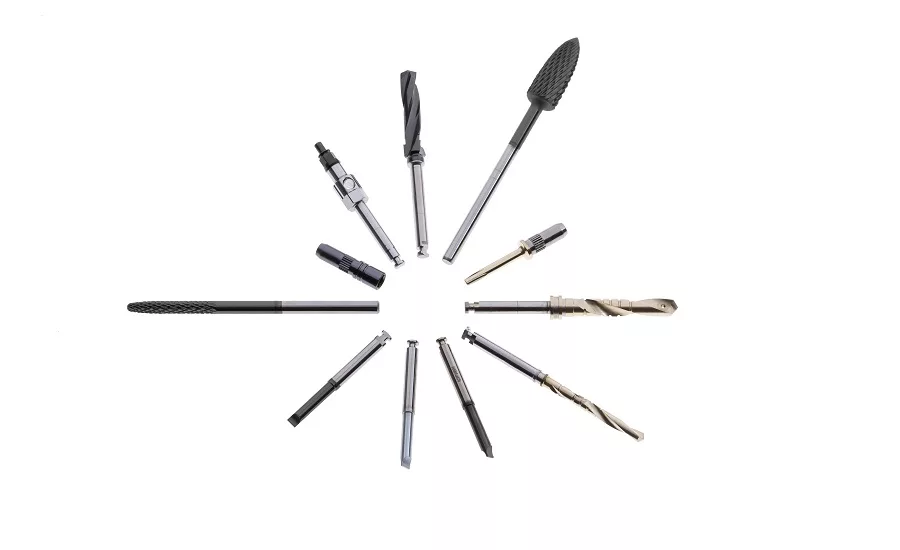
As the medical device industry continues to grow rapidly, manufacturers must contend with a variety of challenges if they wish to differentiate products in a highly competitive market. With this in mind, greater emphasis is being placed on the functional coatings that are applied to stainless steel, titanium and other substrates of critical medical devices from implants to scalpels, needle drivers, bone saws, and reamers.
When manufacturers first began coating instruments, the primary purpose was to improve the aesthetics of instruments and improve identification during surgery. Titanium nitride, with its easily recognizable gold color, quickly became the coating of choice for this purpose.
However, OEMs are now looking to move beyond aesthetics by applying titanium nitride and other innovative PVD coatings to improve wear resistance, reduce galling between sliding component, increase lubricity and even help retain sharp edges on cutting instruments.
These same coatings can also deliver other important functional benefits, such as providing anti-glare surface for bright operating rooms, antimicrobial properties and anti-fouling in the presences of blood and tissue. In some cases, it can even potentially turn devices into multiple re-use items, for example with laparoscopic instruments.
Coatings for Medical Devices
One option medical device manufacturers often consider for adding functional value to medical devices is medical-grade PTFE. Although this type of coating is known for its low coefficient of friction, it is not recommended for high load applications because it is relatively soft and can wear away or experience micro-fracturing under high loads.
Another alternative is anodization, an electrolytic process that coats the metal substrate. Unfortunately, it is impossible to effectively anodize stainless steel without losing wear resistance and durability, which is a significant disadvantage.
Moreover, anodization can form a layer of rust on the stainless steel, causing it to corrode. For this reason, anodization is typically only used on aluminum or titanium. This limits the range of medical devices that can utilize this type of coating.
Physical Vapor Deposition
To overcome these challenges, medical device manufacturers are increasingly turning to physical vapor deposition (PVD), a process that describes a variety of vacuum deposition methods that can be used to produce extremely hard, thin coatings on stainless steel, titanium, ceramics and other advanced materials.
These coatings provide a unique combination of extreme surface hardness, low friction coefficient and anti-corrosion properties. The coatings also have the advantage of being thin, typically 1-4 μm. This feature, in conjunction with close tolerancing, means that the component retains its form, fit and dimensions after coating without the need for re-machining.
Introduced into the medical device industry nearly 20 years ago, PVD coatings like titanium nitride (TiN) are extremely hard (2,200 to 2,400 Vickers) coatings that provide excellent wear resistance. However, despite its functional properties the first medical instruments used the coating as a decorative, high-end finish.
“Initially, the industry was looking for ways to differentiate instruments aesthetically and for identification purposes, and titanium nitride was as a solution for that. To this day, it is the highest volume PVD coating used in the medical device industry,” explains Matt Thompson, business development manager in North America with Oerlikon Balzers, a company that has been producing specialized PVD coatings for more than 70 years. The company offers coating services at more than 140 coating centers worldwide, including 16 locations throughout the United States.
Thompson adds that the orthopedic industry was the first medical segment to realize the functional strengths of PVD coatings, as applied to surgical instruments supplied with implants. The surgical instruments coated included items such as reamers, drills, taps and broaches.
Given its widespread use, titanium nitride is well established in the medical device industry. This is supported by a vast quantity of literature and testing that supports the bio-compatibility of the coating, and many precedents with the FDA.
As a result, other PVD coatings like diamond-like-carbon (DLC) and aluminum titanium nitride (AlTiN) have gained widespread acceptance – particularly for coating stainless steel. This is significant because there are few surface treatments that can be applied to stainless steel while still providing the desired functional properties.
“DLC coatings provide an ideal combination of low coefficient of friction like PTFE, but with the hardness of a ceramic,” explains Thompson. “The coating has good functional properties, including excellent wear resistance, lubricity, corrosion resistance, anti-sticking and anti-fouling.”
The DLC Coating even improves sharp edge retention of surgical instruments extending the service life of the instrument considerably. As an added benefit, cleaner cuts help surgical incisions heal more quickly, reducing patient recovery time.
In addition to its low coefficient of friction and wear resistance, PVD coatings may eliminate the need for lubrication, functioning even under dry running conditions. This is particularly useful for the pneumatic components of powered instruments such as surgical bone saws or for the implantation and removal of intramedullary nails.
Surgeons that must perform under the harsh glare of operating room lighting have also found PVD coatings useful for its anti-glare properties. For example, Oerlikon Balzers’ BALINIT®DLC Medical and BALINIT® C (a WC/C ductile carbide carbon of the DLC family) are black or dark grey, enabling surgeons to work faster and with greater comfort in bright operating rooms.
Antimicrobial Properties
Another important factor that device manufacturers must consider is whether the coating solution they choose contains antimicrobial properties. Invasive surgical instruments circumvent the body’s natural lines of defense. Therefore, it is critical that instruments’ surfaces are antimicrobial whenever possible to reduce the incidence of infection.
Oerlikon Balzers’ titanium nitride (TiN-Ag) coatings, which are doped with silver and have a film thickness of approximately 2 μm, were specifically designed to address this issue and are one of the only types of coatings on today’s market to offer this antimicrobial protection.
“Silver-doped titanium nitride is especially useful in trauma applications in which you've got a lot of open wounds,” explains Thompson. “These may require medium- to short-term implantation of devices and, subsequently, are prone to a higher percentage of surgical site infections.”
Using the bacterial log reduction test method, TiN-Ag has demonstrated high-antimicrobial efficiency with a Log 3 reduction with SA (staphylococcus aureus) and MRSA strain (methicillin-resistant staphylococcus aureus). Antimicrobial activity has also been confirmed by ASTM / JIS.
In addition, when tested using the cytotoxicity testing method (ISO 10993-5), TiN-Ag has shown no cytotoxic effect. Oerlikon Balzers’ TiN-Ag coatings, in particular, are specially certified under the MEM Elution method, 72 hours (according to USFDA 21 CFR Part 58).
Nevertheless, regardless of a coating’s antimicrobial and biocompatibility properties, it is, ultimately, worthless if it delaminates from the surface of a part after going through the thermal cycling of an autoclave cycle.
With that in mind, the TiN-Ag coating was designed to withstand multiple autoclave cycles without influencing the antimicrobial activity itself (demonstrating a Log 3 reduction after 50 autoclave cycles).
“An antimicrobial PVD coating has the potential to take a product to an entirely different level compared to the competition,” says Thompson.
Customized Solutions
To further differentiate products, medical device manufacturers often require even more customized surface coatings.
For this, companies like Oerlikon Balzers have the R&D capabilities to tailor coating solutions to meet unique requirements. In addition to coating thickness and hardness, properties such as structure, chemical and temperature resistance, and adhesion can be precisely controlled.
According to Thompson, in a perfect world OEMs would look into PVD coatings early in the design phase of new products. However, in the real world, many seek out PVD coating solutions only after experiencing excessive wear, high friction and other issues in early engineering builds.
“OEMs often come to us with a problem late in the design phase and they are looking for a coating solution when certain properties such as the substrate material may already be locked in,” says Thompson. “Our goal is for customers to start thinking about PVD and PACVD coatings as a design element to fully unlock the potential of this technology and add value to precision components.”
For more information, visit oerlikon.com/balzers.
Looking for a reprint of this article?
From high-res PDFs to custom plaques, order your copy today!



.webp?height=200&t=1777391381&width=200 "a rendering of a robotic-assisted surgical system")