Critical Challenges faced by Quality Departments and Recommended Actions
Each organization’s challenges may stack up differently based on considerations like industry sector, product/service type, customer base and culture.
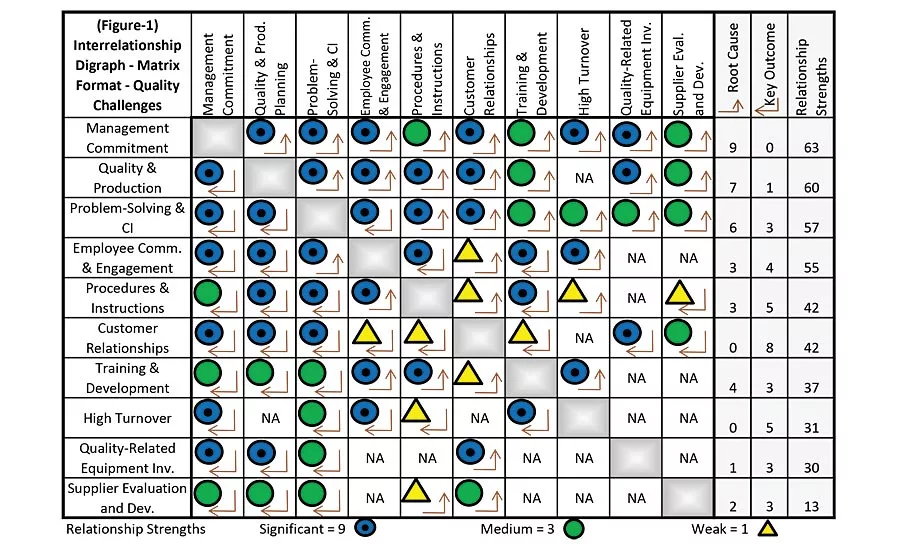
Figure 1. An interrelationship digraph in a matrix format was created to rate the relative importance of the priority quality challenges.
Successful management and leadership of the quality department for an organization involves an integrated approach that includes a communication network that extends both horizontally and vertically within the organization as well as outward to customers and suppliers.
The top 10 challenges identified below are the primary constraints to achieving effective quality assurance. Each challenge is defined, concerns indicated and successful resolution identified. Most of these challenges are interrelated; therefore, one will often affect others.
These challenges are especially critical in a new or turnaround operation where quality has either not been established or otherwise ignored for an extended amount of time. An organization may also experience multiple challenges in the same timeframe as well as high turnover, primarily in the quality department.
An interrelationship digraph in a matrix format was created to rate the relative importance of the priority quality challenges (Figure 1). Most notable are the top three challenges (management commitment, inadequate quality and production planning and problem-solving CI teams) which share in common a high number of root causes in addition to the relationship strengths. My interpretation of this result based on these three challenges is that risk analysis is critical for an organization. The high outcome rating for “customer relationships” in the matrix is not surprising in that many internal processes ultimately affect customers.
Ratings for these challenges are based on the organizations I have worked for as well as various customer and supplier interactions. My primary experience has been in the automotive part manufacturing sector.
1. Management Commitment – All the challenges listed here connect to management commitment. Failure to communicate the appropriate details for management will almost certainly lead to a lack of support. Identifying and determining the details, cost and justification, setting a timeline and getting approval for completing all necessary activities is an essential first step in a plan to successfully address challenges and reduce risk. Providing management with updated status on these challenges is also important.
2. Inadequate Quality & Production Planning – It is critical for the sales function to have the technical and logistical capability as well as team support to produce reasonable quotes. Without a proper team feasibility review with all relevant stakeholders before committing to a price and subsequent PO, sales may underquote. This deficiency can lead to compromises in quality. The feasibility review should also include risk analysis to stay ahead of any potential technical or logistical issues. Make sure all customer requirements derived from drawings and specifications are clearly understood by all internal and external stakeholders. If the organization needs other specifications to further clarify “grey areas” or otherwise protect them, include those as well. Do not assume you cannot negotiate existing or new specifications. Negotiating specifications could increase the organization’s capability to produce the required product as well as minimize cost for the customer and organization.
3. Quality Support for Problem-Solving and Continuous Improvement Project Teams – Ongoing efforts to resolve problems and otherwise continue to make improvements based on the importance of issues is imperative to maximize the effectiveness of an organization as well as stay ahead of the competition. Failure to form and maintain these project teams as well as include the appropriate team members will lead to higher scrap rates, decreased customer satisfaction and increased risk for the organization. Team leaders that maintain priority-based action item lists with firm completion dates should drive these teams. Team leaders should keep top management in the loop to sustain their commitment to the resources needed to address the challenges.
4. Employee Communication and Engagement – Keeping all employees in the loop is essential to productivity and quality as well as the morale of the organization and can drive a positive culture. This approach is a two-way street that includes communicating with the employees as well as getting input from employees. Failure to make these connections will lead to gaps in information shared both ways that will cause a decline in quality and productivity as well as employees’ willingness to contribute. Methods to communicate to employees include monthly meetings, posting (current) results, newsletters, etc. On the other side, maximizing engagement includes involving employees in corrective actions, continuous improvement initiatives, training needs assessments, etc. Communication and engagement also involve managers visiting work areas on a regular basis to facilitate informal two-way conversations.
5. Procedures and Instructions not Written or Updated – This is one of the most common findings in ISO-9001 QMS third-party audits for organizations that certify to this standard. Some organizations rely too much on verbal communications and partially retained memories. The extent of documentation should be determined based on the complexity and interactions of the various processes as well as the scope of training for the employee. A guideline to use for developing a work instruction set is to have a basic version visible at the point of use for those who perform the task regularly. Also, have a more detailed version taken from the training documentation available at the point of use accessible by recently trained employees or employees that have not run the process for a while. There should also be a system of tracking documents to assure the most current version is available.
6. Breakdown in Customer Relationships – This is usually a result of poor or declining quality or delivery and related communications. Accompanying this is poor follow-up on issues or otherwise no substantial progress to resolve issues. It is critical to maintain ongoing communications on the status of any issues that includes an action plan with identified dates of completion. Depending on the significance of the issue, you may communicate by email or phone. Use the phone when speed and clarity are essential. Document calls by following up with emails to primary stakeholders.
7. Training and Development – This is a systemic issue for the majority of organizations at some level. There is a tendency to get new employees to the work areas as soon as possible. Managers that interact regularly with new employees in their work areas indicate that employees often express concern about training for their job. Employees are afraid to approach their supervisor for fear of criticism for not retaining all the information communicated to them during their brief training session and that it is not available at the point of use. The ideal training program should consist of an approved documented program that considers past experience and entails the level of complexity depending on the type of job. This hands-on approach should include describing the job, show them how to do the job, and then letting them do the job to validate their training. The trainee should also be comfortable asking follow-up questions, and there should be a mentor assigned to the trainee for a designated amount of time, depending on the level of complexity.
8. High Turnover and Shortage in Quality and Production Employees – High turnover rates can have a substantial effect throughout all levels of the organization. Reasons for high turnover can include inadequate pay, lack of appreciation or being mistreated by the supervisor, and insufficient training related to performance issues (employee leaves or is terminated). As the popular phrase goes, “people are your best resource.” This should always be on the minds of management. Ongoing and adequate training and development, praise for a good job done, and appropriate pay for a given job will go a long way to retain employees at all levels of seniority as well as affect the bottom line.
9. Lack of Investment in Quality Equipment or Quality-Related Production Equipment – After setting priorities for equipment repair, refurbishment or replacement through problem-solving or continuous improvement teams, management needs to plan ahead to have the financing available to address the challenges. Many companies have great expectations on the front end of problem-solving and continuous improvement initiatives but stall out due to declining or shifting priorities. Return on investment for many capital projects is typically one to three years based on quantifiable and qualifiable considerations. Management must have the strategic vision to maintain the commitment to move forward with these investments.
10. Supplier Evaluation and Development – Suppliers are an important part of the quality equation. All too often, suppliers fall off the radar until they have issues. Frequently, these issues are only taken seriously when reject supplier material reaches the organization’s customer. Suppliers providing material with critical characteristics should be high on a priority list for evaluation and development. Purchasing and quality should thoroughly assess all critical suppliers before their approval for use. In some cases, dual sourcing could also be considered as a contingency when a supplier is unable to provide an acceptable material.
Of course, each organization’s challenges may stack up differently based on considerations like industry sector, product/service type, customer base and culture.
Accurately identifying the challenges your organization faces along with getting management commitment are critical first steps in effectively working toward a successful resolution.
This approach aims to move an organization from a reactive (firefighting) position to a proactive (best in class) position. Q
Looking for a reprint of this article?
From high-res PDFs to custom plaques, order your copy today!