Quality Magazine logo
search
cart
facebook twitter linkedin youtube
  • Sign In
  • Create Account
  • Sign Out
  • My Account
Quality Magazine logo
  • NEWS
  • PRODUCTS
    • FEATURED PRODUCTS
    • SUBMIT YOUR PRODUCT
  • CHANNELS
    • AUTOMATION
    • MANAGEMENT
    • MEASUREMENT
    • NDT
    • QUALITY 101
    • SOFTWARE
    • TEST & INSPECTION
    • VISION & SENSORS
  • MARKETS
    • AEROSPACE
    • AUTOMOTIVE
    • ENERGY
    • GREEN MANUFACTURING
    • MEDICAL
  • MEDIA
    • A WORD ON QUALITY PUZZLE
    • EBOOK
    • PODCASTS
    • VIDEOS
    • WEBINARS
  • EVENTS
    • EVENT CALENDAR
    • IMTS
  • DIRECTORIES
    • BUYERS GUIDE >
      • Supplier Insights
    • NDT SOURCEBOOK
    • VISION & SENSORS
    • TAKE A TOUR
  • INFOCENTERS
    • Digital Quality Management Systems
    • NEXT GENERATION SPC & QUALITY ANALYTICS
  • AWARDS
    • ROOKIE OF THE YEAR
    • PLANT OF THE YEAR
    • PROFESSIONAL OF THE YEAR
  • MORE
    • Expert Columns
    • NEWSLETTERS
    • QUALITY STORE
    • INDUSTRY LINKS
    • SPONSOR INSIGHTS
  • EMAG
    • eMAGAZINE
    • ARCHIVES
    • CONTACT
    • ADVERTISE
  • SIGN UP!
Vision & Sensors

Vision & Sensors | Machine Vision 101

A Quick Guide to Choosing Machine Vision for Collaborative Applications

What are the main considerations to keep in mind?
By Mike DeGrace
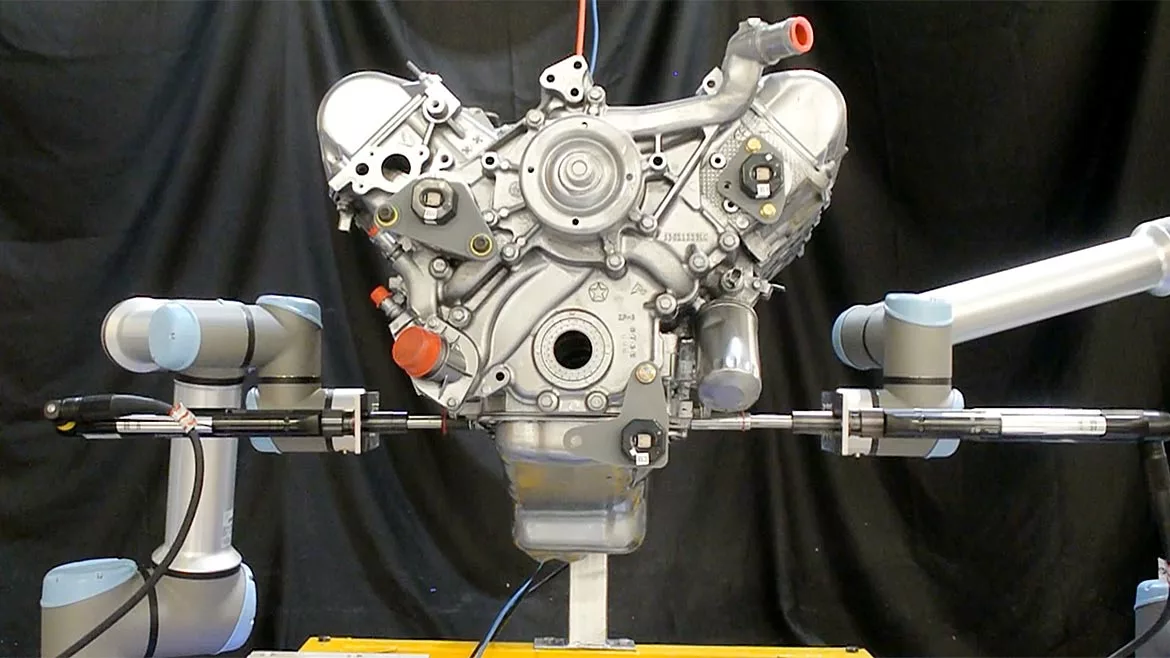
Machine Vision 101 feature. a pair of UR10e and UR16e cobots from Universal Robots perform assembly tasks on an engine that’s in motion –no machine vision required.

New England-based Humatics has developed a radio frequency-based system for high speed, advanced cobot-powered applications that require microlocation and fast data transfer. Here, a pair of UR10e and UR16e cobots from Universal Robots perform assembly tasks on an engine that’s in motion –no machine vision required. All Images Source: Universal Robots

December 27, 2023
✕
Image in modal.

The first industrial machine vision systems date back to the beginning of the modern industrial robot age in the 1980s. Today, augmenting collaborative robots (or cobots) with vision enables them to achieve with higher precision, greater flexibility, and more intelligence. Integration is not a one-size-fits-all process however, since the specific requirements of each application can vary greatly.

Consider an electronics assembly line, for example. A cobot working on printed circuit board (PCB) assembly could use machine vision for two (or more) tasks with high precision requirements, such as locating the position of components on a PCB and inspecting the quality of solder joints post-assembly.

Meanwhile, simple applications, such as detecting whether a product has a sticker indicating that it has passed inspection, can be performed by basic, 2D camera-based systems and at a lower price point.

The versatility of machine vision has seen the global machine vision market grow by 10.7% between 2021 and 2022 to reach a value of USD12 billion, according to MarketsandMarkets. The global market is projected to reach USD17.2 billion by 2027. Major factors driving the adoption of machine vision in collaborative automation include: the increasing affordability of machine vision hardware; usability enhancements; and the rise of artificial intelligence. These improvements work together to improve performance, make new cobot applications possible, and reduce the total cost of ownership (TCO) on machine vision projects.

What are the main considerations to keep in mind when choosing a machine vision system for a cobot-based application?
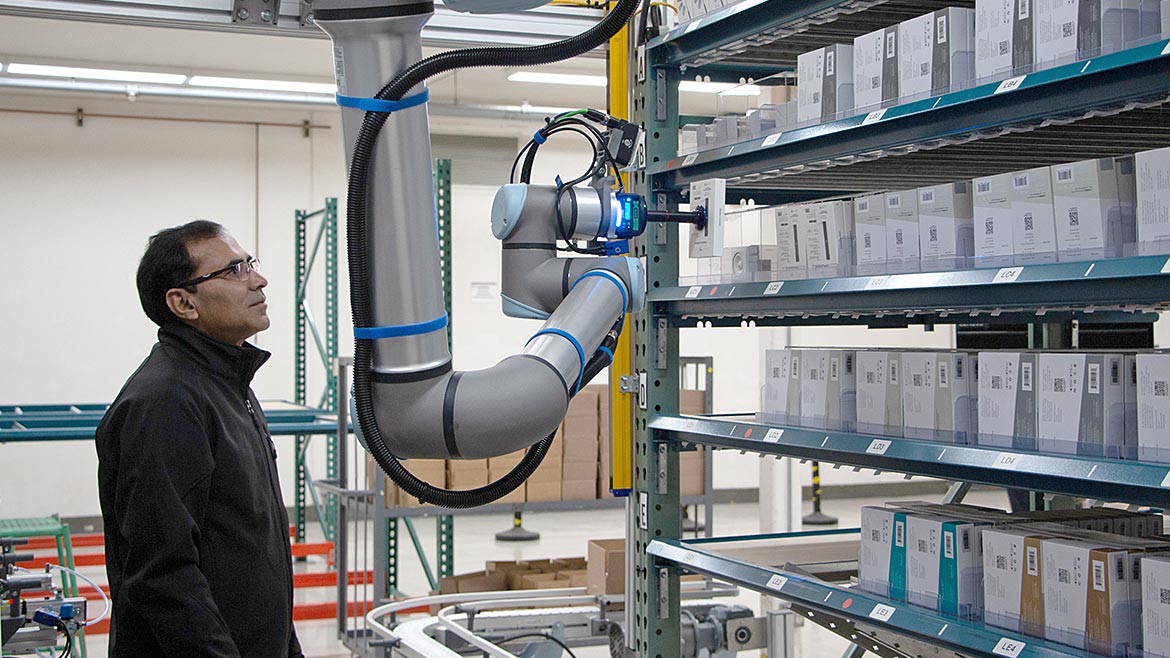
Machine Vision 101 feature. At DCL Logistics, a 3PL fulfillment center in California, the company has deployed a UR10e cobot equipped with a Datalogic vision camera. Once a product is picked, the SKU is verified by the camera.
Universal Robots (UR) certifies numerous vision cameras to integrate seamlessly with UR cobots through the UR+ platform. At DCL Logistics, a 3PL fulfillment center in California, the company has deployed a UR10e cobot equipped with a Datalogic vision camera. Once a product is picked, the SKU is verified by the camera that sends a “pass” or “fail” command to the cobot. If the product picked is incorrect, the UR10e places the product in a reject bin.

1) Do You Need Machine Vision?

Are you sure that your application requires machine vision? Could it be performed using traditional sensors or fixturing? Some cobots have built-in user-friendly palletizing wizards that can easily pick up parts placed in a grid pattern on a peg board, which would not require vision at all. Similarly, simple sorting and detection applications that don’t require high precision could be carried out using traditional sensors.

All that said, many critical industrial tasks require some sort of machine vision system. These include applications involving object recognition, variable object locations, quality inspection tasks, and safety.

2) Location, Inspection, Or Safety?

Before purchasing a cobot arm with built-in vision, ensure that it is the right vision solution for your application. Cobots that provide seamless integration with a wide range of vision solutions from entry-level to advanced are in real demand, because broad compatibility provides more flexibility and helps to futureproof your initial cobot investment.

The vast majority of vision-based applications fall into one of three subdomains: location (including path planning), inspection, and safety. For part location applications, the vision system has to be capable of accurate object recognition and pose estimation.

For quality inspection roles, the system should be able to detect extremely minute defects. This requires high-resolution cameras and advanced image processing software.

For those all-important safety applications, such as detecting when a human has approached and/or entered the cobot’s workspace, you’ll need a machine vision system with real-time processing capabilities, tracking functionality, and robust object detection.
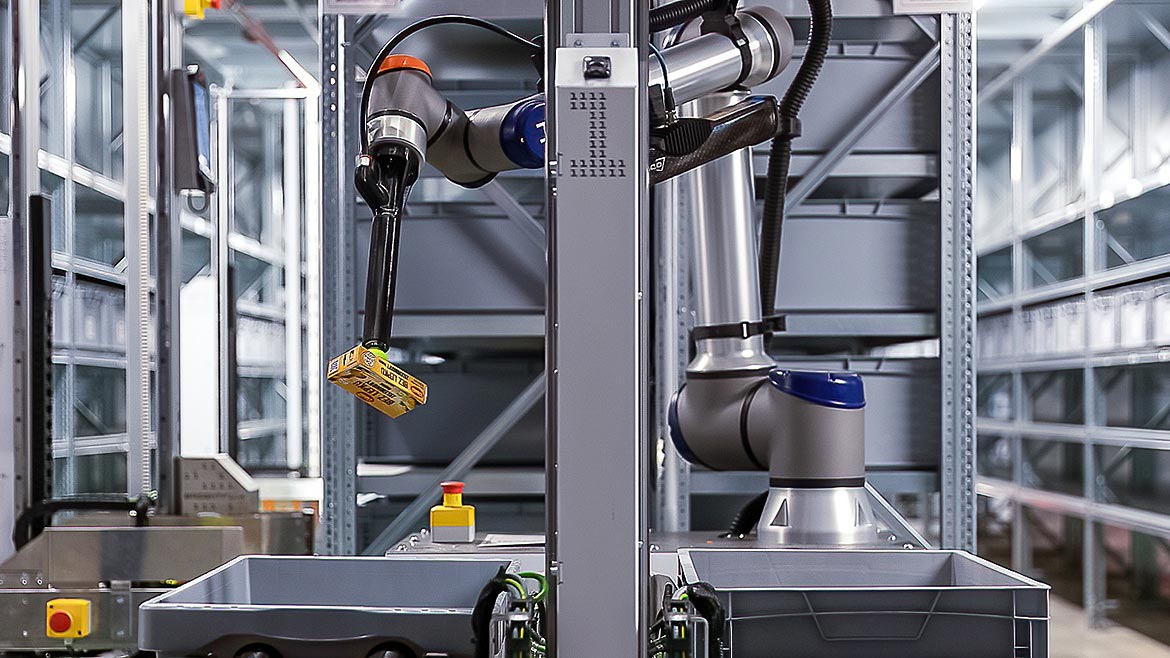
VS 0124 Machine Vision 101 Photoneo's 3D Meshing with MotionCam3D color mounted on an UR cobot.
Universal Robots has an expansive UR+ ecosystem of partners developing vision solutions that integrate seamlessly with the UR cobot arms. Combining UR+ partner Photoneo's 3D Meshing with MotionCam3D color mounted on an UR cobot allows for fast 3D object model creation for manufacturing validation, equality control and further processing.

3) Lighting

Lighting has a major impact on image quality and the performance of vision systems. Some vision systems require consistent, high-contrast lighting conditions. Some machine vision systems come with illumination capabilities to address these issues.

Other machine vision solutions are easily able to cope with variable lighting conditions, so that changes in ambient light levels over the course of a day will have no impact on performance. Even a change as small as switching from fluorescent to LED bulb use can cause some vision systems to fail, so make sure to explore this topic with your integration team.

4) 2D Or 3D Camera?

Vision & Sensors

A Quality Special Section

  • The Power of SWIR Illumination and Imaging
  • What Drives the Trends in Machine Vision
  • Making Vision and AI Easier for Users
  • Read More ≫

2D robotic vision is highly effective at handling a wide range of non-complex applications. Typical examples include barcode reading, label orientation and printing verification. That said, 2D cameras only provide length and width information – not depth – which dramatically limits the number of applications they can handle.

At the other end of the spectrum, 3D cameras provide extremely accurate depth and rotational information, making them a good fit for applications that demand detailed information about an object’s precise location, size, surface angles, volume, degrees of flatness, and other features. Advanced inspection applications that need to be able to detect minute defects in a product’s finish will perform best using 3D camera systems.

5) Precision Requirements

Closely examine the accuracy, repeatability, and tolerance requirements of the application before you select a machine vision system for your cobot.

For example, applications like microchip manufacturing and precision assembly require advanced vision systems with high-resolution cameras and complex image processing capabilities. Applications with more lenient tolerances can be performed by cheaper vision systems.

6) Cycle Time

The processing speed of machine vision systems needs to align with the cycle time of the cobot operation. High-speed applications require systems with fast image capture and processing capabilities – but keep in mind that processing all this visual information takes time, which will impact performance and will need to be factored into your cycle time considerations.


Radio frequency-based systems: A new alternative to machine vision

There are noteworthy alternatives to vision-based systems, including those that use radio frequencies –rather than light—to provide high precision microlocation and sub-millimeter precise path planning for cobot arms in real-time. They achieve levels of precision traditionally associated with the most advanced 3D systems.

One such system, specially developed for the automotive sector but with applications across numerous verticals is being developed by Humatics. It enables extremely advanced applications, such as having two cobots work concurrently on an engine as it moves on a conveyor.

Radio frequency-based systems can outperform vision on some tasks, says Ron Senior, vice president of sales, marketing and business development at Humatics.

“The ability to process data in complex environments, such as an engine in motion, is well suited to the lightweight, highly rapid positional data that radio frequency provides. It’s very difficult to achieve the same performance with machine vision because of the image processing required,” he explains.

KEYWORDS: Cobots (Collaborative Robots) machine vision manufacturing printed circuit boards

Share This Story

Looking for a reprint of this article?
From high-res PDFs to custom plaques, order your copy today!

Mike DeGrace, UR+ ecosystem manager, Universal Robots. For more information, call 844-GO-COBOT or email [email protected]

Recommended Content

JOIN TODAY
to unlock your recommendations.

Already have an account? Sign In

  • 2024 Quality Rookie of the Year Justin Wise 1440x750px banner with "Quality Rookie of the Year" logo inset

    Meet the 2024 Quality Rookie of the Year: Justin Wise

    Justin Wise is an exceptional individual who has been...
    Aerospace
    By: Michelle Bangert
  • Man with umbrella and coat stands outside while it rains at night looking at a building.

    Nondestructive Testing: Is there an ethics problem?

    I was a whistleblower who exposed fraudulent activities...
    NDT
    By: Dale Norwood
  • Unraveling Deflategate: Football stadium with closeup of football on field

    Unraveling the Tom Brady Deflategate

    The Deflategate scandal erupted following the 2014 AFC...
    Measurement
    By: Greg Cenker and Henry Zumbrun
Manage My Account
  • eMagazine Subscriptions
  • Newsletters
  • Online Registration
  • Subscription Customer Service
  • Manage My Preferences

More Videos

Sponsored Content

Sponsored Content is a special paid section where industry companies provide high quality, objective, non-commercial content around topics of interest to the Quality audience. All Sponsored Content is supplied by the advertising company and any opinions expressed in this article are those of the author and not necessarily reflect the views of Quality or its parent company, BNP Media. Interested in participating in our Sponsored Content section? Contact your local rep!

close
  • Key Takeaways for Quality Leaders
    Sponsored byComplianceQuest

    Key Takeaways for Quality Leaders from the 2026 Gartner Magic Quadrant™ for QMS

  • This image shows a person seated next to a Bobcat T66 compact track loader.
    Sponsored byPolyWorks by InnovMetric

    Supercharging Digital Gauging at Bobcat North America

  • Dorsey Calibration Lab photo by Tom LaBarbera Picture this Studios
    Sponsored byDorsey Metrology International

    Ensuring Product Quality in a Competitive Manufacturing Landscape

Popular Stories

This image shows a person seated next to a Bobcat T66 compact track loader.

Supercharging Digital Gauging at Bobcat North America

a professional in the aviation field performing maintenance, repair, and overhaul (MRO) work

Manufacturing Retention: Strategies for Improving Company Culture, Engagement and Skill Development

Dorsey Calibration Lab photo by Tom LaBarbera Picture this Studios

Ensuring Product Quality in a Competitive Manufacturing Landscape

2026 Quality Professional of the Year!

Events

June 22, 2026

Automate 2026

Automate is North America's largest robotics and automation event — and the best place to take your ideas from insight to impact.
 
Our show floor features the world’s leading automation solutions, from AI and robotics to motion control, vision systems, and more. Plus, our educational conference is second to none, led by the brightest minds in automation today.
 
Ready to transform the way you work? Take the next step at Automate.
July 14, 2026

Quality Leaders Forum: Better Communication, Better Quality Data

The Quality Leaders Forum is a quarterly, editor-moderated fireside chat series hosted by Quality Magazine, featuring candid conversations with senior manufacturing and operations executives shaping enterprise-level quality.

View All Submit An Event

Products

Lean Manufacturing and Service Fundamentals, Applications, and Case Studies

Lean Manufacturing and Service Fundamentals, Applications, and Case Studies

See More Products
Quality Podcast Channel Custom Content

Related Articles

  • robot vision

    2.5D Vision Hits Sweet Spot for Collaborative Applications

    See More
  • Minitab

    The Quick Guide to Six Sigma Statistics: 10 Tools Explained

    See More
  • Mitutoyo logo

    Quick Guide to Precision Measuring Instruments

    See More

Related Products

See More Products
  • louis hannigan.jpg

    The Non-Idiot's Guide to ISO 9001:2015: Understanding and Using the Quality Management System Standard to your benefit

  • 51FLQLR9hqL__SX373_BO1,204,203,200_.jpg

    Juran's Quality Handbook: The Complete Guide to Performance Excellence, Seventh Edition

  • Machine Vision and Error Proofing DVD

See More Products

Related Directories

  • VISION fOr VISION

    VISION fOr VISION specializes in the development of software for machine vision applications. We implement standard and custom vision algorithms, tune them for best performance, adapt them to your platforms, and assemble complete solutions that suit your needs.
  • Machine Vision Store

    Machine Vision Store has a laser-sharp focus on machine vision imaging. We deliver a select group of components - cameras, lenses, lights, industrial vision PC's - from leading manufacturers known for quality. Components we understand, support and stand behind. Components and consulting services that will power your success.
×

Stay in the know with Quality’s comprehensive coverage of
the manufacturing and metrology industries.

Newsletters | Website | eMagazine

JOIN TODAY!
  • RESOURCES
    • Advertise
    • Contact Us
    • Directories
    • Manufacturing Division
    • Store
    • Want More
  • SIGN UP TODAY
    • Create Account
    • eMagazine
    • Newsletters
    • Customer Service
    • Manage Preferences
  • SERVICES
    • Marketing Services
    • Market Research
    • Reprints
    • List Rental
    • Survey/Respondent Access
  • STAY CONNECTED
    • LinkedIn
    • Facebook
    • YouTube
    • X (Twitter)
  • PRIVACY
    • PRIVACY POLICY
    • TERMS & CONDITIONS
    • DO NOT SELL MY PERSONAL INFORMATION
    • PRIVACY REQUEST
    • ACCESSIBILITY

Copyright ©2026. All Rights Reserved BNP Media, Inc. and BNP Media II, LLC.

Design, CMS, Hosting & Web Development :: ePublishing