Case Study
Remote Robot Monitoring & Control Slashes Downtime Costs
A new approach to remote robot monitoring and error recovery helps companies restart production faster in cases of unplanned robot downtime.
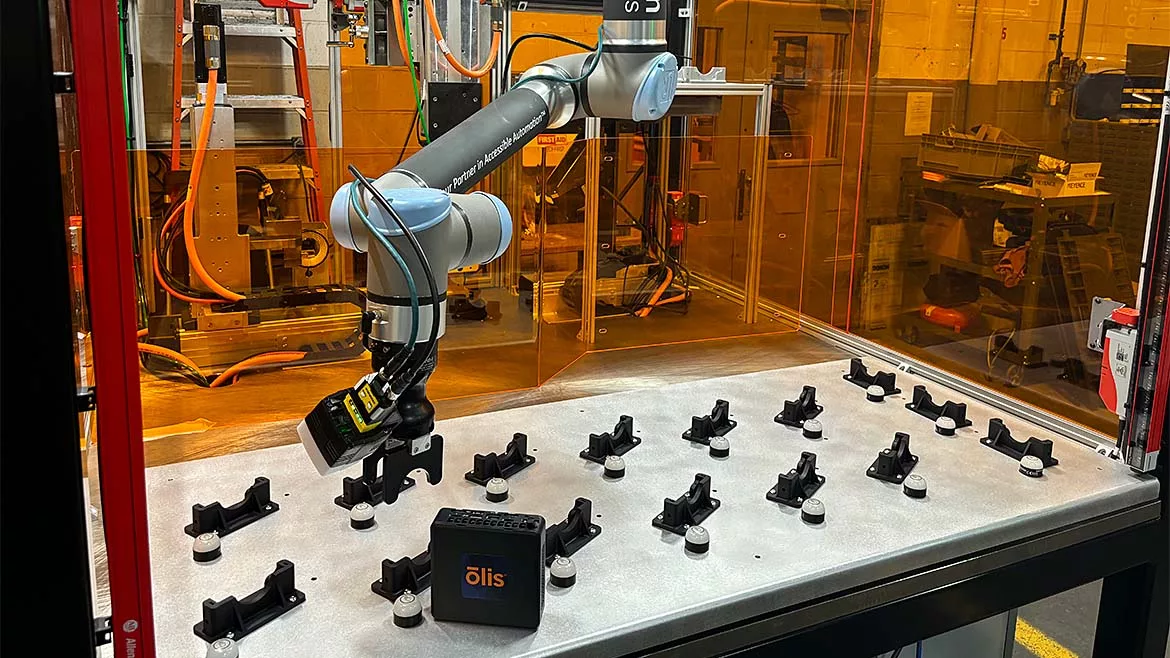
Olis remote monitoring and error correction system enables rapid resolution of unplanned robot downtime issues. Image Source: Precision Cobotics
Automated quality inspection cells help manufacturers achieve zero-defect production by plugging labor gaps, ensuring consistent output, and increasing quality throughput via 24/7 operations. AI-based vision systems are another set of tools helping to advance automation adoption in vision-based quality inspection tasks.
But what happens when your automated cell comes to an unplanned stop? It’s almost impossible to predict every possible scenario that might occur in a cell, especially in complex, AI-powered vision-based inspection cells which can produce unexpected edge cases.
Do you call an integrator? Push all the buttons and hope for the best? Wait for an expert to arrive onsite? Hope that an expert can quickly work out what caused the failure and fix it? How much is all that going to cost?
With unplanned downtime costing manufacturers anywhere from several thousand to more than a million dollars per hour, minutes matter when it comes to tackling unexpected robot errors.
Dealing with downtime
Working out the cause of robot cell failure is the first step to fixing the problem, says John Bridgen, president at Precision Cobotics, a Pennsylvania-based integration firm.
“Our customers are sensitive to the costs of unplanned robot downtime, so performing the root cause analysis quickly and effectively is crucial. Traditionally, that debugging process has involved some guesswork and a trip onsite to perform the fix,” says Bridgen.
This traditional scenario is frustrating, costly, and time-consuming. For some end-users, it’s enough to put them off deploying automation altogether. This is especially true for many small-to-medium size (SME) companies with budgets that don’t stretch far enough to justify the ongoing operational costs of automation deployments.
The pandemic era
The Covid pandemic showcased the effectiveness of remote robot monitoring and control technology –and the limitations of some systems. Pre-pandemic, the trend towards increasing adoption of remote robot monitoring and control systems was already underway, but social distancing requirements and labor shortages saw industry adopt these technologies at an unprecedented rate.
Over that period, the benefits of remote monitoring and control software became clear. These technologies enable companies to gain access to robotics experts more quickly, thereby reducing troubleshooting costs, and restarting production faster. The global market for remote monitoring and control systems was estimated at US$23 billion in 2020. By 2026, it’s expected to reach US$31.7 billion at a CAGR of 5.4%.
Not all remote monitoring and control systems are the same, however. Some provide remote monitoring only, which will send out alerts in cases of unplanned robot downtime, but don’t get you -- or your integrator -- any closer than that to solving the problem. It’s one thing to be notified about issues with your robot’s performance, but quite another to be able to do something about it via remote robot control.
Many remote monitoring systems provide a layer of analytics capabilities that allow companies to adjust their automated cells to achieve better performance, using KPIs such as overall equipment effectiveness.
Despite the obvious advantages, there are two lingering obstacles to widespread adoption of traditional remote robot monitoring and control systems –cybersecurity concerns and physical safety.
Overcoming obstacles
The manufacturing sector is the number one target for cyberattacks, according to IBM’s most recent X-Force Threat Intelligence Index 2024. IBM researchers found that a quarter of all cyberattacks across the top ten industries were aimed at manufacturers, as malicious actors aim to take advantage of the sector’s sensitivity to costly downtime.
Historically, computers connected to the cloud have been used to remotely control industrial robots automatically, without human intervention. This approach is well-established and well-understood. But with cyberattacks very much on manufacturers’ minds, remote monitoring and control systems that access the cloud are perceived as introducing additional cybersecurity risks to an already threat-filled environment.
Physical safety is also a concern, even if a human steps into the loop and assumes remote robot operation. What if that remote robot operator sends an instruction that overrides onsite safety settings? The consequences could be devastating and it’s a risk most companies are, understandably, not willing to take.
New approach
A new remote monitoring and control system for industrial robots provides a fresh take on remote connectivity and control. It provides all the remote monitoring and control features of traditional systems, but it also supplies the video forensics required to quickly determine the cause of robot failure. Moreover, it allows remote operators to remotely correct errors and perform actions such as jogging a gripper to release a part to get production restarted.
“It is so important to get that kind of forensic video evidence quickly whenever there is unplanned downtime,” says Precision Cobotics’ Bridgen. “It shortens the time it takes to work out the root cause of robot failures and helps us to get production up and running again.”
Dubbed ‘Olis’ and consisting of several Power-over-Ethernet (PoE) cameras, a compute box and software, the new remote robot monitoring and control system provides 24/7 low latency video and data access to any robot cell.
Once secure remote access has been configured, automation can be monitored and managed remotely via any browser-capable device. When a robot error occurs, the system sends out an alert via secure connection, completely avoiding the cloud—and all the cybersecurity risks associated with it—in the process.

Fast response
One of Precision Cobotics’ customers uses a UR20 from Universal Robots on a complex bin-picking and machine tending application. The setup 4D vision software, and a Doosan Puma CNC machine.
The robot had to pick from two wire mesh bins at least three feet deep and full of parts. Then, using a dual-gripper, it would orient the part precisely in the CNC machine, collect the part when finished and place it onto a conveyor for packaging.
The cell worked well, despite the relatively complex application requirements. Then Precision Cobotics received an alert via Olis that the UR20 had reached a protective stop. There was mystification at the facility as people made various guesses about the cause of the unplanned robot downtime. This was not the case at Precision Cobotics, whose experts were armed with video forensics.
“Using the video feed, we were able to validate why those protective stops were occurring pretty much instantly. It turned out that the bin that was being loaded had excessive denting that the system wasn’t expecting, so the cell was coming to a stop,” explains Bridgen.
The Precision Cobotics team then remotely recovered and restarted the robot and production was back up and running in a fraction of the time it would have taken had an onsite visit been required.
The new solution is also designed in such a way that humans can safely control the robot from any location, but they cannot violate the robot’s existing onsite safety permissions and restrictions. The fact that velocity, acceleration, and joint limit settings on the robot are always obeyed when remote controlling the arm ensures that physical safety is not undermined by remote operation.
Cross-industry benefits
Manufacturers appreciate reduced downtime and the improved analytics provided by the latest remote robot monitoring and error recovery technology. And integrators are empowered to meet growing demand for automation without having to hire new staff. By slashing the length of time it takes to resolve unplanned robot downtime, Olis enables integration firms to handle more troubleshooting calls and even grow their business.
“This technology takes the guesswork out of dealing with unplanned downtime, which saves us an enormous amount of time and allows our customers to get production restarted with minimal delays,” adds Bridgen.
Leveraging Olis’ video forensics capabilities, Precision Cobotics has begun deploying the new technology in a non-robotic, bowl-feeding inspection application. The setup incorporates vibratory feeders and a rotary transfer table that sends items down ‘good’ or ‘bad’ chutes depending on the outcome of the inspection.
“When things go wrong with the system, we can check out the recorded video and work out the cause of the fault. The truth is, is any unattended automated process can benefit from forensic video evidence. We’re fitting Olis on those applications to give us the same efficiency gains we get from deploying it in robot-based cells.”
Looking for a reprint of this article?
From high-res PDFs to custom plaques, order your copy today!