Test & Inspection
Noise Vibration Harshness (NVH) Quality Inspection
To meet the new torque and rpm requirements, the gears for electric drives must be designed with tighter manufacturing tolerances, especially in terms of lead and profile characteristics.
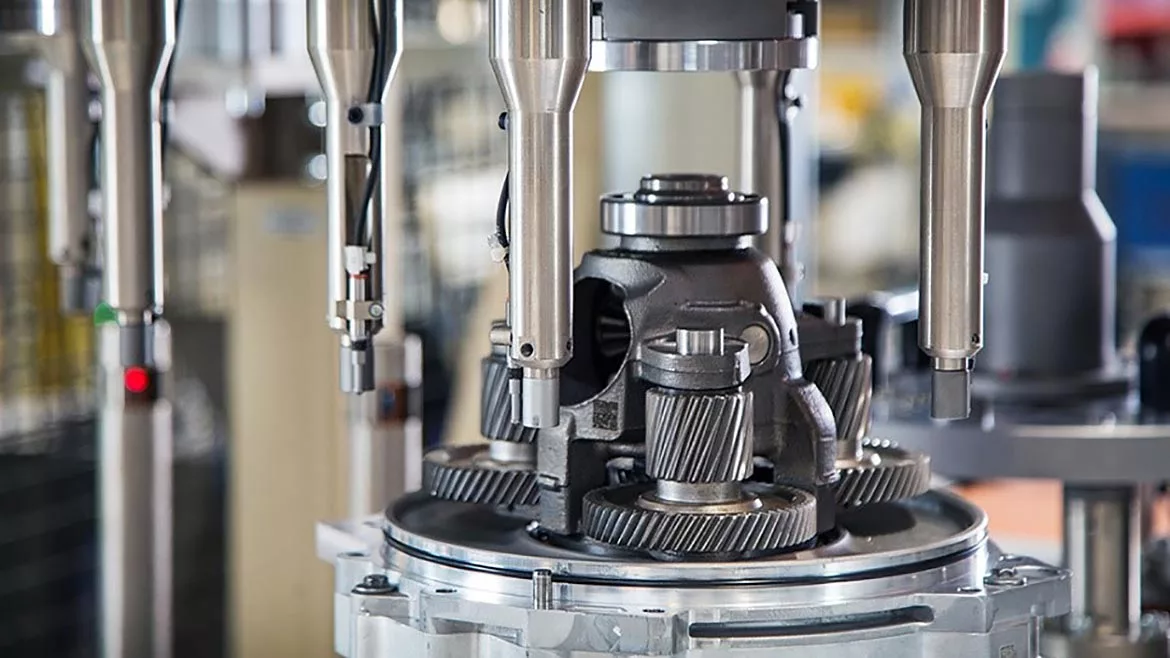
Gears for electric drives need to be designed with tighter manufacturing tolerances, especially in terms of profile and lead characteristics.
Image Source: MARPOSS
The automotive industry is facing a big shift towards electrification and electrified transmissions are subject to new challenges and requirements. On the one hand, the number of gear wheels is significantly reduced in electric vehicles due to the use of single- or two-speed gearboxes instead of the classic manual or twin-clutch transmission. Furthermore, these gears are loaded with torque and rpm not previously found in high-volume production.
To meet the new torque and rpm requirements, the gears for electric drives must be designed with tighter manufacturing tolerances, especially in terms of lead and profile characteristics. Another strict requirement concerns the noise level of the gears, which must be almost negligible. Combined, these new manufacturing specifications become a great challenge for gear manufacturers.
While representing a demanding task for manufacturers, it also allows quality control partners to work more closely with gear producers to improve processes and routines. Indeed, this increased precision required results in the need for highly accurate production control.
The crucial control process is most effective when applied throughout the entire production chain of a gear. This begins with machine monitoring solutions that detect early breakages on the hob tool, through in-process gaging during the grinding operations, to end-of-line measurement and inspection of the finished gear.
Earlier, we mentioned the importance of reduced noise on all drivetrain components. Until recently, a noise analysis - better defined as NVH (Noise Vibration Harshness) study - was performed on the assembled gearbox as a functional end-of-line test. However, now that ensuring a silent gearbox has become of paramount importance, the identification of potential noise-producing components must be moved upstream in the process.
The big question that arises is the relationship between the NVH testing of individual gears and the expected NVH behavior on the final transmission assembly. In the past regarding ICEs, the gear boxes were much more complex, full of gears with lower technical requirements, and connected to a noisy combustion engine; the noise was not a problem. With the growing implementation of BEV, it is now believed that the simpler lay-out of the transmission has made it possible to reveal the impact of the gears on the complete assembly. In addition, the requirements for NVH testing of the gearbox assembly became more stringent in the BEV, forcing transmission manufacturers to adopt 100% NVH testing on individual gears.

Moreover, e-Drive applications introduce a major difference as compared to traditional transmissions, because drive and coast flanks now have to be considered equally important when a transmission is being tested. In fact, in e-Drive configurations energy flows in both directions, from the motor to the wheels during positive acceleration and from the wheels to the battery pack during braking, so the transmission must be quiet under both conditions.
NVH evaluation based on a single component allows for the identification of defects such as micro-geometry errors on a gear, helping to avoid issues that are much harder to solve at the assembly stage. This represents an invaluable benefit in terms of time and money saved for manufacturers. In addition, the NVH test makes it possible to identify defects on the gear flanks that are not normally detectable with the traditional production quality tests (double flank roll checkers, DOB/MdK measurements). These tests are very effective at the early or intermediate stages of the manufacturing process (after hobbing or shaving operations, before and after heat treatment), while their contribution is no longer a “plus” when the gears are already ground, polished or honed, which is a normal requirement for gears used in e-mobility.
For instance, a gear that is machined within the manufacturing tolerances and passes traditional measurement checks may still produce noise at certain frequencies in the gearbox. This event is known as the ripple phenomenon, which is responsible for creating frequencies with amplitudes above the expected threshold (ghost orders). Ghost orders arise from micro-surface problems in the profile and lead directions of the gear flanks.
The main source of noise originates from accelerations that repeat consistently at every part revolution; a part that is geometrically perfect could be noisier than one with a small amount of defects as the presence of defects on the teeth allows the energy to dissipate. Gear manufacturers are struggling to understand how to introduce a controlled amount of variations in the gear teeth to achieve the goal of a silent gear. Which is tricky because from an engineering standpoint, the gear must be designed and manufactured with the lowest number of possible imperfections to ensure the proper mechanical reliability. On the other hand, the challenge is to introduce form deviations that reduce the amplitude of certain orders during meshing.
The NVH test on a single gear analyzes accelerations through a torsional accelerometer sensor. To accomplish its metrological task, the system requires a considerable amount of energy. For this reason, the measurement is performed at high speed (400-3,000 rpm), while the traditional transmission error test is performed at a lower speed (30 rpm).
The signal from the sensor is elaborated to obtain a fast Fournier transform (FFT) that shows the amplitude of the vibration frequencies. This process breaks down the signal into its frequency components. As a result, the system provides the amplitude values of each frequency component, which, when added together reconstruct the complete frequency spectrum of the gear under inspection.
Fourier analysis can be used to understand the possible root causes contributing to non-conformity of a noisy gear. The type of peaks detected over the FFT spectrum of the gear may have different origins, but all of them are related to the manufacturing process. For example, it might be due to an offset (misalignment) that occurred on the grinding wheel, generating eccentricity. In other cases, it may indicate local pitch errors or profile errors due to a division error on a machine tool, or a non-conformity could occur due to an unbalanced grinder or from vibration of the grinding tool.
Retrieving this type of information can be vital to provide proper feedback to the manufacturing process in order to ensure the quality of gear production.


Manufacturers that decide not to adopt an individual NVH gear tester face the possibility of getting more scraps and noisy gearboxes, without understanding the real reason for the non-conformity. If a gearbox fails the End of Line test once it is completely assembled and, consequently, one or more gears are suspected to be the source of the error, then this is often followed by a manual disassembly, the replacement of each gear and performing a new measurement on those gears in the laboratory. It seems clear that this approach is time-consuming and far from cost-effective. Moreover, as mentioned above, even re-measuring the gear (with a traditional measuring instrument) may not guarantee the identification of the fault. In fact, a “perfect” gear may still be the cause of gearbox noise.
Looking for a reprint of this article?
From high-res PDFs to custom plaques, order your copy today!