Management
How Toy Helicopters Lead to a Career with Real Robots
From a childhood love of math to an engineering degree—and then a second engineering degree—this mechatronics student has enjoyed the journey.
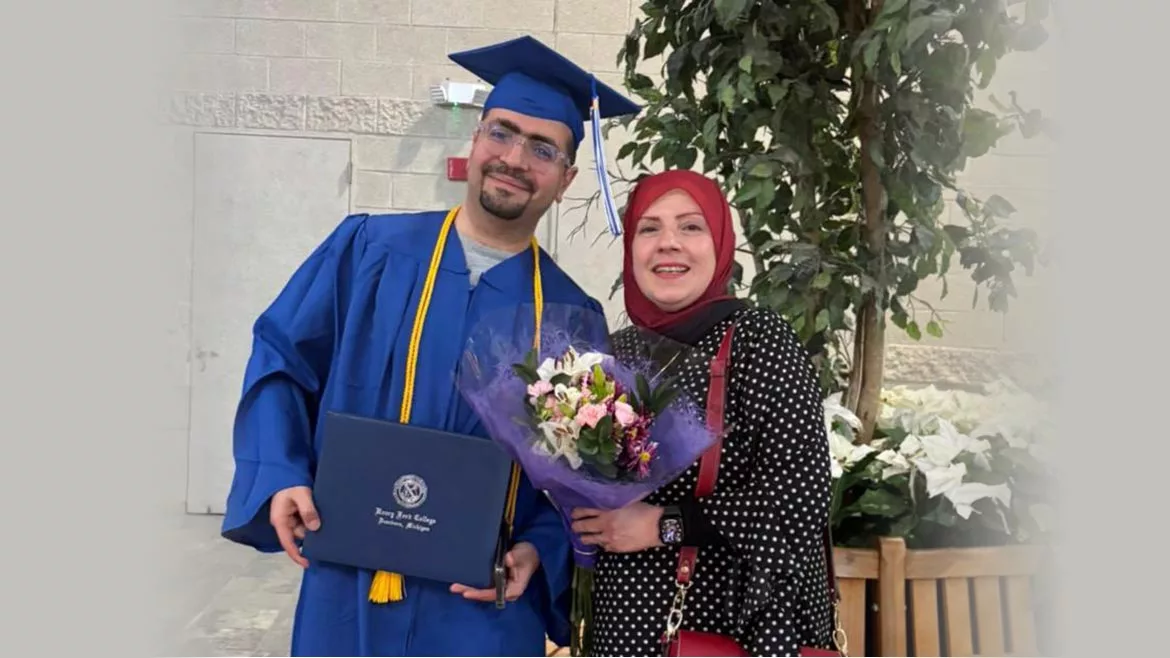
Image courtesy of Ibrahim Intabli
Ibrahim Intabli was always interested in taking things apart, gifted in math and science, and had a mentor in engineering. It sounds like the standard route to an engineering career.
But his story has a twist. After studying engineering in college, he went back to school for a second engineering degree in his thirties.
As a child, his family gave him a set of Meccano toys. "They were just a bunch of screws, gears, motors, and you connect them together, you build stuff. At one point, I think my favorite project to build was a helicopter that was actually a functioning helicopter made out of steel. I was 12, 13 years old. It always said 18 plus, but I didn't care."
"Maybe that particular toy was what inspired me to go to mechanical engineering," Intabli says. "And perhaps it's my instructors at the high school level that really saw my potential in the mechanical part of physics."
Today he is finishing up his associate's degree at Henry Ford College in mechatronics. In fact, when we spoke, it was the day before graduation.
For those interested in pursuing a career in engineering, he urges students to try it out early, and take classes in high school if possible. For manufacturers looking to recruit the next generation, be sure to have open houses and tours.
Math vs. Engineering
Intabli originally wanted to be a math teacher.
"For the first two years of my university, I was taking both math courses and engineering courses at the same time, until I decided, you know what, I like engineering better. When you're studying mathematics, you're not studying how to apply the formula. You're studying why did we create these formulas. You go into the philosophy of mathematics.
"It's way beyond, I mean, I know one plus one is two, but there's a course that explains in mathematics, what is a plus?"
Education
He originally got his engineering degree back in 2014 and master's degree in 2017.
"The weird part is that after all these years, I went back to school to get an associate's degree in mechatronics. I graduated as a mechanical engineer, but it was a general mechanical engineering degree."
"I always wanted to specialize in mechatronics, automation," he says. But at his school, the track was designed in such a way that you had to take courses in sequence. He would have to study another year to add this track, which wasn't possible at the time because of his scholarship.
After that, he worked as a planning engineer in project management for eight years. "At one point, it was time to jump ships. I always wanted to go back to automation."
While he was visiting his parents in the U.S. (they are citizens here), he did some research and stumbled upon Henry Ford College. He met several professors who helped him learn more about the program.
"They helped me out, really, along the journey," he says. "And here I am, one year later, I'm about to graduate with a mechatronics degree."
Back to School
The transition back to school at age 33 was initially a little frustrating, he says, but many of his peers were studying for their doctorates, so he wasn't the only one in school.
It was an adjustment learning the industry lingo—many of the students had been working on the line for more than 20 years—not to mention the American system of measurements. But this didn't dampen his enthusiasm.
"Actually, it was really fun. I really enjoyed every course I've taken so far."
Perhaps not everyone would find a mechanical engineering coursework "really fun" but this lines up with Intabli's interests.
"I did enjoy opening YouTube videos, how things are made, new technological enhancements in every industry. I mean, you open my YouTube, my TikTok, that's all you can see. This is what I tell everyone. I'm a nerd. I'm proud of it."
For those considering a career in engineering, he would advise them to try to take as many hands-on courses in their high school as possible.
"We have actually in Henry Ford College, and you wouldn't believe this, in many of the courses I was in, on my right hand was a 50-year-old man working in Ford. On my left hand, a 14-year-old in high school sent by their high school to actually learn mechatronics."
"That's what I really love. I haven't seen in any place else. And that's amazing. This is a program I would recommend."
Intabli lights up when describing his work.
"I just finished a project now called Machine Tool Processes, and it was really, really hands-on. It was an introductory level manufacturing course. The project was to manufacture a hammer out of nowhere. It doesn't seem like very complex, but every detail in this is an operation on its own.
"And the instructor was like, this is something you don't just keep in your drawer. This is a prize you give to your grandchildren in the future and tell them, I made this out of nowhere."
He also took a robotics course where they had to teach a robot to palletize and arrange items in a certain order as well as put obstacles along the way. "And that worked perfectly fine with the different and weird obstacles. We tried to think outside the box and putting the obstacles in weird places, and it still worked."
"The reason I chose mechatronics in the first place is because I like robotics. And what automation is, is just creating a link between different machines so that they know what sequence they will work in.
"And believe it or not, somehow it relates to my previous work experience because I'm coordinating different disciplines to know what sequence they go with, which is basically what I used to do as a planning engineer."
How can others get involved in manufacturing?
"We need to do some more demos, more videos, and that's the best eye-opener you can provide for students at the high school level so that they can choose what courses they would take, either at the college level or while they're still at high school.
"You've basically planted the idea of industrialization and manufacturing into their brain. So that's the best advice I could give to these big firms. Do your factory tours and go regularly to high schools once or twice a year."
Next Steps
Intabli is here on a student visa so he has the opportunity to work for one year in the States before going back to Lebanon.
"Since I'm in the southeast Detroit area, the big three are here. I'm planning to apply for these three big firms, Ford, GM, and Chrysler. But other than that, I don't mind doing either an internship or an apprenticeship program at one of the big facilities."
While the helicopter may be long gone, Intabli has built new tools.
"I actually told my dad, don't buy a hammer. I'm bringing a new one. When my dad saw it, he's like, 'No, I'm not going to use this. This is a masterpiece. You should not hit a single nail with it.'"
Looking for a reprint of this article?
From high-res PDFs to custom plaques, order your copy today!