Quality Magazine logo
search
cart
facebook twitter linkedin youtube
  • Sign In
  • Create Account
  • Sign Out
  • My Account
Quality Magazine logo
  • NEWS
  • PRODUCTS
    • FEATURED PRODUCTS
    • SUBMIT YOUR PRODUCT
  • CHANNELS
    • AUTOMATION
    • MANAGEMENT
    • MEASUREMENT
    • NDT
    • QUALITY 101
    • SOFTWARE
    • TEST & INSPECTION
    • VISION & SENSORS
  • MARKETS
    • AEROSPACE
    • AUTOMOTIVE
    • ENERGY
    • GREEN MANUFACTURING
    • MEDICAL
  • MEDIA
    • A WORD ON QUALITY PUZZLE
    • EBOOK
    • PODCASTS
    • VIDEOS
    • WEBINARS
  • EVENTS
    • EVENT CALENDAR
    • IMTS
  • DIRECTORIES
    • BUYERS GUIDE >
      • Supplier Insights
    • NDT SOURCEBOOK
    • VISION & SENSORS
    • TAKE A TOUR
  • INFOCENTERS
    • Digital Quality Management Systems
    • NEXT GENERATION SPC & QUALITY ANALYTICS
  • AWARDS
    • ROOKIE OF THE YEAR
    • PLANT OF THE YEAR
    • PROFESSIONAL OF THE YEAR
  • MORE
    • Expert Columns
    • NEWSLETTERS
    • QUALITY STORE
    • INDUSTRY LINKS
    • SPONSOR INSIGHTS
  • EMAG
    • eMAGAZINE
    • ARCHIVES
    • CONTACT
    • ADVERTISE
  • SIGN UP!
Vision & Sensors

Vision & Sensors | Vision

Unlocking Imaging Benefits with Compression

The growing deployment of 3D across a range of end-applications, from logistics to robotics and inspection, will also increase bandwidth demands.

By Ed Goffin
Dental X-ray feature image
Image Source: Pleora
October 2, 2025
✕
Image in modal.

Compression, once considered a compromise in high-bandwidth machine vision, is now used extensively as video becomes an essential tool across more industries.

In terms of technology, most people first encounter compression through audio. Audiophiles can argue for hours about the poor fidelity of streaming music services versus physical media. In a previous role, our R&D team worked extensively on preserving audio quality while employing various compression techniques for voice over IP, cellular, in-car, and teleconference services.

In vision systems, H.264 compression is commonly applied at the sensor level in embedded applications where visual appearance takes precedence over data integrity. This lossy compression approach helps minimize power, footprint, storage and bandwidth demands for wireless transmission in consumer or commercial drone, robotics, and IP camera surveillance applications. Lossy compression is also beneficial in edge processing applications, where raw data is analyzed on-device and only metadata or events are transmitted to processing.

A lossy, or “visually lossless,” method produces video that is indistinguishable to the human eye. Designers can benefit from higher compression ratios, but removing or altering some data does compromise the quality and performance of processing. This makes it unsuitable for most real-time applications where data integrity is critical, such as real-time security monitoring and medical imaging.

Mathematically lossless compression, in comparison, ensures imaging data remains intact while meeting latency demands for real-time processing. From sensor to processor, data remains an exact bit-for-bit match, though at a lower compression ratio versus lossy techniques.

Lossless compression approaches include JPEG-LS and JPEG 2000, and a patented hardware acceleration technique. The technique compresses imaging data line-by-line with under two image lines of latency, making it ideal for real-time applications. The algorithm dynamically selects the best compression profile for each line and includes a feature allowing users to reduce CPU load during decompression.
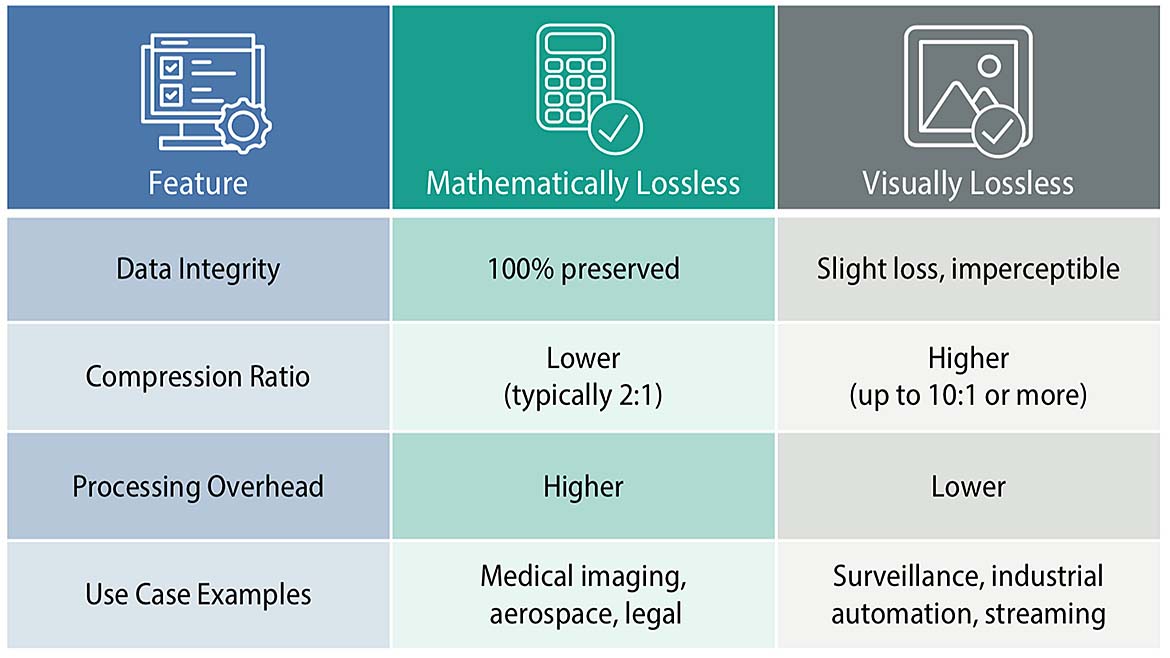
Chart 1: Mathematically lossless and visually lossless compression methods.
Chart 1: Mathematically lossless and visually lossless compression methods provide trade-offs in data integrity, efficiency, and processing overhead. Designers can align compression strategies with application needs. Image Source: Pleora Technologies

Advantages of Mathematically Lossless Compression for Imaging

A mathematically lossless compression approach provides several key benefits for imaging device designers and integrators to meet growing demands for higher resolutions and low latency performance while managing total system costs.

For imaging devices, lossless compression enables the use of high-resolution sensors that generate large volumes of data that can be transmitted over limited networking infrastructure. This allows more images to be sent in the same time frame, or for multiple high-bandwidth sources to operate on existing networks. Many industries rely on legacy infrastructure not built for today’s data demands, and upgrading is expensive.

Chart 2: Compression technologies
Chart 2: Compression technologies deliver distinct infrastructure cost and performance advantages in both medical imaging and machine vision. Image Source: Pleora Technologies

Compression and Perimeter Security

Secure facilities, including airports, military bases, borders, and commercial warehouses, are adopting more advanced imaging systems integrating infrared and visible capabilities to automatically detect and track potential threats. Infrared imaging consumes significant bandwidth, especially when uncompressed, and multicasting to multiple processing, display, and storage systems also increases network demands.

In one case, an integrator has developed an infrared 360° camera system for airport security. The system integrates multiple cameras to provide real-time detection, classification and tracking to safeguard against unlawful and accidental intrusions, protect critical areas, and manage the movement of personnel, aircraft, and vehicles.

Diagram of airport
In airport surveillance systems, lossless compression enables real-time transmission of up to 2 Gbps of video over standard 1 Gbps Ethernet links. This reduces infrastructure costs while ensuring high-quality imaging for centralized monitoring and detection. Image Source: Pleora

Here, a video interface with integrated lossless compression transmits real-time, low-latency video from the camera over extended-reach Ethernet cabling to a central office. Power, control signals, and data are all transmitted over a single, thinner, lighter, and more flexible cable. With GigE Vision, multiple cameras are networked to a single host PC for processing and display and new cameras are easily added to the network. Video can also be multicast to processing, displays, and storage systems.

The lossless compression algorithm transmits up to 2 Gbps of video over 1 Gbps Ethernet, reducing infrastructure and system costs while lowering power consumption. This nearly doubles the effective bandwidth and allows additional sensors without overloading the network.

Compression nearly doubles the effective bandwidth of the existing infrastructure, enabling the system expansion with additional sensors without overloading the network.

Cost and Patient Advantages in X-ray Imaging

Mathematically lossless compression in X-ray applications reduces image size without impacting quality. This means more images can be taken in a shorter time, resulting in shorter exam times and faster diagnoses for patients.

Real-time fluoroscopy relies on continuous X-rays for applications including cardiology, radiography and neurovascular imaging. The bandwidth demands of transmitting real-time video from the flat panel detector to processing makes it a good candidate for compression techniques.

Similarly, dental imaging is adopting compression techniques as it evolves from still X-ray to more complex 3D applications. Panoramic radiography, or panoramic X-ray, uses small doses of ionizing radiation to capture the entire mouth in a single image, including teeth, jaw structure, and surrounding tissues. Unlike intraoral X-ray where the film is placed inside the mouth, a panoramic X-ray machine consists of an X-ray tube mounted on one side and an FPD on the opposite side. During the examination, the X-ray tube rotates in a semicircle and projects a beam through the patient onto the FPD.

The FPD integrates embedded hardware supporting 1 Gbps image transmission – along with metadata, power, and control data – to processing over low-cost Gigabit Ethernet. As imaging performance demands increase, maintaining the cost of the network infrastructure plays a key role in total system cost advantages for solution providers.

To boost the capabilities of the existing Ethernet infrastructure, the mathematically lossless compression hardware acceleration approach transmits up to 1.5 Gbps throughput rates over existing 1 Gbps infrastructure. The compression technique ensures original and post-compression data are identical while supporting ultra-low latency performance for real-time dental imaging.
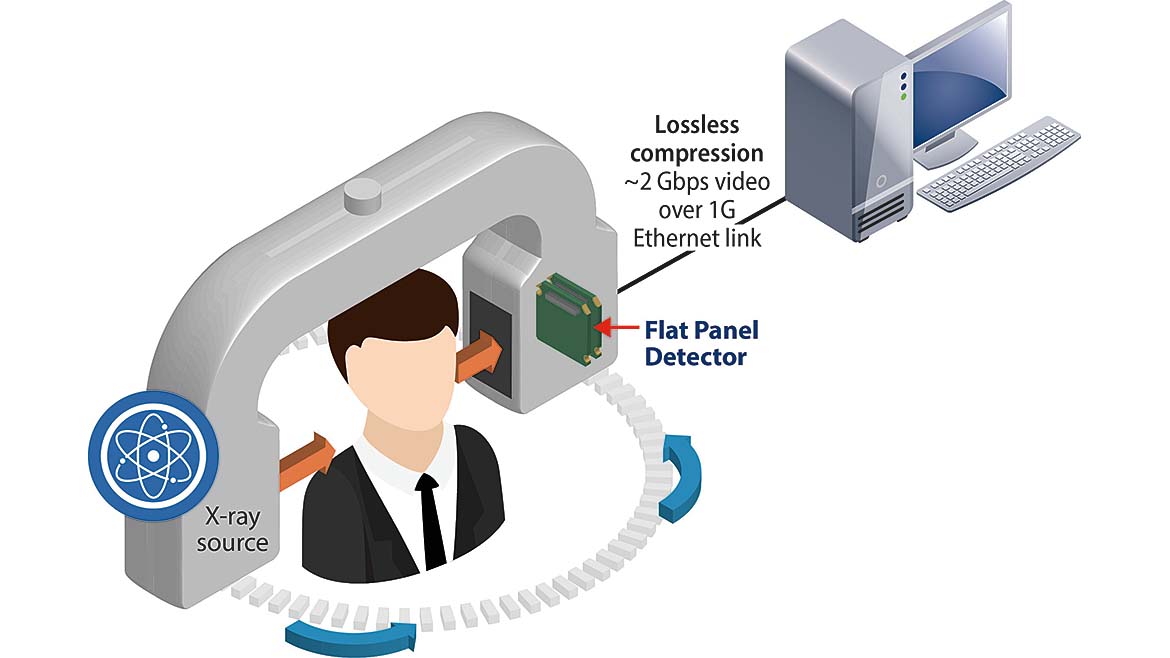
Dental panoramic X-ray systems
In dental panoramic X-ray systems, lossless compression enables flat panel detectors to transmit high-resolution, real-time video at ~2 Gbps over standard 1 Gbps Ethernet links. This ensures diagnostic image quality while reducing infrastructure costs. Image Source: Pleora

Emerging Trends and Compression

There are several emerging application areas that will benefit from efficient compression techniques focused on preserving quality for end-processing. Multi-sensor applications that fuse imaging and data streams require efficient compression to maintain performance over limited infrastructure. The growing deployment of 3D across a range of end-applications, from logistics to robotics and inspection, will also increase bandwidth demands for infrastructure.

Designers have several choices in their approach to compression, and the right choice considers the processing requirements of the application and the cost and performance expectations for end-users.

READ MORE

  • Cutting Through the Complexity of AI
  • Making Vision and AI Easier for Users
  • Podcast: Artificial Intelligence: What’s Next?
KEYWORDS: imaging imaging and vision technologies machine vision quality

Share This Story

Looking for a reprint of this article?
From high-res PDFs to custom plaques, order your copy today!

Ed Goffin is marketing manager with Pleora Technologies, a supplier of video interfaces for machine vision, medical imaging, and security applications. For more information, email him at [email protected] or visit www.pleora.com.

Recommended Content

JOIN TODAY
to unlock your recommendations.

Already have an account? Sign In

  • 2024 Quality Rookie of the Year Justin Wise 1440x750px banner with "Quality Rookie of the Year" logo inset

    Meet the 2024 Quality Rookie of the Year: Justin Wise

    Justin Wise is an exceptional individual who has been...
    Aerospace
    By: Michelle Bangert
  • Man with umbrella and coat stands outside while it rains at night looking at a building.

    Nondestructive Testing: Is there an ethics problem?

    I was a whistleblower who exposed fraudulent activities...
    NDT
    By: Dale Norwood
  • Unraveling Deflategate: Football stadium with closeup of football on field

    Unraveling the Tom Brady Deflategate

    The Deflategate scandal erupted following the 2014 AFC...
    Measurement
    By: Greg Cenker and Henry Zumbrun
Manage My Account
  • eMagazine Subscriptions
  • Newsletters
  • Online Registration
  • Subscription Customer Service
  • Manage My Preferences

More Videos

Sponsored Content

Sponsored Content is a special paid section where industry companies provide high quality, objective, non-commercial content around topics of interest to the Quality audience. All Sponsored Content is supplied by the advertising company and any opinions expressed in this article are those of the author and not necessarily reflect the views of Quality or its parent company, BNP Media. Interested in participating in our Sponsored Content section? Contact your local rep!

close
  • Key Takeaways for Quality Leaders
    Sponsored byComplianceQuest

    Key Takeaways for Quality Leaders from the 2026 Gartner Magic Quadrant™ for QMS

  • This image shows a person seated next to a Bobcat T66 compact track loader.
    Sponsored byPolyWorks by InnovMetric

    Supercharging Digital Gauging at Bobcat North America

  • Dorsey Calibration Lab photo by Tom LaBarbera Picture this Studios
    Sponsored byDorsey Metrology International

    Ensuring Product Quality in a Competitive Manufacturing Landscape

Popular Stories

This image shows a person seated next to a Bobcat T66 compact track loader.

Supercharging Digital Gauging at Bobcat North America

a professional in the aviation field performing maintenance, repair, and overhaul (MRO) work

Manufacturing Retention: Strategies for Improving Company Culture, Engagement and Skill Development

Dorsey Calibration Lab photo by Tom LaBarbera Picture this Studios

Ensuring Product Quality in a Competitive Manufacturing Landscape

2026 Quality Professional of the Year!

Events

June 22, 2026

Automate 2026

Automate is North America's largest robotics and automation event — and the best place to take your ideas from insight to impact.
 
Our show floor features the world’s leading automation solutions, from AI and robotics to motion control, vision systems, and more. Plus, our educational conference is second to none, led by the brightest minds in automation today.
 
Ready to transform the way you work? Take the next step at Automate.
July 14, 2026

Quality Leaders Forum: Better Communication, Better Quality Data

The Quality Leaders Forum is a quarterly, editor-moderated fireside chat series hosted by Quality Magazine, featuring candid conversations with senior manufacturing and operations executives shaping enterprise-level quality.

View All Submit An Event

Products

Lean Manufacturing and Service Fundamentals, Applications, and Case Studies

Lean Manufacturing and Service Fundamentals, Applications, and Case Studies

See More Products
Quality Podcast Channel Custom Content

Related Articles

  • Test Compression with Less Stress

    See More
  • Data from the AIA Global 2016 Machine Vison Market Study

    USB Brings Cost and Connectivity Advantages to Imaging

    See More
  • WMEP Benefits Wisconsin Manufacturers with $164 Million Impact

    See More

Related Products

See More Products
  • leanss.jpg

    Lean Six Sigma for Engineers and Managers With Applied Case Studies

  • Green Lean: Achieving Outstanding Environmental Performance with Lean DVD

  • Building Lean Supply Chains with the Theory of Constraints

See More Products
×

Stay in the know with Quality’s comprehensive coverage of
the manufacturing and metrology industries.

Newsletters | Website | eMagazine

JOIN TODAY!
  • RESOURCES
    • Advertise
    • Contact Us
    • Directories
    • Manufacturing Division
    • Store
    • Want More
  • SIGN UP TODAY
    • Create Account
    • eMagazine
    • Newsletters
    • Customer Service
    • Manage Preferences
  • SERVICES
    • Marketing Services
    • Market Research
    • Reprints
    • List Rental
    • Survey/Respondent Access
  • STAY CONNECTED
    • LinkedIn
    • Facebook
    • YouTube
    • X (Twitter)
  • PRIVACY
    • PRIVACY POLICY
    • TERMS & CONDITIONS
    • DO NOT SELL MY PERSONAL INFORMATION
    • PRIVACY REQUEST
    • ACCESSIBILITY

Copyright ©2026. All Rights Reserved BNP Media, Inc. and BNP Media II, LLC.

Design, CMS, Hosting & Web Development :: ePublishing