Measurement
The Challenges of Aerospace Manufacturing
As aerospace manufacturing grows more complex, the need for consistent, reliable measurement will only increase.
-(1).webp?t=1777322999&width=1080)
.webp?t=1777323021&width=1080)
.webp?t=1777323045&width=1080)
.webp?t=1777323068&width=1080)
In aerospace manufacturing, precision is not optional. Every component must meet strict tolerances, function reliably within complex assemblies, and comply with rigorous regulatory standards. Yet across the industry, a persistent challenge continues to affect production, supplier alignment, and quality outcomes: the measurement gap.
The measurement gap occurs when inspection results differ across teams, suppliers, or measurement systems, even when everyone believes they are following correct procedures. In aerospace, where multiple suppliers contribute to a single system, these inconsistencies can lead to delays, rework, and uncertainty in critical components.
At its core, this issue is not just about technology. It is about how measurement knowledge is developed, shared, and applied.
The Risk of Institutional Knowledge in Aerospace
A major contributor to the measurement gap is reliance on knowledge, unwritten practices shaped by experience rather than standardized understanding.
In many aerospace environments, inspection methods are influenced by local procedures, individual habits, or legacy training programs. While these approaches may work within a single team, they often break down across suppliers or facilities.
Without a shared framework, different groups may measure the same feature in different ways and arrive at conflicting results. This lack of alignment becomes especially problematic in aerospace manufacturing, where consistency across the supply chain is essential.
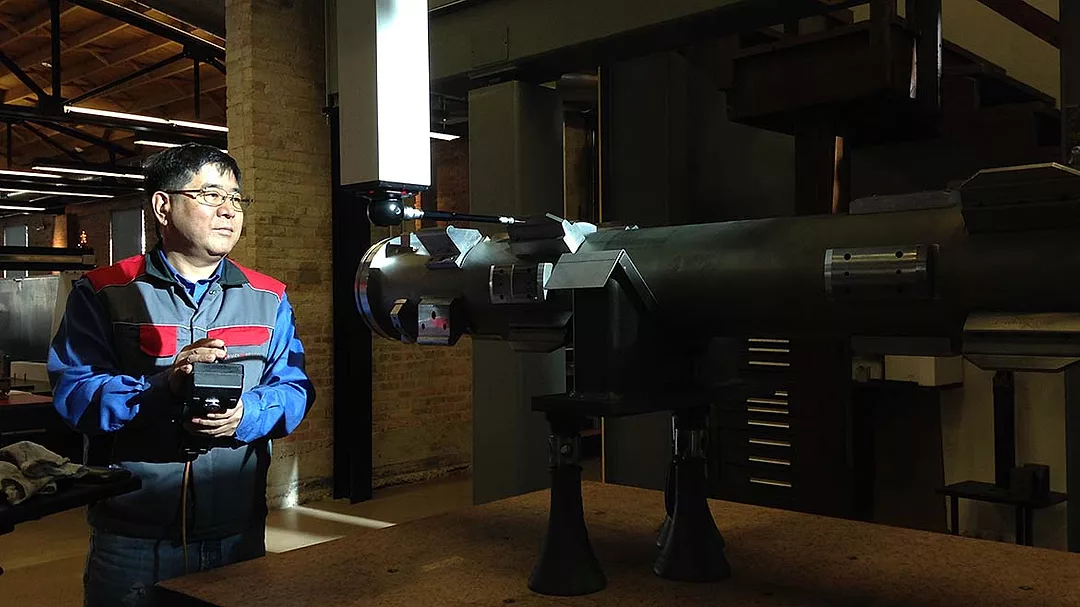
For this article, we spoke with Jacek Macias, the director of metrology training and certified AUKOM instructor with over 33 years of experience at Made to Measure. With a background in precision machining and a focus on metrology, he holds AUKOM Level 1, 2, and 3 certifications, as well as ASME GDTP Senior Certification. He brings a practical, cross-industry perspective shaped by decades of solving complex measurement challenges.
As Jacek explains, many inspectors are left solving complex problems without a solid foundation: “Individuals frequently kind of grope in the dark for the right solution instead of having knowledge that allows them to make informed decisions.”
Reducing reliance on institutional knowledge requires a shift toward structured, repeatable approaches that can be applied consistently across teams and suppliers.
When “In Tolerance” Isn’t Enough
Measurement issues often surface downstream. Parts may pass inspection yet fail during assembly or integration.
This is a familiar challenge in aerospace manufacturing. Suppliers may certify parts as compliant, but those same parts do not function as expected in final assemblies.
“Every company experiences issues where someone sends parts certified as in tolerance, and then the company can’t assemble them,” Macias notes.
The root cause is frequently not the part itself, but how it was measured. Differences in inspection strategy, feature interpretation, or data processing can lead to inconsistent results.
In aerospace, where tight tolerances and complex geometries are standard, these inconsistencies can quickly escalate into costly delays and disputes.
Measurement Variability Across the Supply Chain
Measurement is not a single, fixed process. Different strategies can produce different results, even when evaluating the same feature.
For example, when measuring a one-inch diameter hole on a coordinate measuring machine, the number of data points collected can vary widely.
Without clear guidelines, one supplier may use a minimal number of points, while another collects hundreds. Both approaches may be technically valid, yet they can produce different outcomes.
In aerospace manufacturing, this variability creates uncertainty across the supply chain. To address this, some organizations establish internal rules for how features should be measured. However, these requirements often vary between companies or locations.
As a result, measurement practices remain fragmented, and consistency depends heavily on local knowledge rather than shared standards.
Understanding Measurement Beyond Equipment
Advanced measurement systems are essential in aerospace, but equipment alone does not ensure consistency.
Measurement results depend on how data is collected, processed, and interpreted. In practice, measurement devices gather data, while software applies mathematical models to construct geometric features.
Different algorithms can interpret the same data differently, leading to variations in results. Without understanding these processes, inspectors may struggle to explain discrepancies or validate outcomes.
This reinforces the limitations of institutional knowledge. When decisions are based on habit rather than principle, consistency becomes difficult to maintain, especially across multiple suppliers and systems.
In aerospace manufacturing, where traceability and repeatability are critical, this lack of clarity introduces risk.
Standardization as a Path Forward
Standardization is one of the most effective ways to reduce variability and replace institutional knowledge with consistent practices. However, achieving standardization in metrology is inherently challenging.
Measurement systems vary widely, and aerospace applications often require different inspection strategies depending on the part and process.
Despite these challenges, the need for alignment is clear. Research has identified lack of standardization and insufficient training as primary drivers of metrology-related issues.
In aerospace, standardization does not mean enforcing identical procedures everywhere. Instead, it means building a shared understanding of how measurement systems work, how data should be interpreted, and how results should be communicated.
This shift helps organizations move away from experience-based practices and toward structured, knowledge-driven approaches.
Creating a Common Language for Measurement
Eliminating institutional knowledge requires more than written standards, it requires a common language.
Traditional training often focuses on operating specific equipment or software. While important, this approach does not always provide the deeper understanding needed to interpret measurement results or resolve discrepancies.
In aerospace manufacturing, where inspectors, engineers, and machinists must collaborate closely, this gap can create friction.
A more effective approach emphasizes fundamental measurement principles that apply across technologies. This includes understanding how data is collected, how features are constructed, and how results should be evaluated.
By building this shared foundation, organizations can improve alignment across teams and reduce ambiguity in measurement decisions.
Communication Across Aerospace Teams
Measurement is only valuable if it is clearly communicated.
In aerospace environments, inspection results must be understood across multiple functions, including engineering, manufacturing, and quality. However, communication is often one of the most overlooked aspects of metrology.
Inspection reports may appear straightforward, but unclear or inconsistent reporting can lead to misunderstandings, disputes, and delays.
Efforts to standardize reporting practices have begun to provide guidance on how to structure and present measurement data more effectively.
In aerospace manufacturing, where documentation and traceability are critical, improving communication is essential to closing the measurement gap.
Moving Beyond Legacy Thinking
Addressing the measurement gap also requires a cultural shift.
Some organizations still view quality as a cost rather than a value driver. This mindset can limit investment in training and discourage the adoption of standardized practices.
However, in aerospace manufacturing, the cost of inconsistent measurement, delays, rework, and supplier disputes, often exceeds the investment required to improve processes.
Organizations that recognize this are more likely to adopt systematic approaches to measurement, replacing legacy practices with scalable, consistent methods.
From Training to Execution
Training is a critical step in building measurement capability, but it must be reinforced through application.
Without opportunities to apply new knowledge, employees may revert to familiar habits, reintroducing inconsistency.
Successful aerospace organizations support training with leadership and accountability. Internal champions ensure that new skills are applied, shared, and integrated into daily operations.
This approach transforms training into long-term capability rather than a one-time event.
AUKOM and the Path to Measurement Alignment
One approach gaining traction in aerospace and other high-precision industries is AUKOM, which stands for Ausbildung Koordinatenmesstechnik, or Coordinate Metrology Training.
AUKOM is not tied to a specific machine, software, or manufacturer. Instead, it provides a structured, globally recognized framework for understanding measurement at a fundamental level.
Its focus is simple but powerful: create a shared foundation of knowledge that applies across systems, suppliers, and teams.
Rather than teaching operators what buttons to press, AUKOM emphasizes why measurement works the way it does. This includes how data is captured, how geometric features are constructed, and how results should be interpreted and communicated.
This distinction is critical in aerospace manufacturing.
When teams rely only on equipment-specific training or local practices, variability is inevitable. But when inspectors, engineers, and quality professionals share a common understanding of measurement principles, alignment becomes achievable.
AUKOM helps establish that common language.
By standardizing how measurement concepts are taught and understood, it reduces dependence on institutional knowledge and enables more consistent decision-making across the supply chain.
In the context of the measurement gap, AUKOM represents more than training. It represents a shift toward knowledge-based execution.
It reinforces the core idea explored throughout this article: consistency in measurement does not come from tools alone, but from shared understanding.
For aerospace manufacturers working to improve reliability, reduce rework, and strengthen supplier alignment, adopting a unified framework like AUKOM can be a meaningful step toward closing the measurement gap.
Closing the Measurement Gap
As aerospace manufacturing grows more complex, the need for consistent, reliable measurement will only increase.
Closing the measurement gap requires moving beyond Institutional knowledge and adopting structured, knowledge-based practices. This includes improving standardization, strengthening communication, and reinforcing training through real-world application.
By aligning teams, suppliers, and systems around a shared understanding of measurement, aerospace manufacturers can reduce variability, improve efficiency, and increase confidence in their inspection processes.
In an industry where precision is critical and failure is not an option, closing the measurement gap is not just a technical priority, it is a strategic one.
Looking for a reprint of this article?
From high-res PDFs to custom plaques, order your copy today!