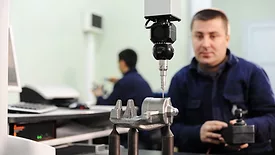
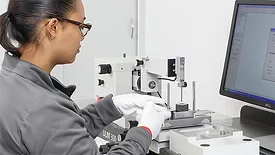
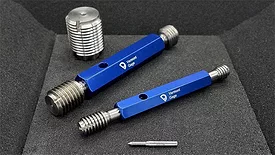
In manufacturing, maintaining product quality is essential. Quality departments should be involved throughout the entire process, from engineering to shipping, to ensure high standards. Consistent quality can be challenging without adequate protocols.
The rapid expansion of New Energy Vehicles (NEVs), including battery-electric, hybrid, and plug-in hybrid platforms, has fundamentally reshaped the metrology requirements for rotating powertrain components.
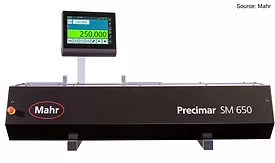
Mahr Inc., a leading provider of dimensional metrology solutions, introduced the new Precimar SM setting instrument, designed to simplify and accelerate the adjustment of measuring equipment.
Western’s Micro IIi Air Gage Readout delivers precise measurements of internal and external diameters, tapers, and roundness with 5 micro-inch resolution. It features a microprocessor, digital and analog displays, USB and RS-232 outputs, and auto-calibration. Western also offers custom air gages for various precision inspections.
Gages need calibration, but an annual calibration sticker can mislead non-experts. In addition to regular calibration, proper maintenance, operation, and frequent result verification are crucial. The best practices outlined in this article will help ensure reliable measurements during and between calibrations.
Mahr Inc. announced the launch of its newly updated MaraMeter 36B line of bench ID/OD gages, designed for measuring precision inside and outside diameters directly at the point of manufacture in industries such as bearing production.
Drift, as defined by NIST, refers to a slow change in a gauge's response. When measurement equipment drifts beyond specifications, it can result in inaccurate data, negatively affect product performance, and potentially lead to recalls. Drift can occur simply through normal use over time.
The gaging setting standard is essential for accurate measurements in high-performance manufacturing, despite often being overlooked. While digital calipers are versatile, they lack the precision of comparative gages that rely on a master-setting standard for sub-micron accuracy. Proper use of this standard can enhance performance and lower calibration costs.
We are lucky in the metrology and gage manufacturing world to have access to standards maintained by ANSI, ASME, Mil, NIST, DIN, ISO, IEC and many more.
Understanding industry terminology is vital for success, especially for newcomers and seasoned professionals in new roles. This article explores how standards from organizations like ASME clarify key definitions in metrology and gage manufacturing, helping to prevent costly misunderstandings.
Quality 4.0 transforms manufacturing by integrating digital technologies with quality management, enhancing visibility and traceability throughout the production process. By leveraging data from interconnected machines, it helps manufacturers proactively manage risks and reduce waste, leading to a safer and more efficient future.

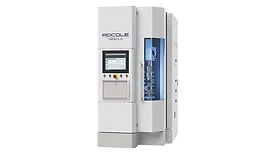


.webp?height=168&t=1755696487&width=275 "36B-10 w 1087 R Indicator_0360-0361 (crpd).jpg")