Every manufactured product, from a smartphone component to a commercial aircraft, relies on precise dimensional accuracy. Even small deviations from the intended design can lead to assembly problems, performance issues, or product failure.
For much of the industrial era, engineering communication revolved around 2D technical drawings. Today, advances in Model-Based Definition (MBD) are reshaping that paradigm.
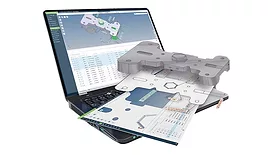
Technology companies in automotive and aerospace are revolutionizing engineering with Model-Based Definition (MBD), which makes 3D CAD models the primary source for product details, integrating dimensions and tolerances directly.
In the manufacturing landscape, the disconnect between design, production, and quality is a growing challenge. As OEMs embrace Model Based Definition (MBD) and Product Manufacturing Information (PMI), suppliers must adapt quickly. Discover how innovative solutions are bridging these gaps, streamlining the journey from 3D design to inspection, and driving a more efficient future in manufacturing.
Whether you’re new to GD&T or a seasoned pro, identifying these issues early can improve communication, streamline inspection, and ultimately result in better parts.
This article outlines common mistakes in applying GD&T and datum features that can frustrate machinists, confuse quality inspectors, and hinder CMM programmers. Recognizing these issues early can enhance communication, streamline inspection, and lead to better parts.
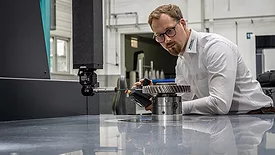
Gear inspection has significantly evolved since the early 20th century. What began as basic evaluations for high-precision gears in the 1920s has now become a complex field with standardized protocols and advanced technology. This evolution continues to transform quality assurance in gear manufacturing.
Integrated digital inspection ecosystems eliminate manual programming, accelerate reporting, and empower teams to act on live data before parts drift out of specification.
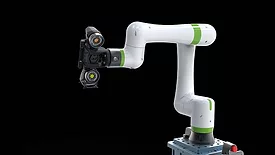
Speed and traceability are vital in fast-paced manufacturing. Automation and digital integration enhance inspection workflows by streamlining CMM programming, generating compliant reports, and enabling real-time quality monitoring.
Dustin Smith, metrology and software training lead at Assurance Technologies Inc., addresses common questions from his GD&T course. He emphasizes the need for everyone—from sales to engineering, production, and quality—to have a basic understanding of GD&T.
The use of advanced 3D scanning tools is revolutionizing quality control, design, and manufacturing, particularly with the adoption of digital standards and 3D printing. However, this shift presents challenges in maintaining consistent standards globally and across different regulations.
GD&T is a language for precise communication of complex geometric requirements for parts and assemblies. It specifies tolerances for exact requirements, ensuring understanding among team members.